

Princeton forced to take a long, hard look at Woodrow Wilson
Student group Black Justice League demands that the university publicly acknowledge his racist legacy
Princeton, New Jersey
FEW historical figures loom as large in the life of an Ivy League university as Woodrow Wilson does at Princeton.
As the school's president in the early 20th century, Mr Wilson initiated its expansion into a full-scale university. He lifted educational standards, created academic majors and introduced the small-group classes, often led by professors, known as precepts.
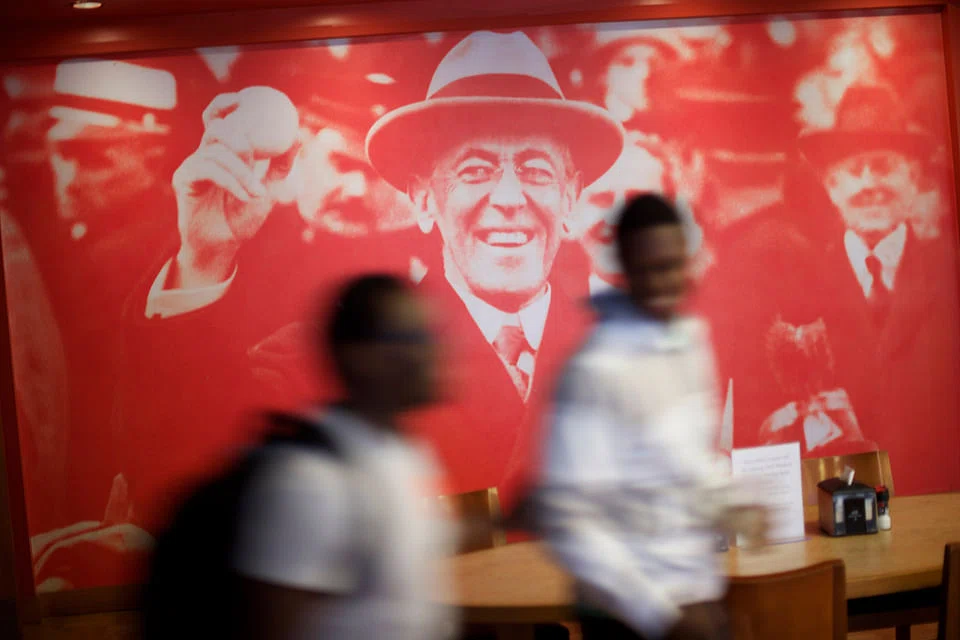
To honour him, Princeton created the Woodrow Wilson School of Public and International Affairs - an elite institution within an elite institution - and a residential complex, Wilson College, where quotations from the revered leader have been displayed on a television screen in the dining hall.
So central is he to Princeton's identity that a theatrical revue performed for freshmen pokes fun at the obsession. "Come into our Wilsonic Temple, a sacred space devoted entirely to our 28th president!" a fervent Wilsonite tells visitors in a skit.
But until posters started appearing around campus in September, one aspect of his legacy was seldom discussed: his racist views, and the ways that he acted on them as president of the United States.

The posters, put up by a year-old student group called the Black Justice League, featured some of Mr Wilson's more offensive quotes, including his comment to an African-American leader that "segregation is not humiliating, but a benefit, and ought to be so regarded by you", and led to a remarkable two days at this genteel campus last week.
After a walkout by about 200 students, and the presentation by the Black Justice League of a list of demands, about 15 students occupied the office of the president, Christopher Eisgruber, overnight last Wednesday. On Thursday, Mr Eisgruber agreed to begin discussions on campus and with trustees about the demands.
At the top of the group's list was a demand that the university "publicly acknowledge the racist legacy of Woodrow Wilson" and take steps to rename the public policy school and residential college.
While naming decisions are up to the university's board of trustees (which includes Mr Eisgruber), Mr Eisgruber promised to push for removing a large mural of Mr Wilson from the residential college's dining room and to direct the trustees to survey "the campus community's opinion" on the Wilson School name and then vote on it.
The protesters also called for mandatory courses on "the history of marginalised peoples"; for "cultural competency training" for the staff and faculty; and for the creation of dedicated housing and meeting space for those interested in black culture.
But as Princeton takes its turn in the national roll call of college campuses where long-festering issues of race have burst into the open, spurred by events in places such as Ferguson, Missouri, and Charleston, South Carolina, it is not surprising that the conversation would pivot around Mr Wilson, an alumnus.
"In some ways, that's the role that symbols play in American politics and culture," Mr Eisgruber said on Sunday before sending an e-mail addressing the issue to the university community. "People become very invested in symbols. And one of the benefits of having a genuine public discussion, informed by scholarly opinion, about some of these questions is that it can help educate people about problems that go beyond the symbol in our society."
In the wake of the sit-in, students were divided on the renaming; even many sympathetic to the Black Justice League's other demands said that expunging Mr Wilson's name went too far, or was unlikely to serve a constructive purpose, or both.
A counterpetition circulating on Change.org called the proposal a "dangerous precedent" for future students who "seek to purge the past of those who fail to live up to modern standards of morality", as well as a bid to erase Mr Wilson's positive contributions.
But one Black Justice League member, Wilglory Tanjong, rejected that argument. "We don't want Woodrow Wilson's legacy to be erased," said Mr Tanjong, a sophomore who was born in Cameroon and grew up near Washington. "We think it is extremely important that we understand our history of this campus. But we think that you can definitely understand your history without idolising or turning Wilson into some kind of god, which is essentially what they've done."
Perhaps best known for leading the United States during World War I and for trying to start the League of Nations, Mr Wilson as president rolled back gains that blacks had made since Reconstruction, removing black officials from the federal government and overseeing the segregation of rank-and-file workers.
Raised in the South, he wrote of "a great Ku Klux Klan" that rose up to rid whites of "the intolerable burden of governments sustained by the votes of ignorant negroes". During his tenure as president of Princeton, no blacks were admitted - "The whole temper and tradition of the place are such that no negro has ever applied," he wrote - though Harvard and Yale had admitted blacks decades earlier. Princeton admitted its first black student in the 1940s.
At Princeton today, Black Justice League members said that they have often felt excluded and continually if subtly called on to justify their presence at one of the nation's top schools. They protest the fact that only about 2 per cent of the faculty is black (the student body is around 8 per cent black).
And for students like Ozioma Obi-Onuoha of the Black Justice League, Mr Wilson's name and image around campus feel like constant reminders that they are not entirely welcome. "It's a haunting," said Mr Obi-Onuoha, a senior majoring in politics who grew up in North Carolina. NYT
Share with us your feedback on BT's products and services
TRENDING NOW

Nvidia reinstates Jensen Huang as CEO; Trump says move poses no national security risk

Indonesia’s coal tycoon Low Tuck Kwong replaced as Bayan Resources president-director

Nvidia surges 33% after reinstating Jensen Huang, reviving AI trade; stocks soar in US and Europe

Consider lowering homeownership barriers for some non-resident foreigners

