

Pushing the envelope on classic folklore
This adaptation of The Butterfly Lovers ambitiously fuses Chinese and Western operatic traditions

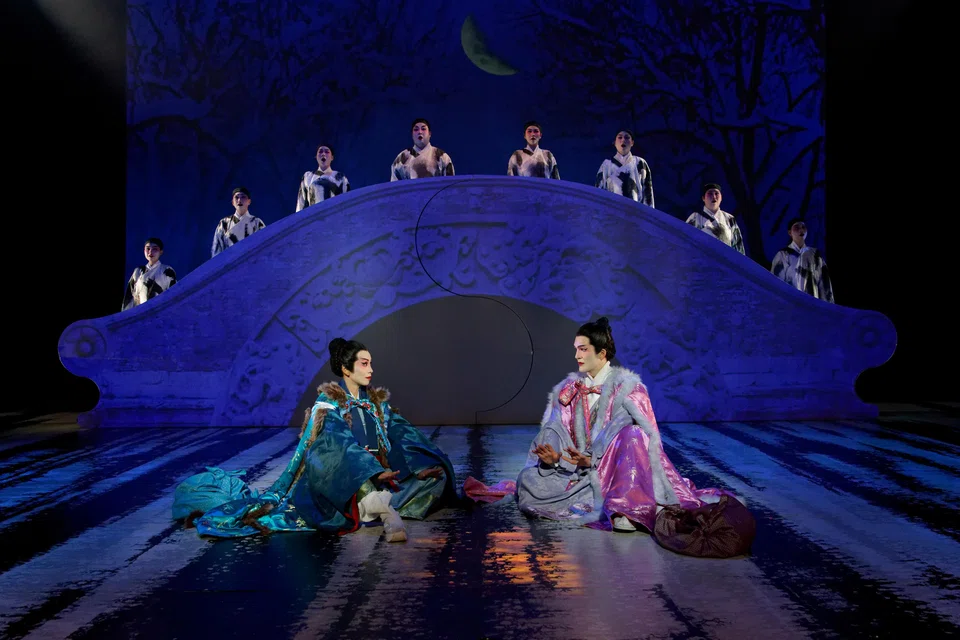
THE famous Chinese folktale The Butterfly Lovers gets an East-meets-West musical treatment by Singapore theatre troupe Wild Rice and Melbourne-based opera company Victorian Opera. Working with conductor and composer Richard Mills, director Ivan Heng has conceived a more risque take on the classic story, playing with its homoerotic undertones to parse the nature of forbidden desire.
Set during the Eastern Jin dynasty era, the story centres on two scholars, Zhu Yingtai (played by soprano Cathy-Di Zhang) and Liang Shanbo (counter-tenor Austin Haynes) who become sworn brothers while pursuing their university studies. What Liang doesn’t realise at first is that Zhu is really a girl disguising herself as a boy for the opportunity to further her education.
Although feelings begin to develop beyond the fraternal, the story ends tragically when Zhu is called home for an arranged marriage to a wealthy man, leaving Liang confused and heartbroken. Subsequently Liang’s health starts to deteriorate rapidly.
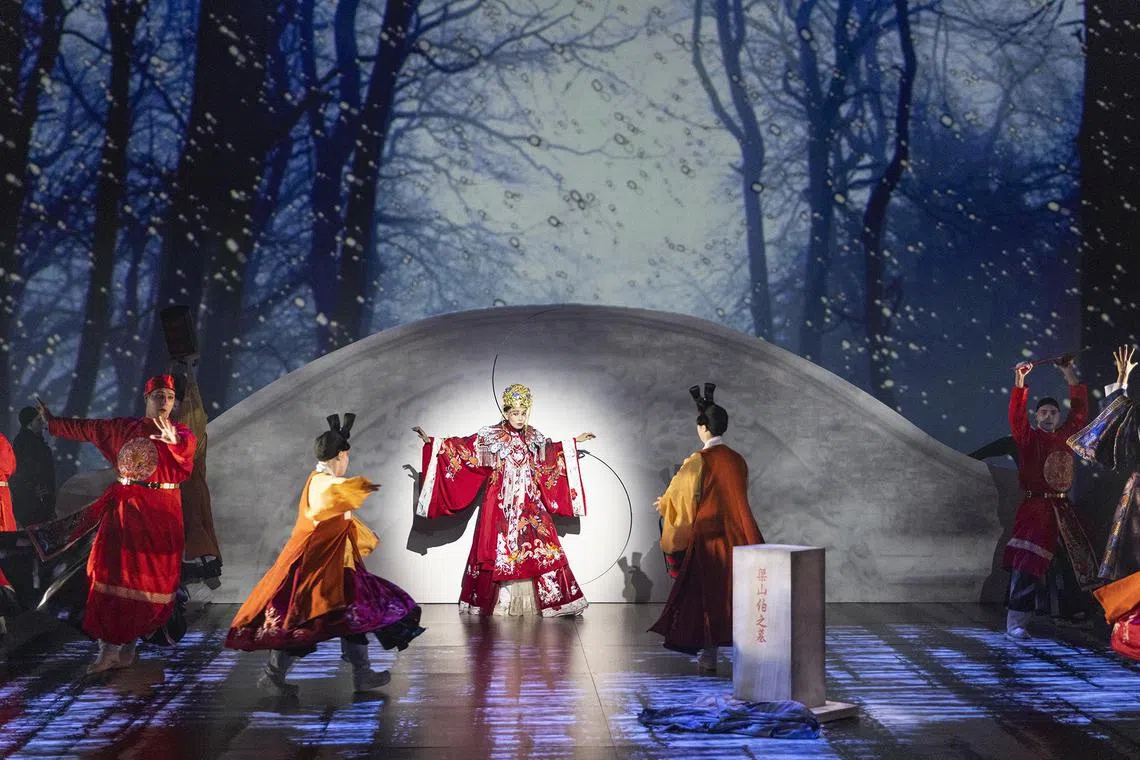
After Liang dies, Zhu visits his grave while en route to the home of her prospective husband. There at his grave, she begs the heavens to open it, so that she may leap in and be with him. The heavens grant her request, and the two lovers are reborn as a pair of butterflies.
Although the story has been adapted into countless operas, plays, books and films, many have tiptoed around the question of Liang and Zhu’s sexuality. Mainstream entertainment portray their relationship as fraternal, tinged with only a slight frisson for Liang who senses the feminine in Zhu. But Heng, working with librettist Joel Tan, is unequivocal about Liang’s instantaneous attraction to Zhu’s physicality, marking it out as a queer romance.
If the plot is boundary-busting, so is the music, which attempts to fuse the pentatonic scale of Chinese music with the atonal flourishes of a modern Western classical score. It is an ambitious project overall, one that bridges two distinctly different worlds and aesthetics, and there are certainly moments of brilliance.
But the midsized scale of the production as well as its abbreviated telling of an expansive tale (it runs just 80 minutes long at the Victoria Theatre) robs the production of a certain grandeur befitting one of China’s most beloved folktales. Max Tan’s costumes are ravishing, but other aspects of the production such as the oversimplified set and choreography does it few favours. Here’s hoping the opera could be restaged someday with more bells and whistles.
Decoding Asia newsletter: your guide to navigating Asia in a new global order. Sign up here to get Decoding Asia newsletter. Delivered to your inbox. Free.
Copyright SPH Media. All rights reserved.






