

Rhinoceros horns worth S$1.2m recovered at Changi Airport in largest seizure to date
 Add BT as a preferred source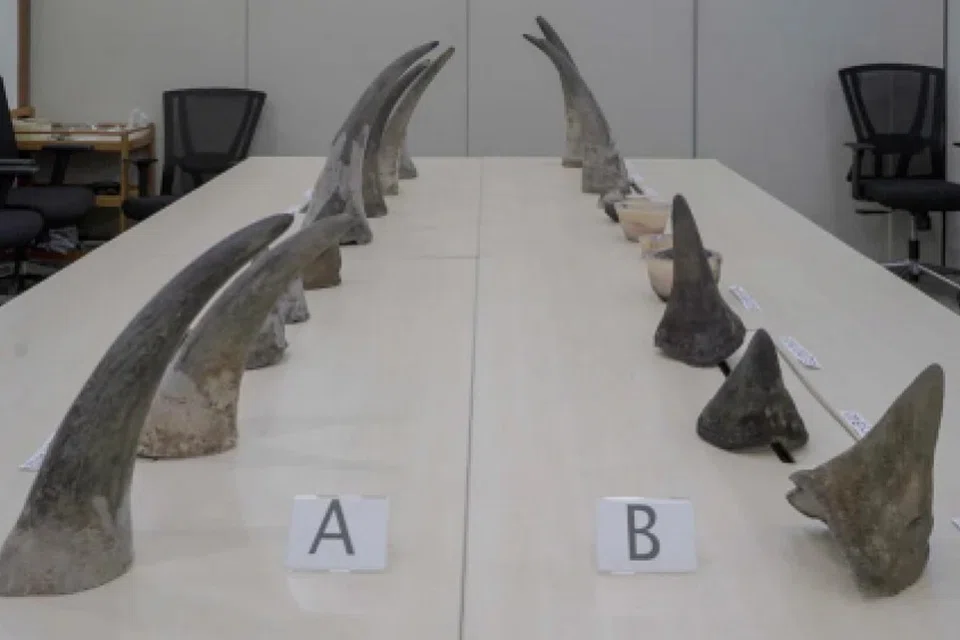
DeeperDive is a beta AI feature. Refer to full articles for the facts.
ABOUT 34kg of rhinoceros horns worth around S$1.2 million were intercepted at Changi Airport on Tuesday (Oct 4) in the largest seizure of rhinoceros horns in Singapore to date.
The horns were detected by officers from airport security and the National Parks Board’s (NParks) K9 unit.
They found 20 pieces of the horns in two pieces of transit baggage bound for Laos.
The owner of the bags, who was travelling through Singapore from South Africa, was arrested immediately, said NParks on Wednesday.
“Rhinoceros are protected under the Convention on International Trade in Endangered Species of Wild Fauna and Flora (Cites) and international trade in rhinoceros horns is prohibited.
“Singapore is a signatory to Cites and is committed to international efforts to curb illegal wildlife trade to ensure the long-term survival of these animals,” added NParks.
Navigate Asia in
a new global order
Get the insights delivered to your inbox.
Genetic testing is currently being carried out at its Centre for Wildlife Forensics to identify which species of rhinoceros the horns came from.
The horns will subsequently be destroyed, NParks said.
This is to prevent them from re-entering the market as well as to disrupt the global supply chain of illegally traded rhinoceros horns.
Under the Endangered Species (Import and Export) Act, an individual in possession of a Cites-scheduled species travelling through Singapore without a valid Cites permit will be liable to a fine of S$50,000 per species (not exceeding S$500,000).
He could also be jailed for up to two years.
The same penalties apply to those possessing or transporting parts and derivatives of Cites-scheduled species.
NParks said that Singapore adopts a zero-tolerance stance on the illegal trade of endangered wildlife species as well as their parts and derivatives.
“Our agencies collaborate closely in a multi-pronged approach, which includes working with our international partners, to maintain vigilance in regulating and enforcing against illegal wildlife trade,” said NParks.
It added that the community can play a key role as well by ensuring their purchases do not contain animal parts of endangered species, and are not contributing to the demand for the illegal trade of wildlife.
The public can contact NParks if they spot any occurrences of illegal wildlife at cites@nparks.gov.sg. THE STRAITS TIMES
Decoding Asia newsletter: your guide to navigating Asia in a new global order. Sign up here to get Decoding Asia newsletter. Delivered to your inbox. Free.
Copyright SPH Media. All rights reserved.
TRENDING NOW

Singaporeans can now buy record amount of yen per Singdollar

Beijing’s calculated silence on the Iran war

China pips the US if Asean is forced to choose, but analysts warn against reading it like a sports result

StarHub hands Ensign InfoSecurity control back to Temasek in S$115 million deal, books S$200 million gain

