

'Ring of fire' solar eclipse thrills skywatchers in Africa, Asia
 Add BT as a preferred source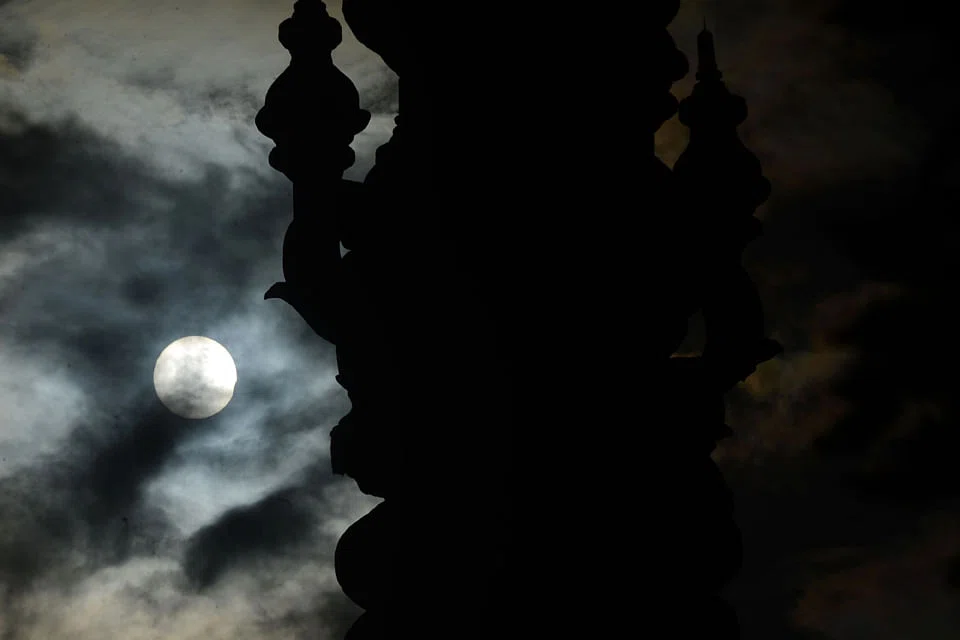
Nairobi, Kenya
SKYWATCHERS along a narrow band from west Africa to the Arabian Peninsula, India and the Far East witnessed on Sunday a dramatic "ring of fire" solar eclipse.
These so-called annular eclipses occur when the Moon - passing between earth and the sun - is not quite close enough to our planet to completely obscure sunlight, leaving a thin ring of the solar disc visible.
They happen every year or two, and can only been seen from a narrow pathway across the planet.
Sunday's eclipse arrived on the northern hemisphere's longest day of the year - the summer solstice - when the earth's north pole is tilted most directly towards the sun.
The "ring of fire" was first visible in north-eastern Republic of Congo from 5.56am local time (12.56pm, Singapore time), just a few minutes after sunrise.
This is the point of maximum duration, with the blackout lasting 1 minute and 22 seconds.
Arcing eastward across Africa and Asia, it reached "maximum eclipse" - with a perfect solar halo around the Moon - over Uttarakhand in India near the Sino-Indian border at 12.10pm local time (2.40pm, Singapore time).
More spectacular, but less long-lived: the exact alignment of the earth, moon and sun was visible for only 38 seconds.
Over in Nairobi in east Africa, observers saw only a partial eclipse as clouds blocked the sky for several seconds at the exact moment the moon should have almost hidden the sun.
Despite some disappointment, skywatcher Susan Murbana, who set up the Travelling Telescope educational programme with her husband, said: "It was very exciting because I think I'm so obsessed with eclipses. Today has been very kind to us in terms of the clouds. We've been able to see most of it".
Without the coronavirus pandemic, the couple would have organised a trip to Lake Magadi in southern Kenya where the skies are generally clearer than over the capital.
"With the pandemic situation, we are not able to have crowds and get kids to look through or do stuff," she said but still managed to share the event on social media.
"We had around 50 people joining us via Zoom and then we have so many people via our Facebook live."
The annular eclipse is visible from only about two per cent of Earth's surface, said Florent Delefie, an astronomer at the Paris Observatory."
It's a bit like switching from a 500-watt to a 30-watt light bulb," he added. "It's a cold light and you don't see as well."
Animals can get spooked - birds will sometimes go back to sleep, and cows will return to the barn.
The full eclipse was visible at successive locations over a period of nearly four hours, and one of the last places to see the partially hidden sun was Taiwan.
People hundreds of kilometres on either side of the centreline across 14 countries could also see light drain from the day but not the "ring of fire".
Weather conditions are critical for viewing. A solar eclipse always occurs about two weeks before or after a lunar eclipse, when the moon moves into earth's shadow. Lunar eclipses are visible from about half of the earth's surface.
There will be a second solar eclipse in 2020 on Dec 14 over South America. Because the moon will be a bit closer to Earth, it will block out the sun's light entirely. AFP
Decoding Asia newsletter: your guide to navigating Asia in a new global order. Sign up here to get Decoding Asia newsletter. Delivered to your inbox. Free.
Share with us your feedback on BT's products and services
TRENDING NOW

The retirement advice that worries me the most

Showdown at Tanglin Club sees new rival slate elected to general committee

Stocks to watch: Mapletree Industrial Trust, The Hour Glass, UI Boustead Reit, Boustead Singapore, Aspial Lifestyle

‘I feel so stupid’: How young Indonesians get stuck on the debt treadmill

