Ronaldo remains the star attraction, but Portugal is no longer reliant on him
Don’t be fooled by the subterfuge both on and off the field, writes RORY SMITH.
 Add BT as a preferred source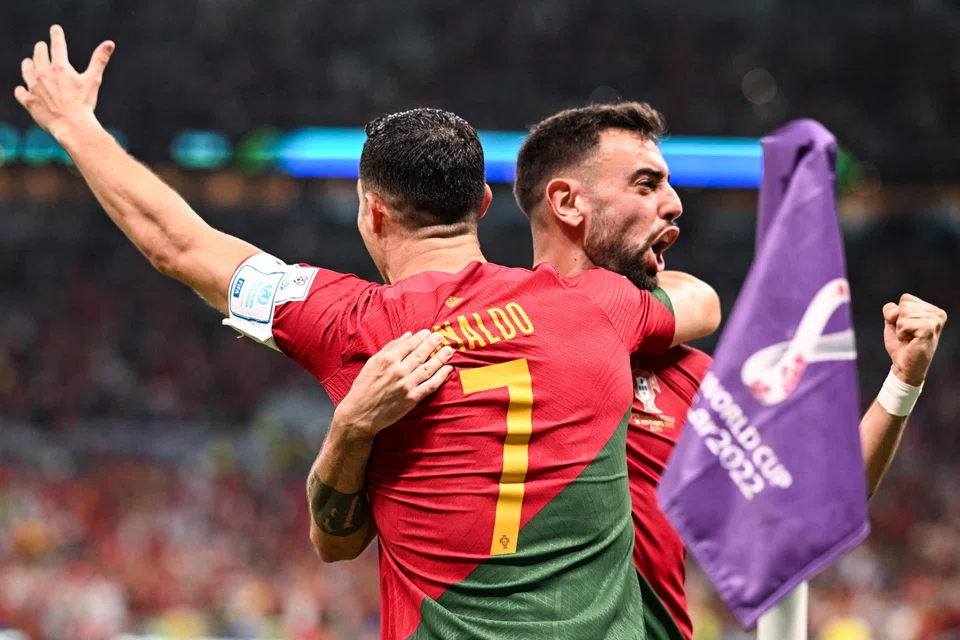
CRISTIANO Ronaldo went through the motions. There he went, wheeling away in delight, his arms aloft. Then came the signature celebration: the soaring leap from the ground, the twisting of the body, the clenching of the fists, the great roar of affirmation. The crowd cheered. This was the moment it wanted, the perfect shot for an Instagram story.
Like a substantial amount of this World Cup, though, all was not quite as it had appeared.
Ronaldo, the 37-year-old captain of the Portugal national team, had been indulging in an ultimately harmless – well, unless you happened to be Bruno Fernandes – and extremely convincing subterfuge. He might have fooled the crowd. He might have fooled some of his teammates.
But Ronaldo could not hoodwink the cold, robotic eye of whatever space-race technology that Fifa is employing for the noble and not at all wasteful purpose of determining the rightful goal scorer at soccer matches.
Ronaldo’s head had certainly been near Fernandes’ cross. It had been within a whisker of it.
A kind reading might have it that perhaps he touched the ball with his aura. He may have just clipped it with his sense of self-esteem.
Navigate Asia in
a new global order
Get the insights delivered to your inbox.
He had not, though, as the replays showed and the watchful overlord in the sky spotted, made any contact with his corporeal form. The goal belonged to Fernandes.
That fact, quite clearly, did not fit neatly into Ronaldo’s version of reality, and if this tournament has taught us anything, it is that you can have any version of reality you want: If a wall that is there can also not be there, and fans can be real and also false, then why can you not score a goal with the finest of glances from your halo?
Even as the teams were leaving the field on Tuesday (Nov 29), Portugal’s 2-0 win over Uruguay and its place in the Round of 16 secured, Ronaldo was still protesting, gesturing emphatically to the part of his face – a cheekbone, perhaps, or an eye socket – he believed had grazed the ball on its way from Fernandes’ boot into the Uruguayan net.

If the precise geometry of the goal mattered to Ronaldo – and we can assume, at this stage, that this stuff definitely does matter to Ronaldo – then it did not carry any larger consequence.
Its real-world significance stretched only to breaking the deadlock in a tepid, soporific game, a monochrome sort of evening that stood in stark contrast to the vivid radiance of the day’s previous offerings between Cameroon and Serbia and Ghana and South Korea, and setting Portugal on its way to a smooth victory against a toothless and bitterly underwhelming Uruguay.
Uruguay threatened only fleetingly to haul Portugal back. There was a chance for Maxi Gomez, who rattled the post, and another for Luis Suarez, who creaked his rusting body into position to send a snapshot into the side netting, but the flame of resistance quickly sputtered out.
By the time Fernandes added a second goal, coolly converting a penalty awarded for a draconian handball call against Jose Maria Gimenez, Uruguay had all but lost hope.
There is a sadness in that. This Uruguayan team has been a reassuringly unchanging presence in the last three World Cups: Diego Godin marshalling the defence, Suarez and Edinson Cavani leading the line, a snapping, snarling opponent for all who crossed its path. It has made a semifinal, a quarter-final and the last 16 in the process, no mean feat for a nation of just three million people.
Success at a fourth tournament, though, has clearly been a step too far.
The country’s old guard had fallen into disrepair, and its new generation, led by the excellent Federico Valverde and the unorthodox, uncategorisable Darwin Nunez, is not yet ready. It has the air of a team caught between eras, not quite ready to say goodbye to the past but not able to wholeheartedly embrace the future.
The same charge could be leveled at Portugal, of course: After all, it started this game with Pepe, 39, at the heart of its defence and Ronaldo, a couple of years younger and raging against the dying of the light, leading its line.
The difference, perhaps, is in the strength of the supporting cast. Ronaldo has at his disposal not just Fernandes, but Bernardo Silva, Joao Felix, Joao Cancelo and Raphael Guerreiro, depth that will make Portugal a considerable threat to anyone once the knockout rounds start.
Ronaldo remains the star attraction, but Portugal is no longer reliant on him, not in the way that it once was. Ronaldo might have thought he had decided this game with the all-important opening goal. It is far more encouraging, from a Portuguese point of view, to know that he did not, as it turns out, touch the ball before it went in. NYTIMES
Decoding Asia newsletter: your guide to navigating Asia in a new global order. Sign up here to get Decoding Asia newsletter. Delivered to your inbox. Free.
Share with us your feedback on BT's products and services