

Russia banned from 2018 Winter Olympics over doping
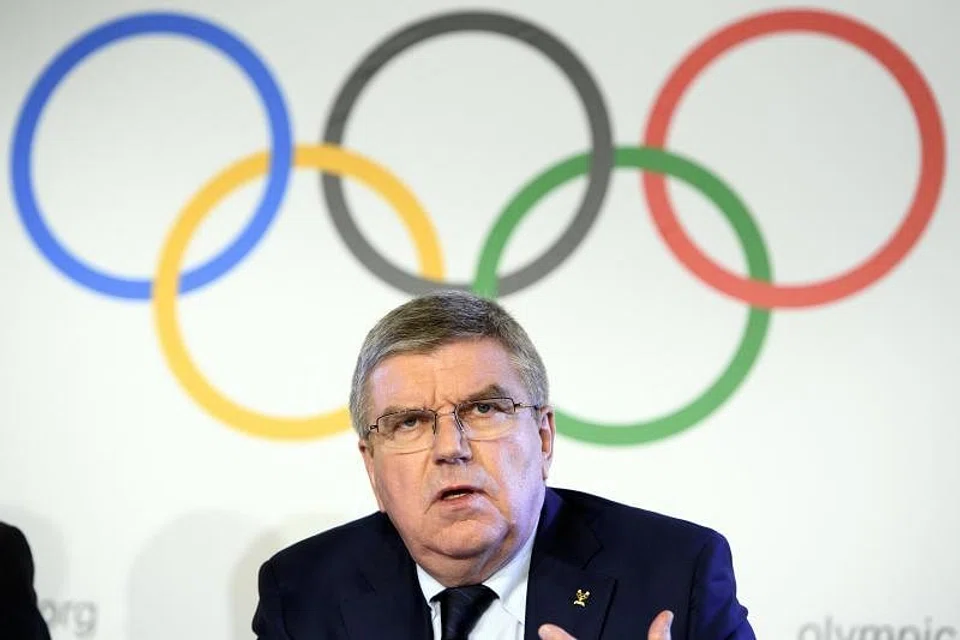
Lausanne, Switzerland
RUSSIA has been banned from the 2018 Winter Games by the International Olympic Committee (IOC) over its state-orchestrated doping programme, but clean Russian athletes will be allowed to compete under an Olympic flag.
The sanction, announced on Tuesday (Wednesday morning, Singapore time) was the toughest ever levelled by the IOC for drug cheating and came just seven weeks before the start of the Games in Pyeongchang, South Korea.
In announcing the decision, IOC president Thomas Bach accused Russia of "perpetrating an unprecedented attack on the integrity of the Olympic Games and sport".
An explosive report by the World Anti-doping Agency (WADA) and two subsequent IOC investigations have confirmed that Russian athletes took part in an elaborate drug cheating programme which peaked during the 2014 Winter Olympics in Sochi.
Mounting evidence has indicated that the scheme involved senior government officials, including from the sports ministry, with help from secret state agents.
The IOC also banned Russia's Deputy Prime Minister Vitaly Mutko - who was sports minister during the Sochi Games - for life. Mr Mutko is currently the head of the organising committee for the 2018 Fifa World Cup, which Russia is hosting.
Attention will quickly turn to see if football's world governing body Fifa allows the scandal-tainted ally of Russian President Vladimir Putin to retain his senior World Cup role.
In a statement, Fifa said that it had "taken note" of the IOC decision but it had "no impact on the preparations" for next year's World Cup.
The IOC also suspended the Russian Olympic Committee (ROC) and its chief Alexander Zhukov. The latter said that he "apologised" to the IOC on Tuesday for the "anti-doping violations" committed in his country in recent years.
The IOC had the option of hitting Russia with a blanket ban, the so-called nuclear option that was applied to apartheid-era South Africa from 1964 to 1988. The IOC's decision to choose a more moderate path offers some Russian athletes a route to competing in the Games - although that will be by invitation only and dependent on a stringent testing programme.
By invitation only
"The IOC, at its absolute discretion, will ultimately determine the athletes to be invited from the list," the IOC said in a statement.
No Russian athlete with a previous doping violation will be allowed to compete, and no official who had a leadership role at Sochi 2014 will be invited to Pyeongchang.
Those athletes who do go to the Games will participate under the name "Olympic Athlete from Russia" and the country's flag will not fly at any 2018 ceremony, the IOC also said.
Winter Olympics organisers said on Wednesday that they would prefer if Russians competed under their own flag, but accepted as "second-best" the IOC ruling which allows clean athletes from Russia to take part in the Games as neutrals.
"We find it the second-best alternative, albeit not the best, that Russian players are at least allowed to compete individually," said Lee Hee Bum, chief of the Pyeongchang organising committee. The decision caught the Games organisers off guard, he added.
And that raises the prospect of Moscow boycotting the Games, something that organisers will be desperate to avoid as they battle low ticket sales and concern over North Korea's nuclear and missile tests.
"We did not know that it (the punishment) would be this much," Mr Lee said, adding that there was a "heated debate" among the IOC members before reaching the decision. Mr Lee said that he had "unofficially" conveyed his messages to the IOC that he hoped that Russia would be able to participate "in any forms", but he respected the latest decision by the IOC.
"We accept and respect the decisions of the IOC Executive Board that Russia may compete under a neutral flag," the Pyeongchang organising committee said in a statement.
Mr Lee said that it was "premature" to worry about a potential boycott by Moscow. "It is too early to predict in advance because it is a decision to be made by Russia," he said. But he vowed to make efforts to urge Moscow officials to "allow as many athletes as possible" to compete at the Games.
The US Olympic Committee praised the IOC's "strong and principled decision". "There were no perfect options, but this decision will clearly make it less likely that this ever happens again," it said.
For Grigory Rodchenkov, the former Russian laboratory chief and whistleblower who lifted the lid on the cheating scheme, the IOC's action was a needed step to clean up the Olympic movement. "It was the most elaborate and sophisticated doping system in the history of sports. If it did not carry the most significant sanction, it would simply have emboldened Russia and other countries who don't respect the rules," Mr Rodchenkov's lawyer, Jim Walden, told reporters on a conference call.
Russian officials have previously met doping accusations with defiance.
National humiliation
Mr Mutko has said that the allegations were an attempt "to create an image of an axis of evil" against his country while Mr Putin has warned that a Russia ban would cause "serious harm to the Olympic movement". He said that forcing Russian athletes to compete under a neutral flag would amount to a national "humiliation".
That has fuelled speculation that Moscow would instruct its athletes to boycott the compromise solution decided by the IOC.
"An Olympic boycott has never achieved anything," Mr Bach said, insisting that given the window left open for clean athletes to compete, a boycott was unwarranted.
But the IOC expulsion sparked immediate outrage in Russia. Pyotr Tolstoy, deputy speaker of the Russian parliament's lower house, the State Duma, has already called for a boycott. "They are humiliating the whole of Russia through the absence of its flag and anthem," he said in televised remarks.
Alexander Zubkov, the president of Russia's Bobsleigh Federation, told Russian TV that the IOC decision was a "humiliation". "This is a punch in the stomach," he said. AFP
Share with us your feedback on BT's products and services
TRENDING NOW
Can a first-time homebuyer couple earning S$18,000 a month afford a new EC unit?

He built the Vingroup empire. Now South-east Asia’s richest man is handing some key roles to his sons

Asia needs new energy security architecture
Chagee, Mixue and Luckin won the market. Sustaining their edge is the harder part

