
Russian film crew wraps space station shoot, returns to Earth
 Add BT as a preferred source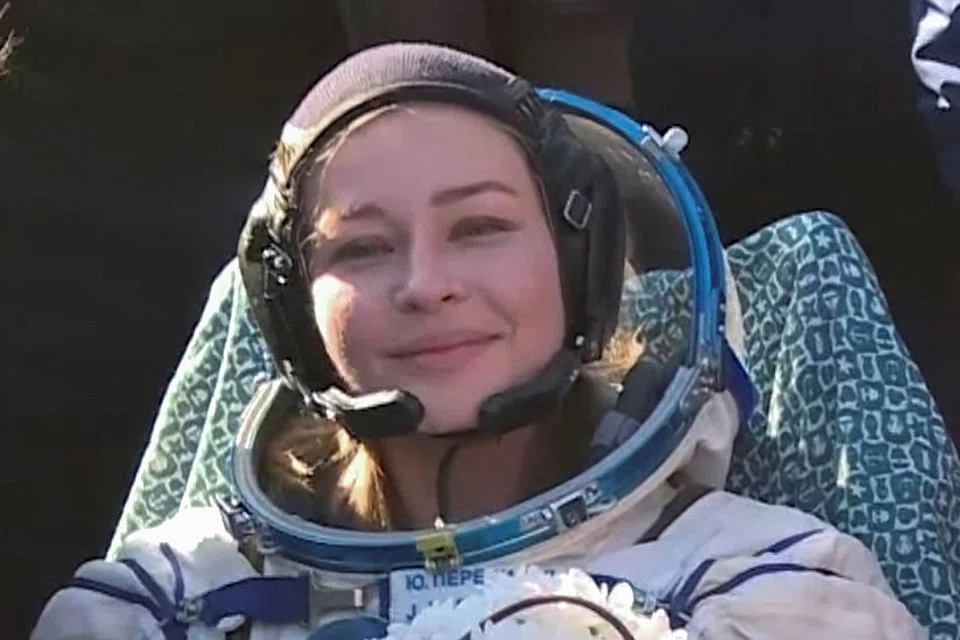
New York
A RUSSIAN actress and a film director landed safely on Earth early on Sunday (Oct 17) after spending 12 days aboard the International Space Station (ISS) shooting scenes for the first feature-length drama made with scenes shot in space.
Yulia Peresild, the actress, and Klim Shipenko, a film director, launched to space with a Russian astronaut on Oct 5 aboard a Russian Soyuz spacecraft. They used the orbital laboratory as one of the main sets for their movie The Challenge, a drama in which Peresild plays a surgeon embarking on an emergency mission to save the life of an ailing cosmonaut.
The 12-day journey, backed by Russia's space agency Roscosmos, was the latest act in a race among spacefaring countries to generate public excitement about human spaceflight and demonstrate that destinations such as the space station are not exclusive to government astronauts. The mission also adds another superlative to Russia's spaceflight record over the United States: beating Hollywood to orbit.
Peresild, Shipenko and Oleg Novitsky - a Russian astronaut who has been on the station since April and played the role of the film's ailing cosmonaut - bid farewell to the station's crew of seven Saturday. The Soyuz MS-18 spacecraft that carried them back to Earth undocked at 9.14 pm Eastern time. The crew's trip home took about three hours before landing at 10.35 am local time in the desert steppe of Kazakhstan's Karaganda Region.
In live footage streamed by Russia's space agency, helicopters from search-and-rescue teams circled the area where the astronauts were to set down, and mission controllers urged the crew to "get ready" and brace themselves for landing. Under a large parachute, the capsule touched down, sending up a cloud of dust.
Navigate Asia in
a new global order
Get the insights delivered to your inbox.
"They landed vertically - awesome, guys," said a mission controller from Russia, suggesting the capsule had not landed in a way that could add some difficulty to the crew's exit. The Russian space agency said that the crew felt well ahead of their exit from the Soyuz, and would undergo a 10-day rehabilitation to help recover from the effects of living in the micro-gravity environment of low-earth orbit.
The filming began as the movie crew arrived in space. Shipenko filmed scenes using hand-held cameras inside the capsule of another Soyuz module as it approached the station. When it docked, Pyotr Dubrov, one of the space station's Russian astronauts, was waiting behind a large digital cinema camera as the crew emerged from their capsule and floated into the station for the first time.
The filming continued as the crew exited the station, boarded their capsule, then landed on a chilly Sunday morning in flat Kazakh grasslands. Astronaut recovery teams, a sizeable film crew, and even Roscosmos head Dmitri Rogozin made for an unusually large crowd at the landing site."No one should be looking into the camera," one producer at the landing site yelled to the bustling crowd that swarmed the capsule. "Everybody remove their masks, thank you."
As Russian officials hoisted the crew out of the MS-18 capsule, other personnel scrambled to lay down a tarp and prepare the film's next set. A camera mounted in a stabilisation rig slowly approached Novitsky, back in Earth's gravity after 191 days on the station, as he was receiving a typical post-landing check by medical staff.
"Guys, please, let us do some shooting," a producer shouted as cameramen positioned themselves for a shot in front of Peresild. "Please, do not do any filming on your smartphones. Do not take any videos, because right now, this is actually the future end of the movie," the producer said, according to a translator on video being streamed live by both the US' National Aeronautics and Space Administration (Nasa) and Roscosmos.
"Take!" yelled a man who appeared to be film's on-site director. The crew filmed at least four takes of a scene where an actor greeted Novitsky, then walked to a smiling Peresild and kissed her hand. In one take, Peresild looked to Novitsky and winked with a smile.
Few details about the plot of The Challenge have been announced. But drama on the station turned real on Friday (Oct 15) when it was tilted out of its position in orbit during a test of the thrusters on the capsule that ferried the film crew home to Earth. Novitsky had been testing out the engines, Roscosmos said, but they fired longer than expected, said a Nasa statement. The station, which is the size of a football field, was tilted 57 degrees out of position, said Russian mission control officials quoted by Interfax, a Russian news agency. The incident sprang Russian and Nasa officials into action, and they corrected the station's positioning within 30 minutes. It was the second such emergency since July, when Russia's new Nauka module erroneously fired its thrusters, shifting the station 1.5 revolutions - about 540 degrees - before it came to a stop upside down.
Whatever caused the problems with the spacecraft's thruster Friday did not recur as the film crew and Novitsky departed the station on Saturday night (Oct 16).
"The Soyuz is in good shape, was declared ready to support undocking and landing this evening, and everything is in order for the departure," said Rob Navias, a Nasa spokesperson, during a livestream of the process.
Russia's space agency announced its intention last year to send an actress to the space station shortly after plans emerged that US actor Tom Cruise would trek to space as part of an action-adventure film directed by Doug Liman. Jim Bridenstine, who served as Nasa's administrator under former President Donald Trump, confirmed the plans on Twitter at the time, but no updates on the film project have emerged since that time.
Other entertainment projects centred on the ISS may occur in the years to come, including a Discovery Channel reality TV competition called Who Wants to Be an Astronaut? NYTIMES
Decoding Asia newsletter: your guide to navigating Asia in a new global order. Sign up here to get Decoding Asia newsletter. Delivered to your inbox. Free.
Share with us your feedback on BT's products and services

