

I read the news today... Oh boy
Two unexpected incidents that spring up in the news show how the medium becomes the message
HER name is Kim Wall, and - there's no other way to say this - she has gone missing after sailing on a submarine.
Kim and I met four years ago at a journalism scholarship awards dinner in New York. Her ginger brown hair was electric with passion for the job, as she bounced onto stage to declare that reporting was what she wanted to do for the rest of her life.
Last Saturday, my Pavlovian scan of Facebook posts revealed a trail of frantic messages left for the 30-year-old Swede.
The Internet shrinks the world into a single page view, as reports showed that Kim, a freelance journalist, was presumed dead after the submarine that she was on board had allegedly been sunk on purpose by the owner. The owner has been charged with preliminary negligent manslaughter, with Kim and him being the only two people on the submarine, the 40-tonne, 18-metre Nautilus. Her body has not been found.
That Kim was in Denmark on a private submarine that was built through crowdfunding, did not surprise me. By this time, she had already travelled to Haiti to write about Vodou folklore, and had spoken with Gaddafi's only two Western friends, who once built civilian rockets for the Libyan dictator. (They called him "such a wonderful man".)
She's already had an interview with a vampire. As it turns out, modern vampires with haematomania - or plainly, blood thirst - don't bite, but feed through inch-long incisions into an undisclosed fleshy part of the body. They don't burn in the sun, and some mock the wannabes with fangs and goth clothing.
Lost contact
Kim's writing shows her to be lit with curiosity about the world, as every journalist should be. She prefers the long-form, because her stories did not lend themselves to speed. Prejudice doesn't die with a tweet, it merely finds a camp. And so in speaking to oddballs and cracking open fringe societies, Kim tries to tell the universal story of the human spirit, one that spills across boundaries.
We had lost contact after I left New York, but I could not forget the night when Kim and I and another Swede sat at a bar, never more sober as we discussed politics across the continents. Large opinions from small states - that was what bound us three journalists. They're from Sweden, not Switzerland, they huffed. Singapore, not China, I said, clinking glasses. "The Swedes drink so much because we're so socially awkward," she had decided. The same could be said of Singapore.
I returned to the memory of that animated discussion among us, bathed in the dull orange light of the bar, while Googling "Kim Wall" every few hours for updates on the case. Every timestamp on her story is a mark of dread - 4 hours ago, 8 hours ago, 19 hours ago, one day ago. The headline of a "missing journalist" turns stale. When you're on edge for a morbid update, a dated story is a reminder of how lives through a kaleidoscope are but images dancing on thin glass.
It was only about a fortnight ago that another surprise death hit closer to home, and played out on the national media. Sixteen-year-old Benjamin Sim, who keeled over after a 2.4 km run in school, was someone I had watched grow up. He was cherubic and energetic, always offering a good chase around the church building as a kid. But on Aug 1, the livewire of the family succumbed to a routine physical activity.
The pronouncement of death took just two grim updates on digital devices. In the approximate half hour following the message that he was being resuscitated, Benjamin was no longer present in this world. Timestamps again tell the story. A good friend called at 11.31am to cry with a person on the other line. More messages streamed in at 11.37am, 12.20pm. Then a long, limp, silence.
Memorial service at 8pm. A pastor preached at his son's own wake for 20 minutes and an eternity.
It is difficult to wrestle with the death of a young boy who lived a sweet ordinary life. You feel it's only right that he had more time - like the rest of us. He didn't have a submarine story. He was a good kid who did well in English, played volleyball, and wanted a better timing for his running test.
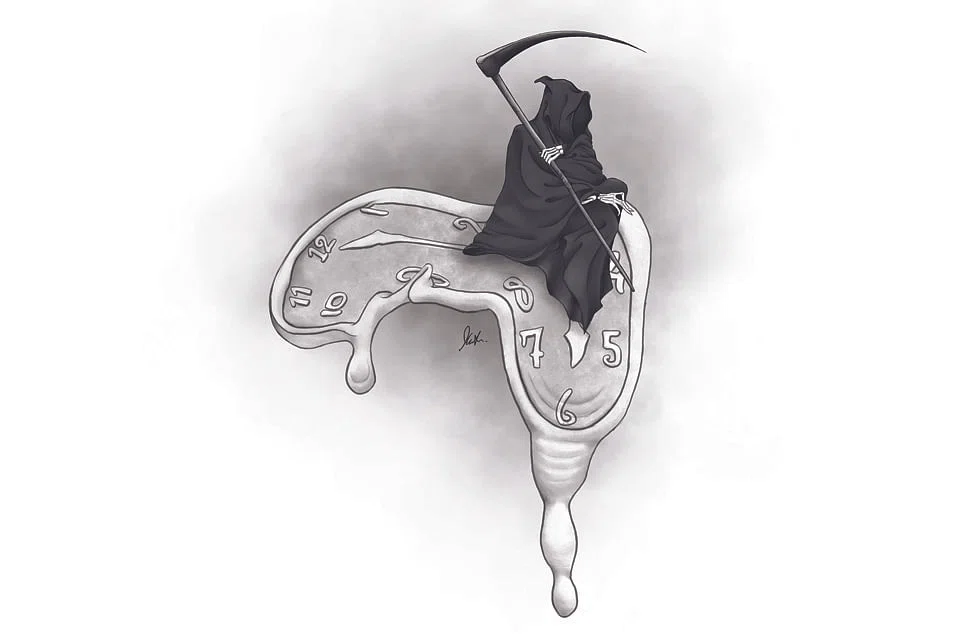
But life doesn't work that way. And time for the rest of the living has a way of pounding the heart into a lump of battered muscle, so you learn that time is not linear in practice, that memories of life are most vivid when the picture reel clicks to an end, and there's no choice but to rewind. We cry as spectators because there is nothing else we can do.
Fragments of Benjamin's life unfolded through the media, in competing online stories and on the evening news in the first two days following his death. Journalists were out at the front of the church, seeking - like Kim - to tell a story of Benjamin, and then, of the love of a father, the grief of a family, and the human spirit of hope and resiliency. The stories have since disappeared off the front pages of news websites. Whether she is dead or alive, so too, will be the story of Kim.
Life can be as transient as its day on the news. Timestamped, we can only live by bursts of our own stories.
Share with us your feedback on BT's products and services
TRENDING NOW

He built the Vingroup empire. Now South-east Asia’s richest man is handing some key roles to his sons

China’s Pinglu Canal likely to benefit Singapore, other South-east Asia ports in the long term

Suntec Reit to increase Singapore focus, sell three Australia properties

Despite the de-dollarisation debate, demand for dollar liquidity in Asia is growing

