DESIGN

Seeing Singapore’s development through its architecture

The new book, Everyday Modernism, shows how the built environment has shaped the country and its inhabitants

Tay Suan Chiang
Tay Suan Chiang

Published Thu, Nov 24, 2022 · 05:30 PM
    • Pedestrian overhead bridges are emblematic of Singapore's development.
    • Pedestrian overhead bridges are emblematic of Singapore's development. PHOTO: DARREN SOH

    WHETHER you are a first-time homeowner or looking to rejuvenate a tired-looking home, Tan Boon Liat Building may have been your go-to source for furniture.

    The 15-storey building on Outram Road has been the unofficial hub for furniture hunters since around 2009, when five furniture stores moved here from Dempsey Hill, bringing along their expatriate and local clients.

    Interestingly, the 46-year-old building didn’t start off this way. Its location near the Singapore River serves as a reminder that the river was once a place of work rather than a spot to leisurely enjoy being near the water.

    In the early 20th century, says the new book, Everyday Modernism Architecture & Society in Singapore, godowns and warehouses lined the waterfront to support the former British colony’s entrepôt trade.

    Tan Boon Liat Building started off as a flatted factory before becoming a hot spot for furniture hunters. PHOTO: DARREN SOH

    Tan Boon Liat Building arose from the redevelopment of godowns owned by its namesake, a well-known rattan merchant who lived on Outram Road. 

    The rectilinear slab block, designed by Chok & Associates, was designed in the spirit of industry and no-nonsense functionalism. The building served as a flatted factory, but no one knows why it kept its industrial function while parcels of land around it were later developed into hotels. 

    Asean Intelligence

    Get insights into businesses across South-east Asia

    Get the free report

    The building lost its relevance when in 1977, the government launched a campaign to clean up Singapore River and turn it into a waterfront for recreation. 

    The story of Tan Boon Liat Building is one of 32 essays in Everyday Modernism that gives readers an insight into Singapore’s development through its architecture, not only seen through buildings but also in everyday or more mundane structures such as overhead bridges and city council pools.

    Celebrating everyday architecture

    Written by Chang Jiat-Hwee, an associate professor at the department of architecture, National University of Singapore, design writer and researcher Justin Zhuang, with photographs by architectural photographer Darren Soh, Everyday Modernism is published by NUS Press, with support and sponsorship from the National Heritage Board. 

    Everyday Modernism is the first comprehensive documentation of Singapore’s modern built environment. PHOTO: DARREN SOH

    In his introduction, Dr Chang, 49, writes that like over 80 per cent of residents in Singapore, he and his collaborators live in public housing flats, and like everyone who grew up since the 1970s, “we were surrounded by, and our lives are enacted in, a built environment that is utterly modernist.”

    “Public housing is modernist, and we socialise in modern markets, shop in modern retail spaces and work in modern office towers.”

    He calls everyday modernism “the quotidian and taken-for-granted modernist built environment that surrounds and structures our everyday lives in Singapore”.

    Dr Chang says the 352-page book differs from others in that instead of just focusing on “heroic modernism” - think iconic buildings such as the former National Theatre, Singapore Conference Hall and Trade Union House - it also covers “ordinary modernism”.

    “These include what HDB and Public Works Department have done - no other book has captured such projects,” he says. “We even cover topics such as lookout towers, interchanges and columbaria.”

    Dr Chang, who also wrote A Genealogy of Tropical Architecture: Colonial Networks, Nature and Technoscience (2016), didn’t want Everyday Modernism to be another academic book, which was why he roped in Zhuang to co-author the book.

    Block 51 Kent Road has a unique zig-zag shape. These HDB flats are modernist in design. PHOTO: DARREN SOH

    A journalism graduate, Zhuang, 38, calls himself an observer of the designed world and its impact on everyday life. He has also written several design books.

    For Everyday Modernism, the authors weave in not only the architectural history of buildings and structures but also social and cultural stories.

    Zhuang says: “We know when a building is completed and at times, when it gets demolished, but we don’t often know what goes on in between. People tend to forget that buildings have lives.”

    The 32 essays make for easy reading and provide context on Singapore’s development from post-independence to the 1980s.

    Everyday Modernism covers lesser thought of structures such as lookout towers. PHOTO: DARREN SOH

    For example, the essay on Futura discusses the past and future of luxury high-rise apartments. Designed by Timothy Seow and completed in 1976, Futura stood out for its elliptic concrete balconies, circular cores and bronze-tinted curtain wall. The authors write that the building not only looked like it came from the future, but also became the future of luxury high-rise residential development in Singapore.

    Of the topics that he researched on, Zhuang found the origin of how pedestrian overhead bridges came to be most fascinating. He came across a 1970 court case, where a pedestrian sued a driver for knocking him down, while he was standing on the centre line of Upper Serangoon Road.

    The court was presented with two different views on the right way to cross a two-way street, and in the end, both parties were to blame.

    Back in the day, jaywalking was acceptable, but with an increase in the number of road accidents between pedestrians and motor vehicles, the government began building safer alternatives for crossing.

    Archival photographs offer a peek into life during Singapore’s post-independence development. PHOTO: DARREN SOH

    “Pedestrian overhead bridges are emblematic of how growth in a city has accelerated, and it was interesting to find out that there were different designs around Singapore,” says Zhuang.

    Dr Chang remembers travelling along Jurong Town Hall Road during his childhood days. Working on the book since 2015 provided him the opportunity to find out why there had been a line of brutalist structures along Jurong Town Hall Road. “It answered a childhood query,” he says. 

    Pictorial compilation

    Accompanying the essays are 200 archival images and drawings. The essays make up half the book, while coloured photographs of modernist buildings make up the rest.

    And when it comes to architectural photographs, there’s no one better than Soh, 46, to do the job. The award-winning photographer usually shoots new pieces of architecture but also spends plenty of time documenting places that are in danger of disappearing. He says he is obsessed with modernist and vernacular architecture that are deemed too banal to be noticed.

    Soh contributed close to 100 photographs for the book, many taken from his own archives. 

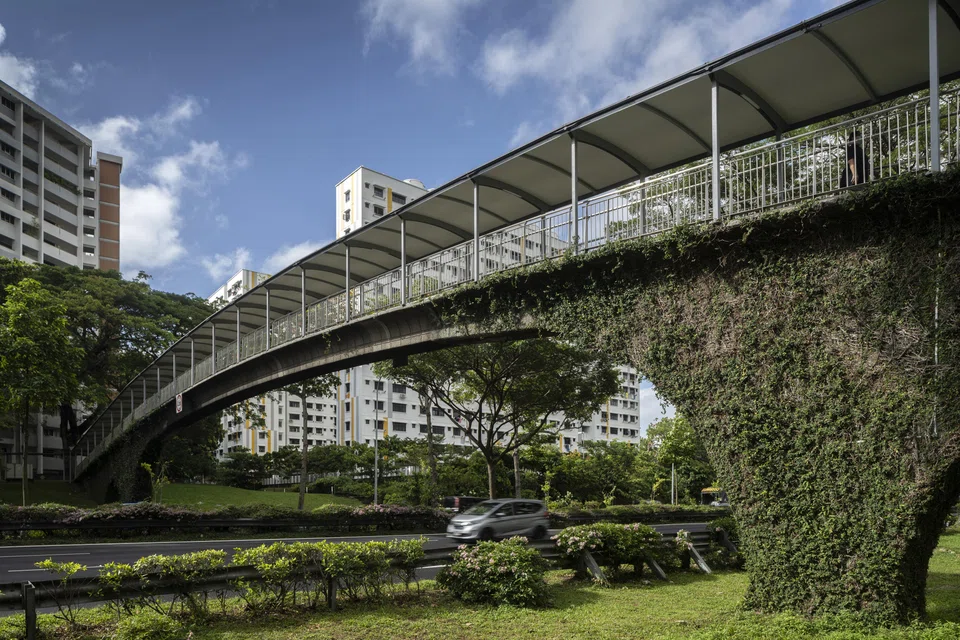
    One of his favourite pictures is that of a curved concrete overhead pedestrian bridge spanning across the Pan Island Expressway that joins Bedok North to Bedok Reservoir. 

    Soh didn’t see overhead bridges as a piece of modernist architecture till he started work on the book. PHOTO: DARREN SOH

    “The bridge is so “everyday” that while I looked at it every time I drove under it, I did not really see it as a piece of modernism until I started work on this book,” says Soh. He adds that photographing the overhead pedestrian bridges for the book was probably the most refreshing for him, as many of the other buildings he already had images of or was expected to shoot at some point.

    He laments that there were some buildings and structures that he missed out on, such as the last wooden overhead bridge on Serangoon Road. “When I finally had time, it was dismantled. The only way to see it now is on Google maps,” he says.

    While the social stories may appeal more to those who grew up in the 1970s and 1980s, Soh says that Everyday Modernism will find an audience with the younger generation too. “There’s an increasing number of millennials and Gen Zs who have no personal history with these buildings but want to learn more about the Singapore that they missed out on,” says Soh.

    Dr Chang says: “We hope readers will connect with the stories in the essays and think more about the modern built environment.”

    Zhuang concludes: “Some buildings and structures may not be iconic, but they have interesting stories to tell.”

    Everyday Modernism, S$65, is available from NUS Press web store, and is available at 20 per cent off until Nov 30 with the code “MODERN20”.

    Decoding Asia newsletter: your guide to navigating Asia in a new global order. Sign up here to get Decoding Asia newsletter. Delivered to your inbox. Free.

    Copyright SPH Media. All rights reserved.