

Sifa 2023: The last hurrah
Singapore International Festival of Arts comes to a close with challenging shows questioning reality

Helmi Yusof
IN DAVID Foster Wallace’s cult novel The Pale King, he famously wrote: “Every love story is a ghost story.” Many have dissected this line, interpreting it as a reflection of how romantic relationships carry remnants of loss, whether it be the loss of innocence, freedom, idealism, or even the loss of a person themselves.
This statement feels particularly fitting when applied to New-Illusion, a beautifully written play by Toshiki Okada, a pioneering figure in Japan’s avant-garde theatre scene, and his company chelfitsch. This production was one of the final shows presented at the Singapore International Festival of Arts (Sifa) 2023, which concluded over the weekend.
In the play, actors Ayana Shiibashi and Tomomitsu Adachi portray former lovers looking back at their failed relationship. Like forensic scientists inspecting the evidence, they recreate their apartment and its furnishings, how they once sat in the living room to read, work or converse. They reflect on what was said, reminiscing about their lofty ideals that were ultimately shattered by the harshness of reality.
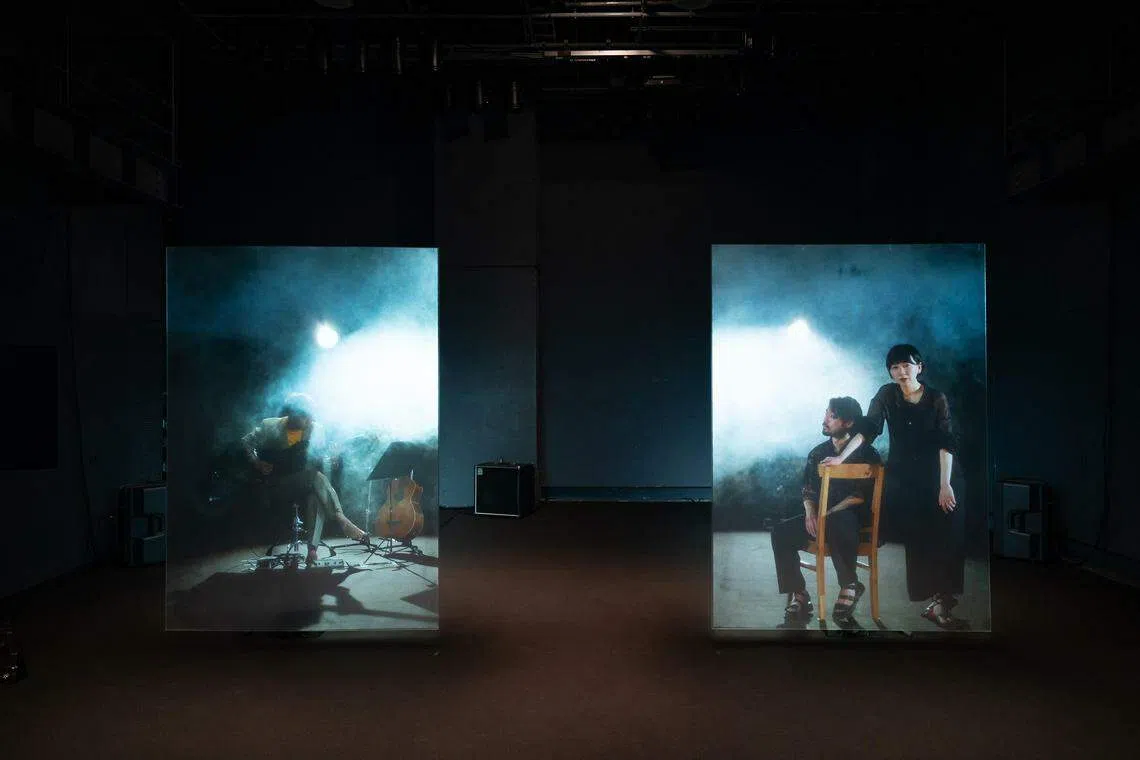
The unique twist of this production lies in the fact that Shiibashi and Adachi are actors playing actors who have recently performed in a theatre play centred around their relationship. Neither of them appears on the stage before us to perform directly. Instead, we observe a pre-recorded film of their performance, displayed on two life-size screens in the present venue. The boundaries between the real, the virtual and the imaginary collapse.
In a sense, the play-within-a-film-within-a-play serves as a metaphor for the ephemeral nature of romantic emotions, showing how their intensity fades over time, gradually transforming into an imitation of their former selves. Similarly, the actors’ performance, when presented on screen instead of live, loses its immediacy and authenticity. It becomes a shadowy replica of a direct, unmediated theatrical experience – a ghost story, indeed.
End-of-the-world ennui
The theme of mediated experience resurfaces in Pompeii, a play written and directed by Edith Podesta, with live camerawork directed by K Rajagopal. The stage is divided horizontally, with the lower half displaying a series of small apartments and the upper half dominated by a large cinematic screen.
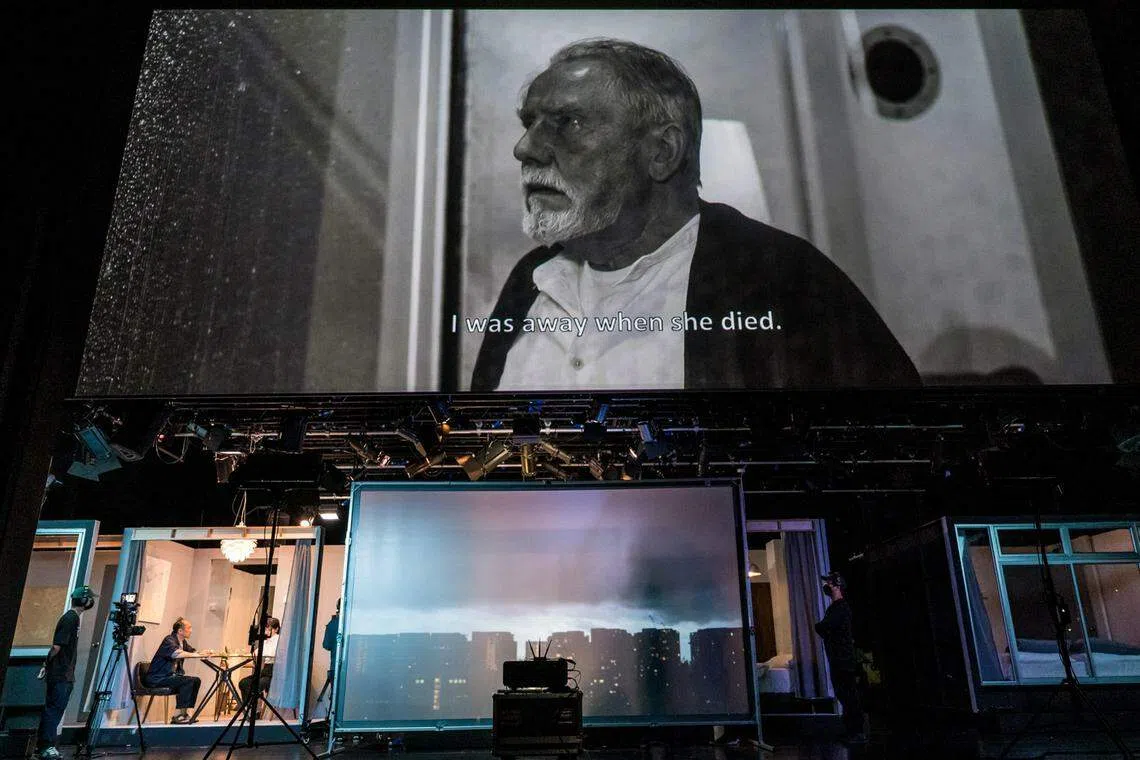
Pompeii revolves around a group of residents living in a condominium of the same name, unaware that their homes are on the brink of collapse in a cataclysmic event, leaving them trapped in their bomb shelters. A narrator (Remesh Panicker) recounts the inner lives of these residents, punctuated by occasional conversations between the characters. They are played by a strong cast that includes Sharon Au, Helmut Bakaitis, Koh Wan Ching and Pavan J Singh.
Embracing the framing devices popularised by renowned Belgian theatre maker Ivo van Hove, Pompeii incorporates camera operators who move among the actors, capturing their intimate moments and projecting them live onto the cinematic screen. The camera crew is intentionally visible, their presence highlighted with extensive equipment and trailing wires.
This constant shifting between cinema and theatre forces us to alter our perspective, underscoring how our hypermediated world keeps us perpetually toggling between the real and virtual world, even during our most intimate moments. We are unable to fully connect with the characters here because our perception is constantly shifting between what is live and what is mediated. (To wit, how well do we perceive reality anyway, when we’re always partly aware of how every one of life’s critical moments could be opportunistically captured on screen and transmitted to the world via social media?)
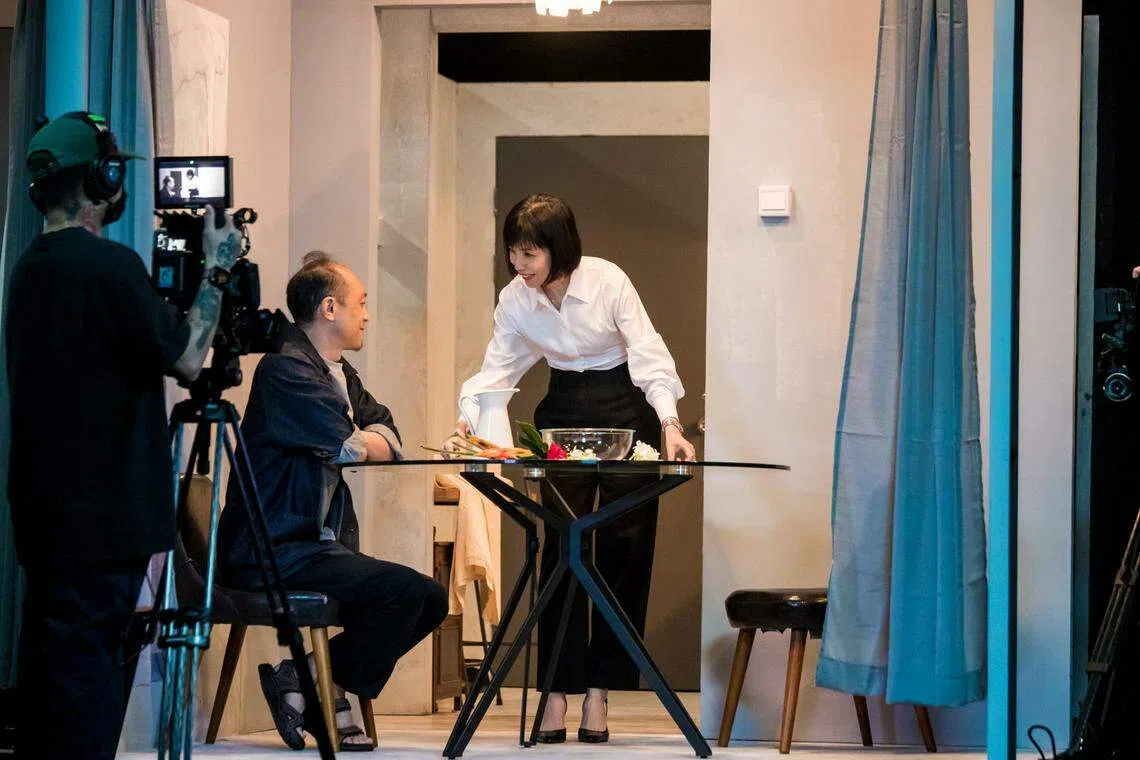
The various tensions between theatre, film and literary fiction become a fascinating meditation on medium specificity and representation.
Human trampolines wow
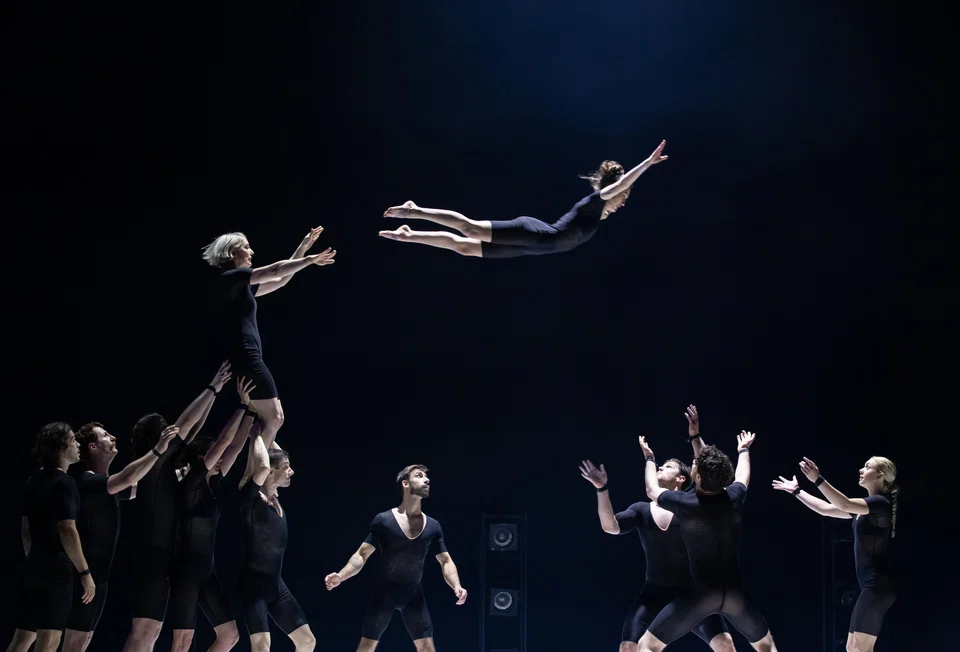
Amid the pervasive ennui of so many productions, the festival chose to end on a happy note: Humans 2.0 presented by the acrobatic troupe Circa was a weekend crowd-pleaser that had audiences glued to their seats. This captivating circus-like performance relies solely on the human body to create a multitude of sculptural shapes and formations. The audience is left in awe of the raw strength and agility displayed by the 10 performers.
Under the direction of Yaron Lifschitz, Humans 2.0 seamlessly blends elements of the circus and contemporary dance. The performers are skilfully balancing on each other’s heads and shoulders. They are launching themselves from human pyramids to be caught by a safety net of their fellow performers. They are catapulting themselves off the stomach of one artist and flawlessly landing on the backs of others.
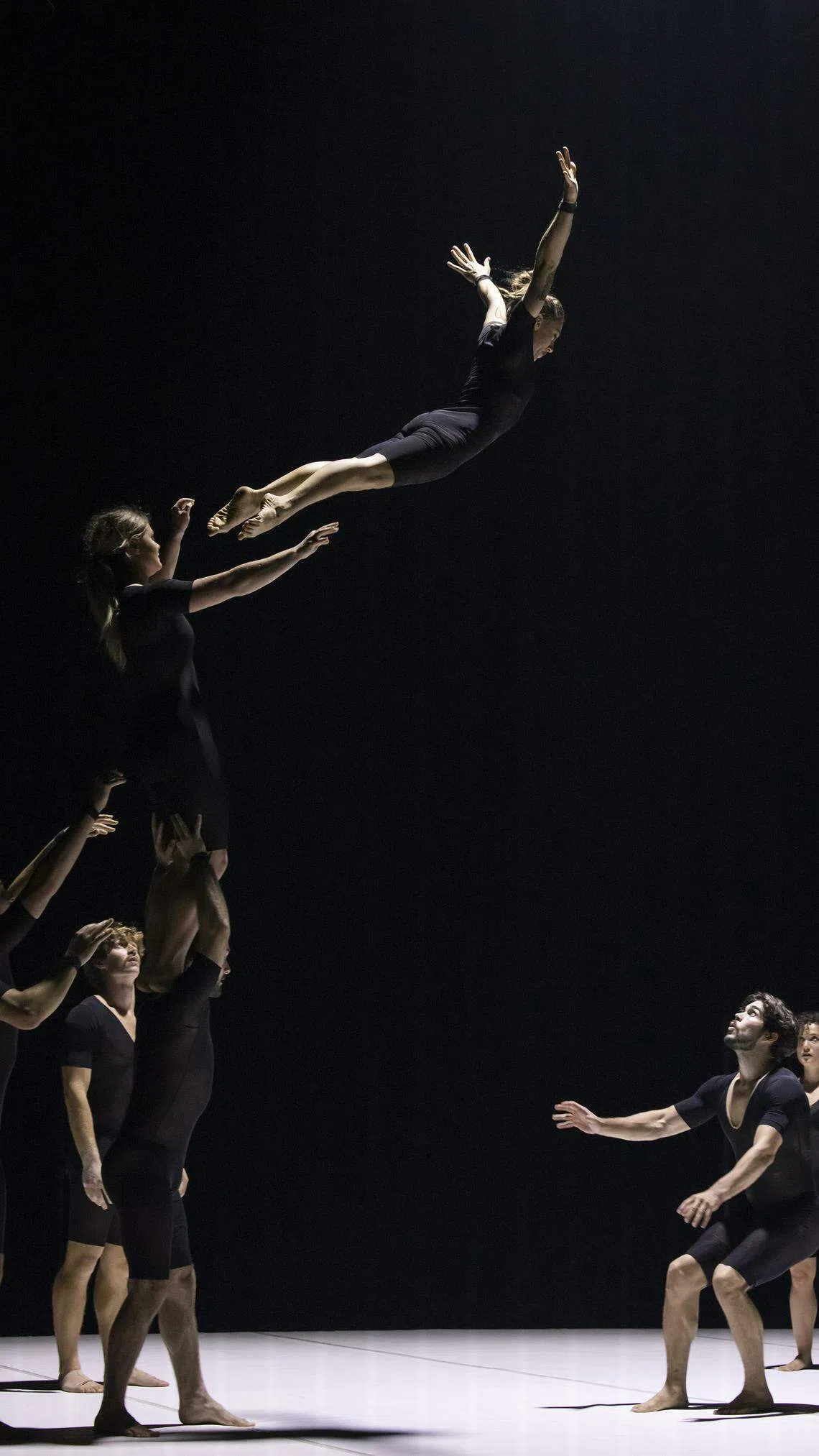
One cannot help but marvel at the performers’ extraordinary strength. But does the show have a deeper meaning? We can’t find any. In the tradition of circuses, Humans 2.0 is pure entertainment with impressive stunts and daredevilry. It came as no surprise that the audience gave it a partial standing ovation, delighted by the spectacle presented before them.
Sifa 2023 has been a festival of largely cutting-edge art – not mainstream entertainment. But for one show only, mainstream audiences finally had something to root for.
Decoding Asia newsletter: your guide to navigating Asia in a new global order. Sign up here to get Decoding Asia newsletter. Delivered to your inbox. Free.
Copyright SPH Media. All rights reserved.






