Singapore-based Piece Future helps startups leverage unused patents
It matches startups to companies and universities that have unused IP, so that the technologies are not sitting idle
[SINGAPORE] Casio, Panasonic and Nokia. These are some companies that are steeped in research and development (R&D) for their products.
For example, Nokia’s website stated that since 2000, the company has invested over 150 billion euros (S$224 billion) in R&D with around 26,000 patent families.
But with so many patents filed, what happens to those that are not utilised?
Piece Future, an intellectual property (IP) bank that does consulting and transactions in this area, recognised an opportunity in this gap and decided to tap it for good.
Its flagship corporate social responsibility IPHatch programme allows multinational corporations and universities to open their unused patented technologies to startups – at no cost – to drive social impact.
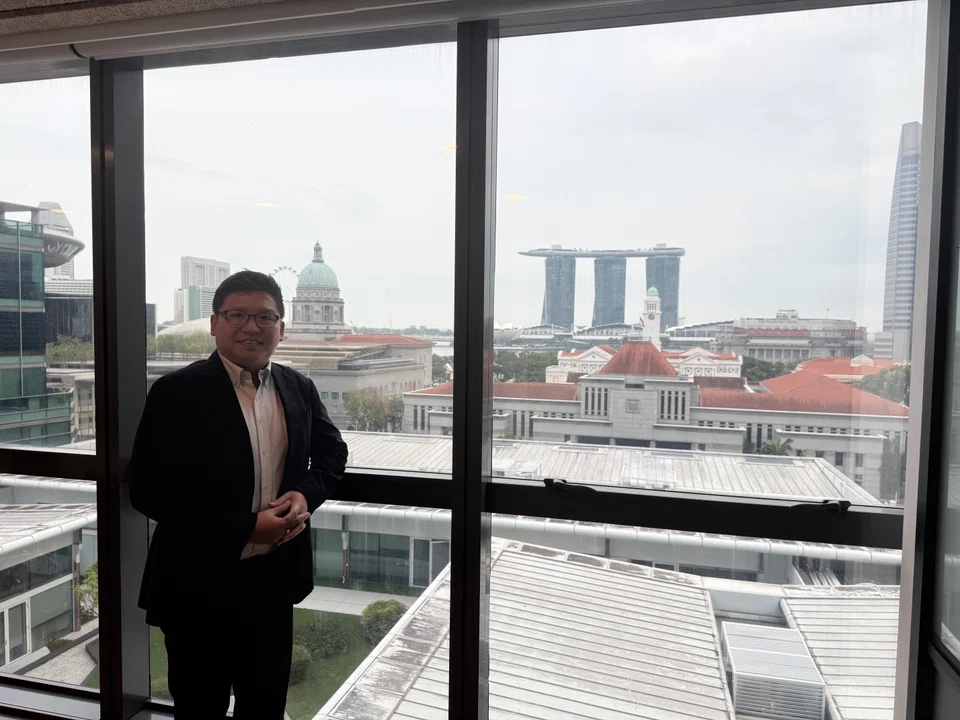
Jason Loh, founder and CEO of Piece Future, said: “We feel that there is a very strong need for Asia companies to be more IP-savvy... It costs a lot to file a patent (and for) companies to do R&D from day one. The whole platform empowers them with their first IP, and then they can use it as a seed or foundation to grow and build their company.”
Facilitating emotional expression
One such beneficiary from the programme was Singapore startup MangaChat.
The company is an artificial intelligence-powered digital journalling platform that supports individuals with attention deficit hyperactivity disorder, autism and socioemotional challenges.
Through the IPHatch programme, it has worked with IP from Tohoku University and Panasonic – particularly Smart Mind Wearables, a virtual reality (VR) device that alleviates motion sickness and navigates menus via non-invasive control.

Huang Sheng-Fang, founder and chief executive of MangaChat, said: “These IPs served as a foundational technology layer, allowing us to prototype faster, test functionality earlier, and focus our resources on content design and real-world use cases.”
Its interactive storytelling tools integrate gamification and therapy principles to personalise journalling experiences.
MangaChat plans to incorporate this tech to support users who want to avoid face-to-face counselling, by using VR games to facilitate emotional expression.
MangaChat is one of more than 100 startups that have benefited from the IPHatch programme so far. The other beneficiaries come from sectors spanning healthcare, sustainability and technology.
The idea for IPHatch emerged when Loh was working in Panasonic, where he spent 16 years and ultimately was the head of strategic planning and IP before founding Piece Future in 2016. As part of his role, he reviewed what technologies were obsolete on a yearly basis.
“We realised that there are so many cool technologies that are not harvested to become a business, and many times this is due to business decisions and the readiness of the market. Corporates are also more conservative in starting a new business, because it requires a lot of manpower and resources,” Loh noted.
Learning opportunities and building trust
The IPHatch programme runs yearly in Asia, the Middle East, the United Kingdom and Japan. The stages comprise a launch event, innovation activities such as workshops, application submission and a pitching day – where startups present their ideas of how they will use their chosen IP to a panel of judges and bid for it.
“As an IP bank, we have the expertise to select ‘trendy’ portfolios that could be deployable to startups. We will curate and market them through the IPHatch platform, through education initiatives such as panel discussions and hackathons,” Loh noted.
The programme also helps startups build credibility and trust with partners.
IPHatch has provided MangaChat insights into the Japanese market, which is more “mature and trust-driven” compared to a “relatively small” market like Singapore, Huang pointed out. It has also personally introduced the startup to partners, reducing “the cost of building credibility from scratch”.
“IP is not just about technology, but a key connector between markets, culture and long-term product strategy,” he said. “Sometimes, IP plays a different role: enabling us to create new product lines or even an ecosystem that fits a larger market, and then allowing our original products to integrate into that ecosystem naturally.”
Another startup from IPHatch is climate-tech venture AgroTree Ledger. The platform combines blockchain and satellite technology to tokenise agroforestry projects, allowing for real-time environmental monitoring.
AgroTree Ledger co-founder and CEO Yohan Brizolier said: “We joined IPHatch to bypass the typical five-year R&D cycle. By assessing patent portfolios from tech giants, we could skip the ‘experimental’ phase and go straight to building a bankable infrastructure layer that institutions trust from day one.”
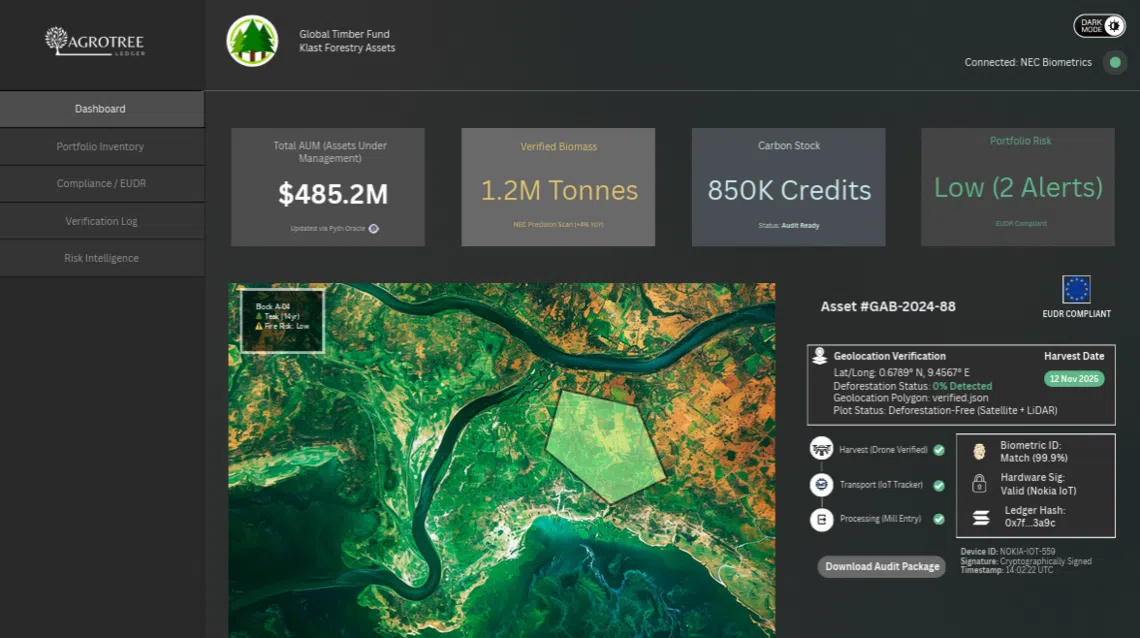
It has leveraged NEC’s computer vision tech originally designed for facial recognition to identify tree species and biomass density more precisely, as well as Nokia’s cryptographic signing technology to secure data at the hardware source such as drones or sensors.
These technologies, along with the startup’s own solutions, allow farmers to digitise their assets and record data.
“By providing low-cost, automated verification, we ensure that ethical producers in regions like South-east Asia and Africa can prove their sustainability and keep selling to the world,” Brizolier added.
Loh said that Piece Future aims to expand to new regions and reach out to more startups and ecosystem partners, as well as corporates who may have dormant patents to offer.
Decoding Asia newsletter: your guide to navigating Asia in a new global order. Sign up here to get Decoding Asia newsletter. Delivered to your inbox. Free.
Copyright SPH Media. All rights reserved.