SMU’s new philanthropy framework aims to support high-potential initiatives with longer time horizon
The ‘moonshot approach’ targets initiatives that have more uncertain outcomes but tackle root causes of social issues
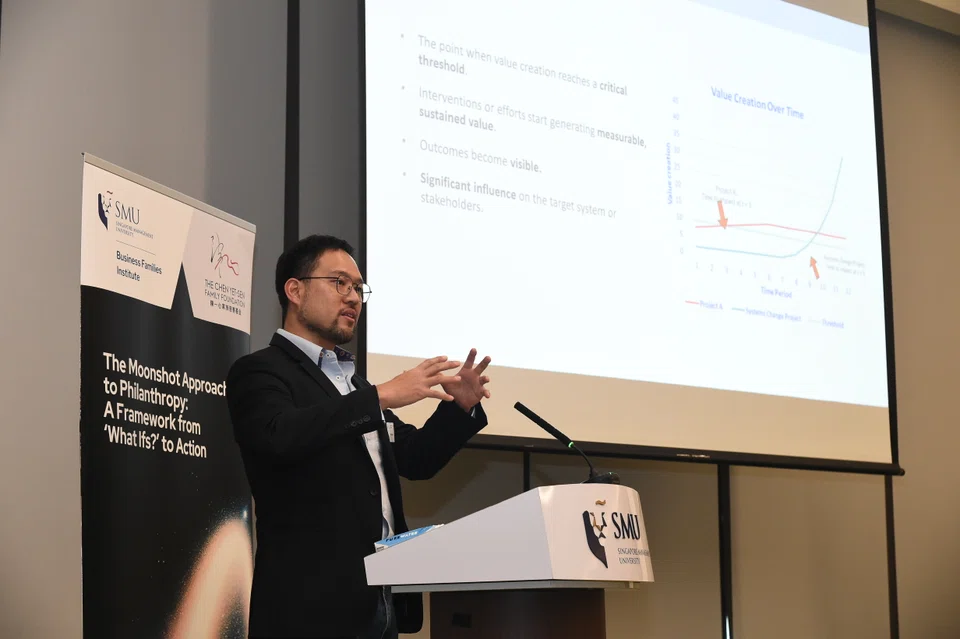
[SINGAPORE] The Singapore Management University (SMU) Business Families Institute (BFI) on Thursday (Mar 12) launched a philanthropy framework focused on high-potential initiatives which have a longer time horizon, but ultimately achieve longer-term impact.
This “moonshot approach” to philanthropy tackles the root causes of social issues by supporting early-stage, high-ambition initiatives, instead of targeting “short-term, measurable outcomes”, SMU BFI said.
The report, titled The Moonshot Approach to Philanthropy: A Framework from ‘What Ifs?’ to Action, was developed with support from The Chen Yet-Sen Family Foundation. It outlines five elements of the moonshot approach, and presents actionable tools for philanthropists to make better long-term funding decisions.
At the launch, SMU Associate Professor of Strategy and Entrepreneurship Kenneth Goh, who led the report, said: “Seventy-two per cent of organisations working on systems change receive less than a quarter of their funding as unrestricted grants, and most philanthropic capital continues to flow towards direct service delivery. These are immediate, measurable and necessary, but insufficient.”
High-potential projects – those that are long-horizon and may lead to more uncertain outcomes – are underfunded. This is because funders prefer certainty over risk-taking and experimentation.
“If we only ever fund what we can measure quickly, we will only ever treat symptoms. The underlying conditions that generate those symptoms will remain exactly where they are,” he added.
Prof Goh noted that viable enterprises were unable to attract funding because their timelines did not fit conventional funding logic. He stressed that the moonshot approach will not replace direct service delivery, but instead work alongside conventional philanthropy to “invest in conditions for lasting change”.
Core elements of the moonshot approach
The first core element is exponential value creation – the pattern that an initiative’s impact accelerates dramatically after an initial period of slow growth. This involves substantial upfront effort and a long early phase of experimentation, learning, capacity-building and adaptation.
The second is the “what-if” mindset, which prioritises exploring transformative approaches instead of relying on the certainty of proven ones. The third is structured learning and involves feedback cycles and sustained collaboration between funders and stakeholders.

The fourth is risk-taking, which involves “adequate” due diligence, SMU BFI said. “Due diligence for the moonshot approach resembles evaluating early-stage startups, with a focus on potential rather than past performance, and adaptability rather than predictability.”
The fifth element reframes the role of philanthropists – instead of micromanaging, they co-create initiatives with community partners, governments and other stakeholders, while offering resources, mentorship and extensive networks.
One initiative that used the moonshot approach is Clearly, a campaign to enable universal access to glasses. It was established by James Chen, chair of The Chen Yet-Sen Family Foundation.
Although Chen started working on Clearly in 2003, he encountered many challenges before he started seeing results in Rwanda, where much of his work took place. By 2016, every Rwandan citizen had access to primary eye care.
“For the first 10 years, I literally had nothing to show for Clearly – other than spending my family’s money. It was all failures… There was a lot of self doubt,” he said. “By 2013, we started to see progress in Rwanda, and by 2017 we exited Rwanda. We succeeded beyond our expectations.”
After partnering strategic stakeholders and conducting a study on how glasses improves productivity of manual workers, Clearly secured a United Nations General Assembly resolution in 2021 to provide access to eye care for the 1.1 billion people living with preventable sight loss by 2030.
Practical tools and frameworks
The report suggested managing philanthropic portfolios with a time-to-impact concept, which provides philanthropists with a “structured way to allocate funding across initiatives, balancing short-term responsiveness with long-term transformational goals”.
While conventional funders are usually just financial sponsors, SMU BFI proposed funders take on a more active role. This involves partnering stakeholders to co-create strategies while learning and improving together.
Another tool is the impact-timing matrix, which aligns funding approaches with the intended depth of impact and maturity of initiatives. It encourages philanthropists to explore initiatives, develop organisational capabilities, strengthen ecosystem partnerships, and consolidate and embed effective solutions.
Prof Goh noted the importance of experimentation, which could also lead to unintended positive outcomes in the long run.
The last tool in the report is a strategic road map to guide philanthropists across all the stages, from exploration to institutionalisation.
Chen highlighted the need for such a framework especially for the next generation of wealth-holders, who want to give back to causes they are passionate about.
“How can we help them go on this journey that will allow them to increase their chance of success, and make it less difficult, lonely and painful?” he said, adding that the framework provides clarity and legitimacy to long-term initiatives.
Decoding Asia newsletter: your guide to navigating Asia in a new global order. Sign up here to get Decoding Asia newsletter. Delivered to your inbox. Free.
Copyright SPH Media. All rights reserved.