

Sotheby's auction house to be taken private in US$3.7b sale
 Add BT as a preferred source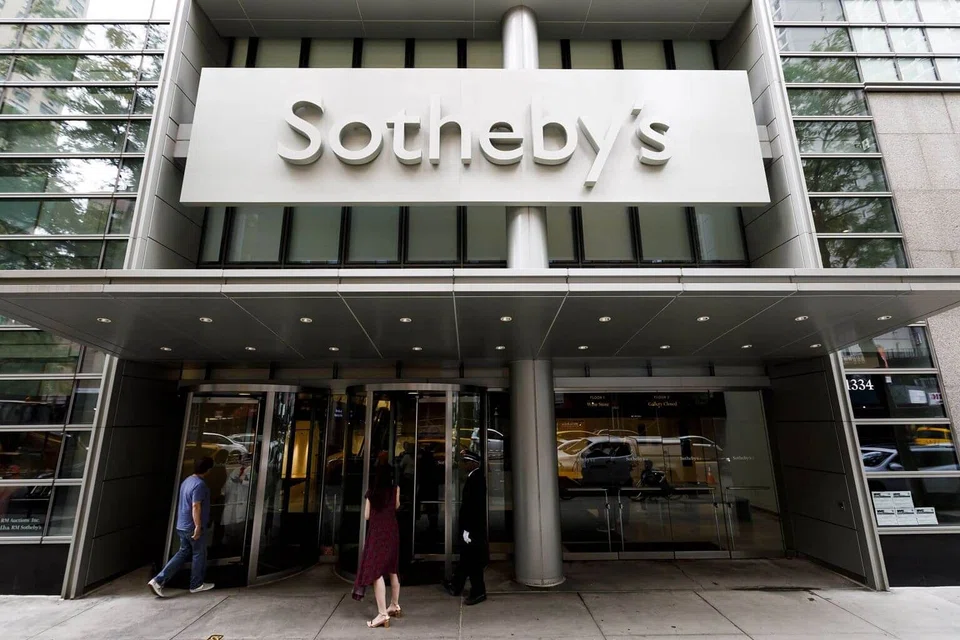
[LONDON] In recent years, the competition between the world's two largest auction houses, Sotheby's and Christie's, has seemed at times like a bit of an unfair fight.
Sotheby's, which is publicly traded, has lost out to its privately held archrival for several headline-grabbing consignments. Last year, Christie's sold the collection of Peggy and David Rockefeller for US$835 million, the highest-grossing auction ever of a private collection. In 2017, Christie's sold Leonardo da Vinci's Salvator Mundi for US$450.3 million, the highest auction price ever for a work of art.
Both auctions were underpinned by financial guarantees arranged by Christie's, which since 1998 has belonged to a holding company owned by French billionaire François-Henri Pinault.
Wendy Goldsmith, a London-based art adviser and former head of 19th century European art at Christie's, noted the advantage gained by an auction house owned by a wealthy individual. "If you wanted to get something done," she said, "you went to the man with deep pockets".
On Monday, Sotheby's moved to level the playing field, agreeing to be acquired by a billionaire of its own, French-Israeli telecommunications entrepreneur Patrick Drahi, in a deal worth US$3.7 billion. The purchase, by Drahi's BidFair USA, returns the only publicly traded major auction house to private ownership after 31 years on the New York Stock Exchange.
About US$2.66 billion of the purchase price will be paid in cash, with Sotheby's shareholders getting US$57 per share of their common stock. That is a 61 per cent premium over the stock's closing price on Friday. Sotheby's shares jumped 58 per cent in trading Monday after the deal was announced.
"This acquisition will provide Sotheby's with the opportunity to accelerate the successful program of growth initiatives of the past several years in a more flexible private environment," Tad Smith, the chief executive of Sotheby's, said in a statement.
Flexibility is something Sotheby's has sorely lacked. As a publicly traded company, it has had to justify every business decision and explain every market fluctuation to shareholders on a quarterly basis. That is a challenge for a business that relies on seasonal revenue and is strongly dependent on the quality of consignments in any given sale.
NYTIMES
Share with us your feedback on BT's products and services
TRENDING NOW

OUE Reit selling Crowne Plaza Changi Airport for S$500 million; unitholders to get special payout

Buyer for England striker Harry Kane’s former mansion must pay £3.4 million after abandoning deal

Singapore releases Economic Strategy Review Final Report with more detailed proposals

Frasers Property proposes S$2.1 billion restructuring of hospitality portfolio

