
Speculators win big with bets on young artists
 Add BT as a preferred source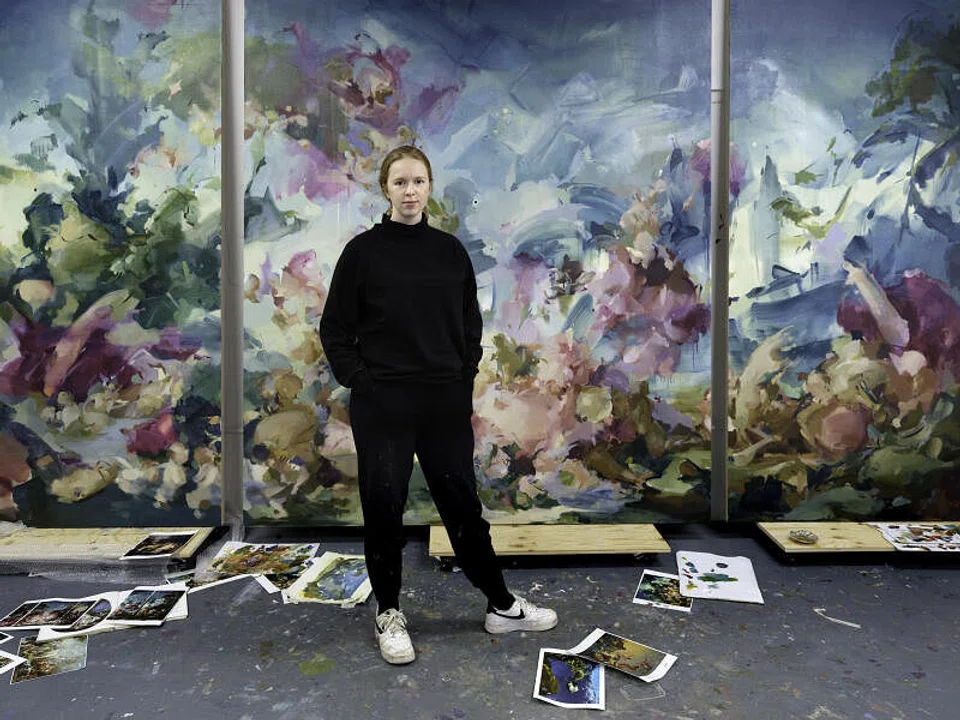
[LONDON] Three years ago, her large paintings were selling at a little-known gallery for about US$40,000 each. In 2021, one of them was resold at a Sotheby's auction for a record US$3.1 million. Another hangs in the Downing Street home of Britain's Finance Minister Rishi Sunak.
Flora Yukhnovich, 31, a British painter whose first solo exhibition at the Victoria Miro gallery in London opened on Tuesday (Mar 1), is one of the most sought-after young rising stars in the art world, and her works are attracting voracious demand internationally from collectors and speculators.
"The number of very interested, serious collectors who have inquired after the work runs in the hundreds," said Matt Carey-Williams, Victoria Miro's head of sales.
The heat in the market for Yukhnovich's exuberant semi-abstract paintings is symptomatic of the phenomenon known as "flipping". When demand for certain artists significantly outstrips supply, those fortunate enough to have acquired their works via galleries can make enormous profits if they offer them at auction.
Galleries are keen to avoid this: A frothy resale market can make it difficult for artists to sustain long-term careers.
Back in 2014, during the last speculative frenzy for young, emerging art, abstract paintings by Lucien Smith, which were fashionable at the time, were routinely being flipped at auction for multiples of their gallery prices.
Navigate Asia in
a new global order
Get the insights delivered to your inbox.
But the market quickly cooled and, by 2015, a disillusioned Smith had stopped exhibiting with commercial galleries.
"Auction results do not affect the pricing strategy adopted for Flora's work," Carey-Williams said.
Yukhnovich, who declined to be interviewed for this article, has a distinctive painting style that dematerialises figure-cluttered subjects by old masters into swirling flecks of colour.
Her latest works in the Victoria Miro show are marked between US$135,000 and US$470,000, reflecting how the artist's gallery prices have "slowly and carefully risen over the past 18 months," said Carey-Williams.
Yukhnovich's auction prices, on the other hand, have risen into a different realm, which only encourages more would-be buyers to join the line.
The stakes for gambling on young contemporary art have never been higher. In 2014, works by artists younger than 40 raised US$181 million at auction. Last year, they turned over a record US$450 million, a 275 per cent increase on 2020, said Artprice, a company based in France that tracks international auction sales.
Eyebrows were raised during that earlier frothing of the market when paintings by artists like Smith, Jacob Kassay and Oscar Murillo were flipped to make auction prices of more than US$300,000.
Recent salesroom prices for Yukhnovich, Matthew Wong and Avery Singer have added an extra digit.
"The market has expanded since 2014," said Wendy Cromwell, an art adviser based in New York. "There are many more people and there is a lot of money in the system. There's competition for just a few artists, and this leads to exponentially higher prices."
The buyers of big-ticket contemporary art are also increasingly younger, Cromwell said.
A new wave of participants in their 40s, 30s and even 20s, enriched by inheritance and the tech economy, is transforming the market, she added. "There's been this youthquake in terms of who's buying the work and who's distributing it," she said.
Sotheby's end-of-year statement noted that "an influx of younger, tech-savvy collectors" had helped the auction house achieve a record US$7.3 billion of sales in 2021, with the number of bidders younger than 40 increasing by 187 per cent.
Given the market's emphasis on youth and tech, it's no surprise that Instagram has been the main driver of interest in Yukhnovich's work, as is the case with so many of today's artists.
"I came across Flora on Instagram, and I definitely wasn't alone," said Matt Watkins, a director of Parafin gallery in London, which held a breakout solo exhibition of Yukhnovich's paintings in 2019.
Influencers like Carey-Williams and young art historian Katy Hessel, whose @thegreatwomenartists account has 250,000 followers, were key early enthusiasts, as was ArtForum's Instagram account, which has 1.2 million followers.
Carey-Williams said Victoria Miro would sell Yukhnovich's works only to "considered collectors where both the gallery and the artist feel very assured that any acquisition will remain a long-term hold".
The approach echoes the gallery's tightly controlled representation of highly regarded Los Angeles-based artist Njideka Akunyili Crosby, which prioritises sales to public museums to enhance Crosby's critical reputation and shut out profiteers.
Over the past 6 years, Victoria Miro has placed works by Crosby with the Metropolitan Museum of Art in New York, the National Gallery of Art in Washington, the Los Angeles County Museum of Art, Tate and other institutions.
No major recent work by this sought-after artist has been resold at auction since 2018, said Artprice.
With dealerships in America and Europe determined to confine sales of the most desirable young art to established collections, new buyers are having to look further afield.
Ghana, in particular, has come to be perceived as a hot spot for emerging talent. Last year, works by one of the country's most prominent young artists, Amoako Boafo, were being flipped at auction for as much as US$3.4 million, against gallery prices of as little as US$10,000.
"It's like nothing I've ever seen," said Victoria Cooke, the director of Gallery 1957, a dealership in Ghana's capital, Accra, that represents local artists and exhibits them internationally.
"Even through the pandemic, there were collectors and gallerists here from Paris, the US and the UK. A lot of people are trying to go directly to the source," she said, adding that buyers were a mixture of collectors and speculators.
"People can come in, and buy out a studio here, and flip the works," Cooke said. "That could seem an exciting opportunity if you haven't got a trusted person advising you otherwise."
Because there are only two major dealerships in Accra (the other being the contemporary art gallery ADA) to act as gatekeeper for Ghana's talent, its budding artists have turned to an international auction house which they hope will reach out to a less sketchy clientele.
In January, Phillips, in its role as a broker of private sales, rather than as a public auctioneer, mounted the 10-day selling exhibition, Birds Of A Feather, at its headquarters in London.
Featuring 18 recent works by 6 all-but-unknown young artists from Ghana, this rare venture by an auction house into the gallery-dominated "primary market" was held in collaboration with Artemartis, an artist collective based in Accra.
Phillips spokesperson Anna Chapman said all of the works sold go at prices ranging from US$4,000 to US$12,200; she declined to release further information about those private sales.
"There are lots of people coming to Ghana trying to work with artists," said Selasie Gomado, the founder of Artemartis, a dealer and a manager for the collective.
"We teach them the importance of contractual agreements, so they can have long-lasting, sustainable careers. An artist can get a lot of attention and then, at the end of the day, end up with nothing."
NYTIMES
Decoding Asia newsletter: your guide to navigating Asia in a new global order. Sign up here to get Decoding Asia newsletter. Delivered to your inbox. Free.
Share with us your feedback on BT's products and services

