

Staying power
Rolex's GMT Master II has come a long way - we trace its evolution

IT'S HOTTER THAN the cola drink it's nicknamed after. Customers thirsting for Rolex's latest GMT II Master "Pepsi" watch were queuing for it even before it arrived in the shops - only to be told that the waiting list is as long as eight years, if not more.
That has sent prices in the grey market through the roof for the watch with the striking blue and red bezel - the going price is as high as US$22,000, over two times the recommended retail price.
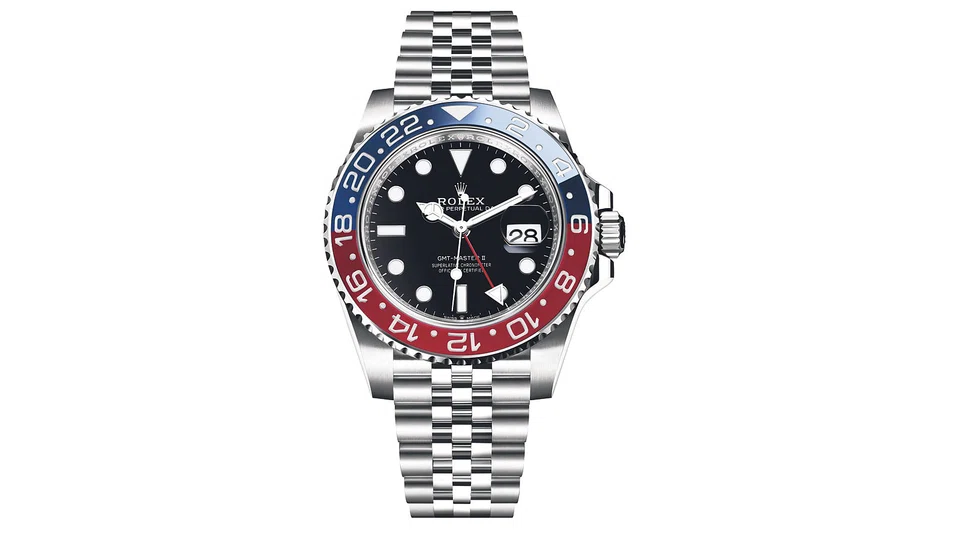
At first glance, the latest Pepsi model, launched in March this year, looks no different from the one rolled out in 2014. For one thing, it's got the same red and blue scratch-proof ceramic bezel with the 24-hour scale. But, you can feel the difference between the two on your wrist: the earlier version came in a 40mm diameter solid white gold case and white gold bracelet; the newer one has a lighter stainless steel case and bracelet.
The less subtle giveaway is the bracelet. The 2014 Pepsi was fitted on a solid-link bracelet. The new Pepsi has the "Jubilee" bracelet which is in the historical five-link style, rather than the more common three-link "Oyster" design. The latter was first created for the Oyster Perpetual Datejust line introduced in 1945. A safety clasp has since been added to the Jubilee link to ensure you don't accidentally open the bracelet. A Rolex-patented fast extension system allows the link to be extended easily by about 5mm for comfort. The Jubilee bracelet has appeared on past GMT Master models, but this is the first time it's brought together with a steel case and a red and blue ceramic bezel in the latest GMT Master II.
Not only is it lighter, the new two-time zone timepiece is more affordable than the previous white gold version, which costs three times more. The updated Pepsi, waterproof up to 300 metres, has a recommended US$9,250 price tag. (The 2014 white gold GMT II Master with black dial model is replaced this year by a new one in a blue dial.)
A new generation automatic movement (Calibre 3285) - once the watch is fully wound - keeps the new Pepsi ticking non-stop for 70 hours when not worn, 20 hours longer than the previous model.
Rolex has 10 patents pending for the technologies incorporated in this movement. Like all Rolex watches rolled out these days, the latest GMT Master II is certified a Superlative Chronometer, a guarantee of excellent performance on the wrist.
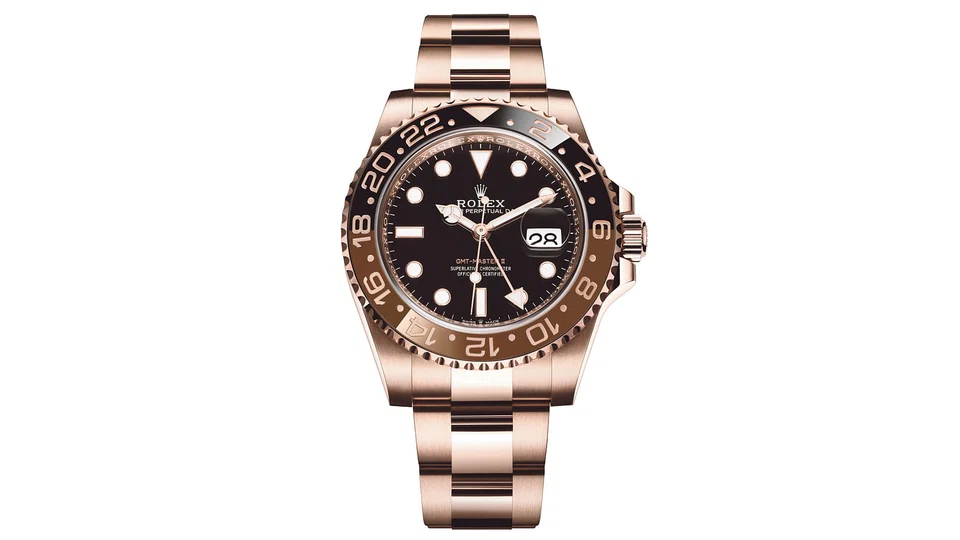
Apart from the Pepsi, Rolex also unveiled a new GMT Master II model with a black and brown ceramic bezel this year - and there are two versions of this: rose gold (US$36,700) and a rose gold and steel "Rolesor" combination (US$14,050). The brown ceramic is a first for a Rolex, and going by the affinity for soft drink comparisons, both the Everose gold and Rolesor versions have been dubbed the "Root Beer".
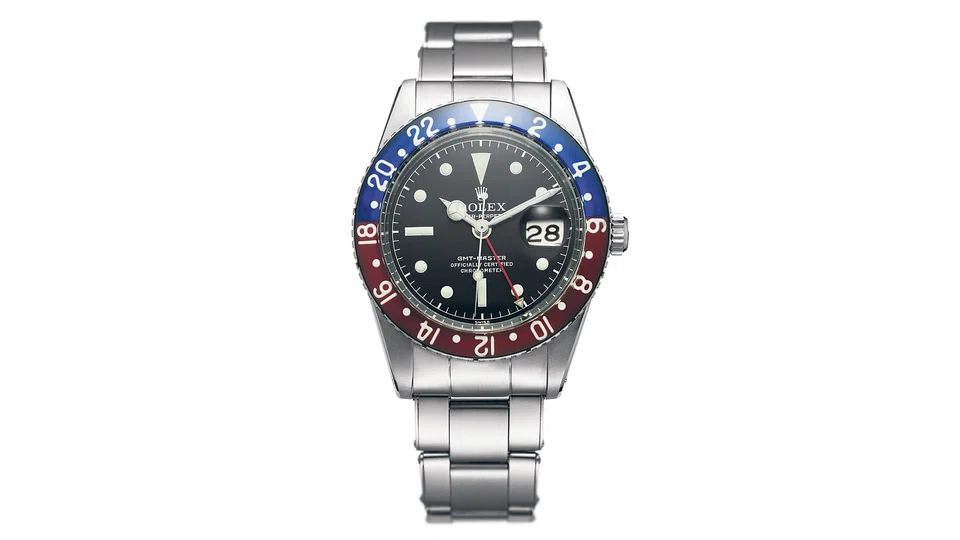
On its part, the red and blue bezel of the new steel Pepsi takes after the original 1955 GMT Master. It remains the defining feature of the GMT series, though the bezel of the GMT collection has appeared in various colours: black and red (the "Coke"), all black as well as black and blue (the "Batman").
Rolex's watches, especially its "professional" models, are created for a purpose. The "GMT" in the Rolex GMT Master watch refers to Greenwich Mean Time, which marks mean solar time at the Royal Observatory in Greenwich, London - the historic location of the official prime meridian used for calculating longitude and determining different time zones around the world.
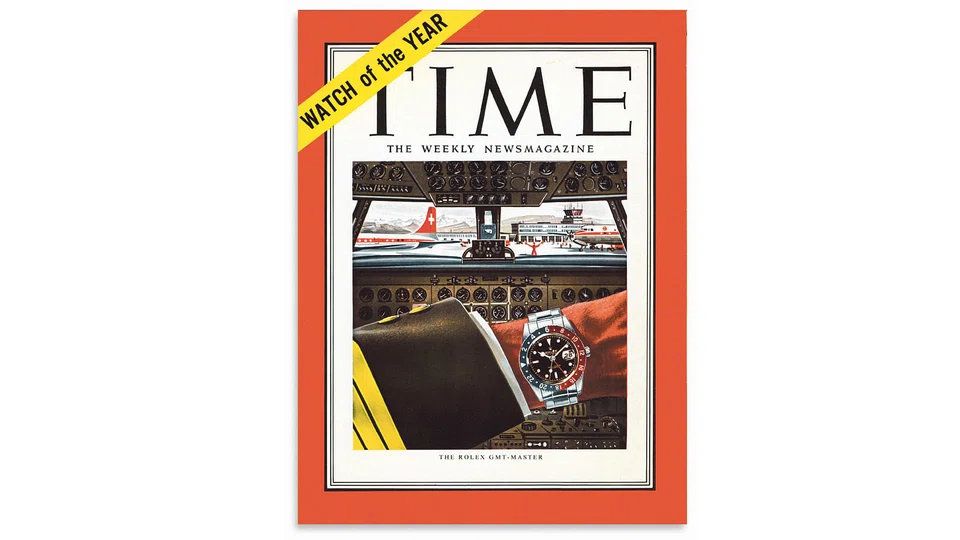
Rolex's GMT Master was therefore designed and made with airline pilots in mind. The watch was rolled out in 1955 when continental travel was expanding rapidly. Pan American World Airways, better known as Pam Am and the American intercontinental airline that stood out most then, even adopted the GMT Master as its official watch. The partnership was marked in 1959 by the first non-stop Pan Am Jet Clipper flight from New York to Moscow. Helping to navigate the flight was a GMT Master, which sat on the wrist of the plane's captain.
Although the first GMT Master had a red and blue bezel, subsequent models were not confined to the Pepsi colours. The first GMT Master was also fitted on an Oyster bracelet, but later variants of the watch and its successor, the GMT Master II, also featured the five-link Jubilee bracelet introduced in 1945.
Key to the GMT Master - and later GMT Master II - is the bi-directional rotatable bezel and 24-hour graduated two-colour or single-colour insert. On the original 1955 model, the insert was split into halves - one red for daylight hours and one blue for night-time hours.
The bezel's 24-hour graduated insert in the first model was made from Plexiglas, with the colours, numerals and graduations painted on the reverse. Aluminium replaced the Plexiglas in 1959 and the colours and inscriptions were created using anodisation - an electromechanical process that made the metal more scratch-resistant.
The conventional hour hand, minute hand and 24-hour hand were synchronised in the first GMT Master. A new movement was installed in 1982, which freed the hour hand to be set independently of the other hands. This made it easier and more intuitive to use and set the watch.
Subsequent models powered by this new movement were called the GMT Master II. The ceramic insert was introduced in 2005, replacing the aluminium insert. The switch was the product of Rolex's pioneering work in creating and designing ceramic components. Two years later, Rolex registered the name "Cerachrom" for the ceramic bezel and insert. The numerals and graduations are moulded into the ceramic bezel and then coated with a thin layer of gold or platinum via the PVD (Physical Vapour Deposition) process. These exclusive components are virtually scratch-proof and unaffected by the sun's ultra-violet rays.
From the start, the Oyster Perpetual GMT Master has been outfitted with the highly shock resistant and waterproof Oyster case, which is one of the signature features of a Rolex watch. Another feature that is synonymous with the GMT Master is the cyclops lens which provides easy reading of the date. From 1959, the crown guard was also stamped as an integral part of the middle case to protect the winding crown.
Share with us your feedback on BT's products and services
TRENDING NOW

OCBC mobile, online banking services restored after Friday afternoon disruption

SGX CEO Loh Boon Chye to step down; succession planning under way

Waymo founder predicts ‘landslide’ robotaxi adoption in Singapore, driven by high car costs

Vietnam’s northern provinces, not Hanoi or Ho Chi Minh City, are powering near 10% GDP growth

