Cardboard, construction nets and coffee pods go couture
Dumpster diver-turned-diva looks rock the runway at Lendlease’s Trash to Couture design competition
ANGELINA Jolie this week unveiled Atelier Jolie, a fashion house that will exclusively use leftover textiles in its products.
In an Instagram post announcing the launch on Wednesday (May 17), Jolie says her journey towards starting the brand stemmed partly from “a desire to make use of the high-quality vintage material and deadstock material already available”.
With more than a million tonnes of textiles ending up in landfills every year, brands like Atelier Jolie fill an important gap in the fashion supply chain, bringing otherwise-wasted materials back into the fore.
Of course, her latest venture isn’t the only one of its kind. Environmentally conscious designs have become increasingly popular among fashion brands, as designers seek ways to eliminate waste from their processes.
While the industry races to halve its greenhouse gas emissions by 2030, the next generation of eco-couturiers could well hail from Singapore.
Over the past few months, Lendlease’s Trash to Couture fashion design competition has pushed designers to their limits, challenging them to transform waste materials into avant-garde apparel.

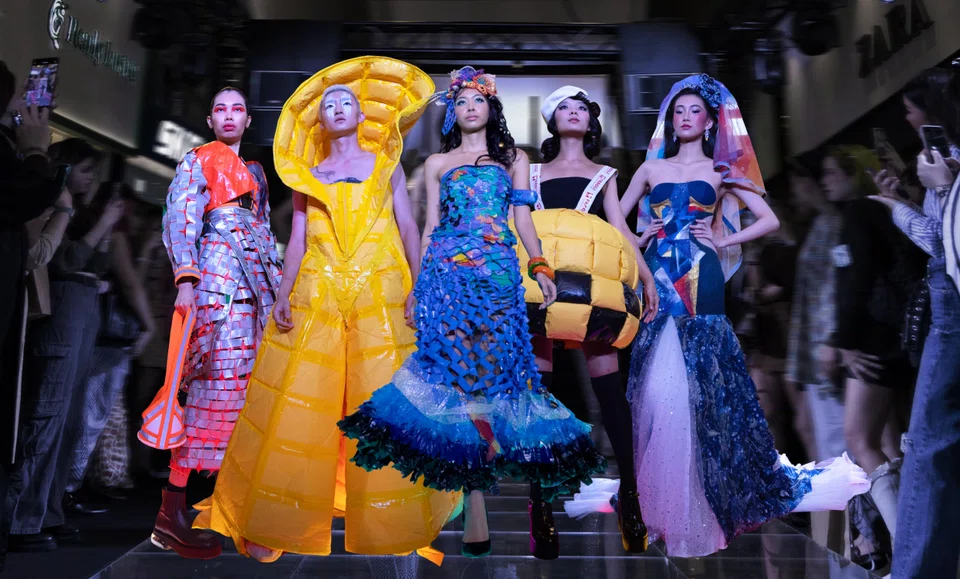
The competition culminated in a runway show and judging at 313@Somerset on May 11, featuring the top 10 designs among more than 100 submissions. From handbags made of hard hats to veils upcycled from fishing nets, contestants pulled out all the stops to make the most of these unconventional materials.
Trashy to flashy
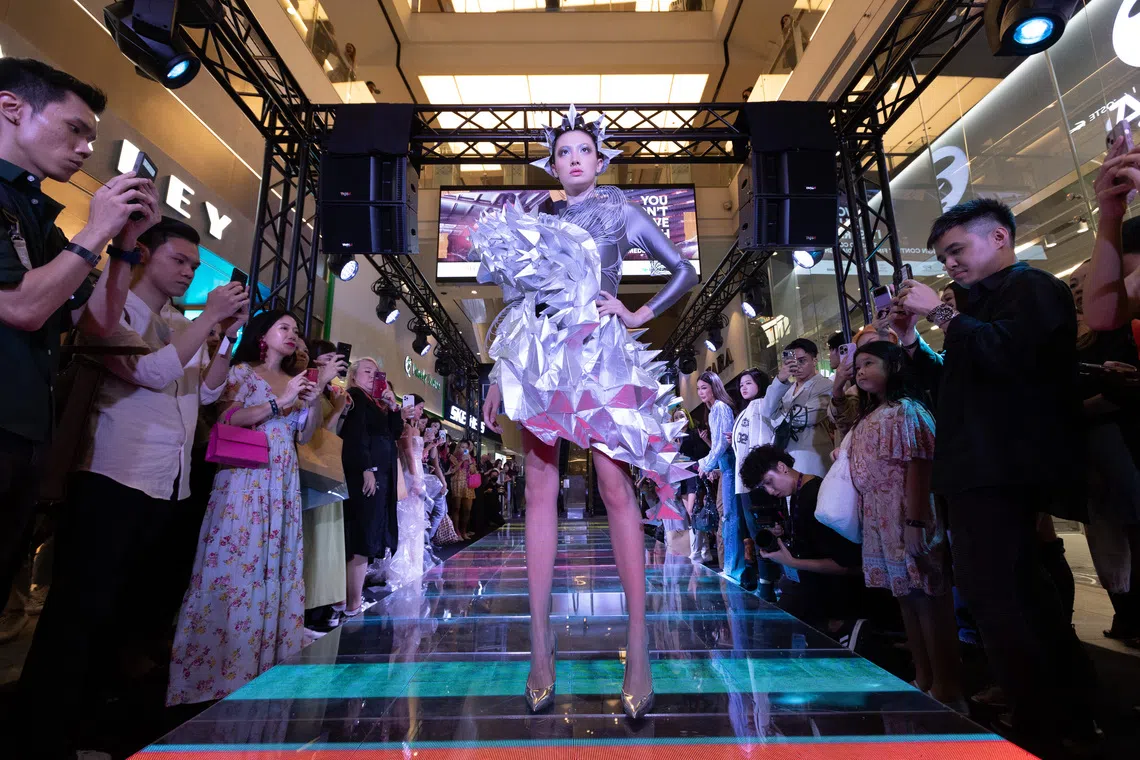
Taking home the top prize was fashion technologist Jamela Law. One would never have guessed that her geometric garment – in all its silvery, angular glory – was crafted from some 200 Tetra Pak drink cartons. The ensemble would have looked perfectly in place in a Lady Gaga music video, or on any number of runways around the world.
Another standout piece was crafted by Gini Ika Jayanti, a domestic worker. Combining gunny sacks with coffee pods and moulded recycled plastic, the 40-year-old turned her model into a glimmering glamour puss. The look, which clinched her second place, drew gasps from the crowd with its incredible level of craftsmanship and detail.



“My look was inspired by Rihanna’s look at the 2015 Met Gala,” Gini tells The Business Times (BT) after her win, referring to the Umbrella songstress’ yellow Guo Pei gown. (Even the renowned Chinese designer could learn a thing or two from her.)

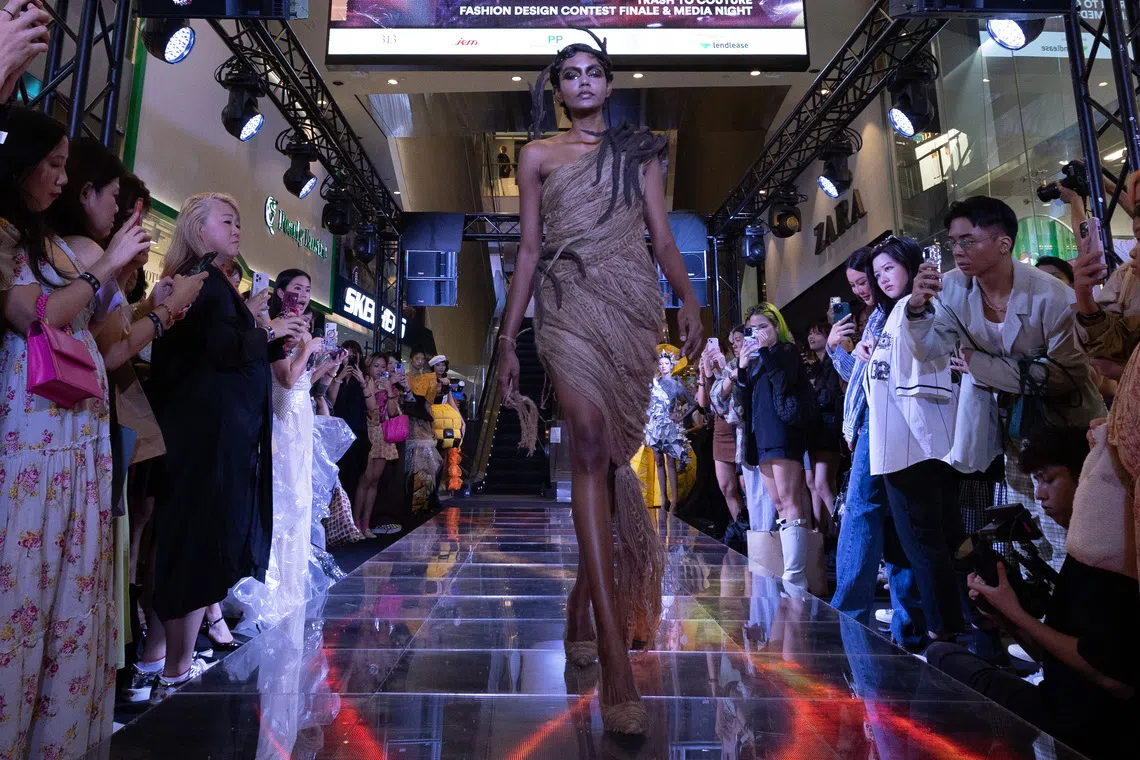
Rounding out the top three was Andrea Karundeng, whose dress made of jute sacks and cardboard boxes felt both ethereal and sculptural, seeming to float while maintaining a sense of organic structure in the curled tendrils that reached gingerly around her model’s body.
On the runway, the Raffles College of Higher Education student explained that this was her first time sculpting a piece for one of her designs. That inexperience certainly didn’t betray her. A member of the audience even commented that the neck piece of the dress appeared to be “growing out of her body”.
The judges of this year’s Trash to Couture competition – the second, after last year’s edition – included Thai designer Apichet “Madaew” Atirattana, who also debuted a mini-collection of upcycled looks at Thursday’s show.
Describing the inspiration behind her pieces, she said that nature and the dramatic black-and-white palette are key to her design language. These showed up in the looks she presented, including one worn by herself, and another by the event’s emcee, Naomi Yeo.
One man’s trash
Also on the judging panel was Joelle Chen, Lendlease’s head of sustainability in Asia. Speaking to BT after the show, she said Trash to Couture is part of the construction and real estate company’s broader green goals. These include a target to reach net-zero greenhouse gas emissions by 2025, and absolute-zero emissions by 2040.
“Personally, I think it’s really important to expand the whole notion of waste, and treat it (instead) as a resource,” says Chen. She adds that the competition was conceived as a way to merge this idea with fashion, “something that people care about very personally”.

Noting that conversations around climate change tend to focus on decarbonisation, Chen says the competition is one way Lendlease is trying to expand the public’s focus to also include waste and circularity.
“What we’re trying to say here is: ‘Hey, let’s not just think about one element of sustainability – can we broaden our conversation, to avoid being caught up in that carbon tunnel vision?’,” she says.
Beyond raising awareness of waste reduction among the public, Chen shares that Trash to Couture also sparked a learning journey for the designers.
Her conversations with them on the sources of their materials in the earlier stages of the competition were “quite simplistic”, she says. But going through the design process helped them better understand their materials, where those materials originated, and how they could be put to better use, to avoid unnecessary waste.
“That was really encouraging, to see that the designers also went through a journey of discovery,” she adds.
Gen-Z powerhouses
The Trash to Couture finals featured a slate of young designers who brought with them fresh interpretations of zero-waste looks. Messaging was front and centre for these new-generation craftsmen, with powerful stories behind their creations. Among these budding talents were Raffles College of Higher Education students Alice Lin, 24, and Feliony Faustine, 21.
The duo’s gown, made mainly of used vinyl banners and bubble wrap, was a true display of craftsmanship. Tucked under the pleated vinyl panels was a corset made of broken garment bags – a remarkable stroke of ingenuity, combined with some serious technical skills.
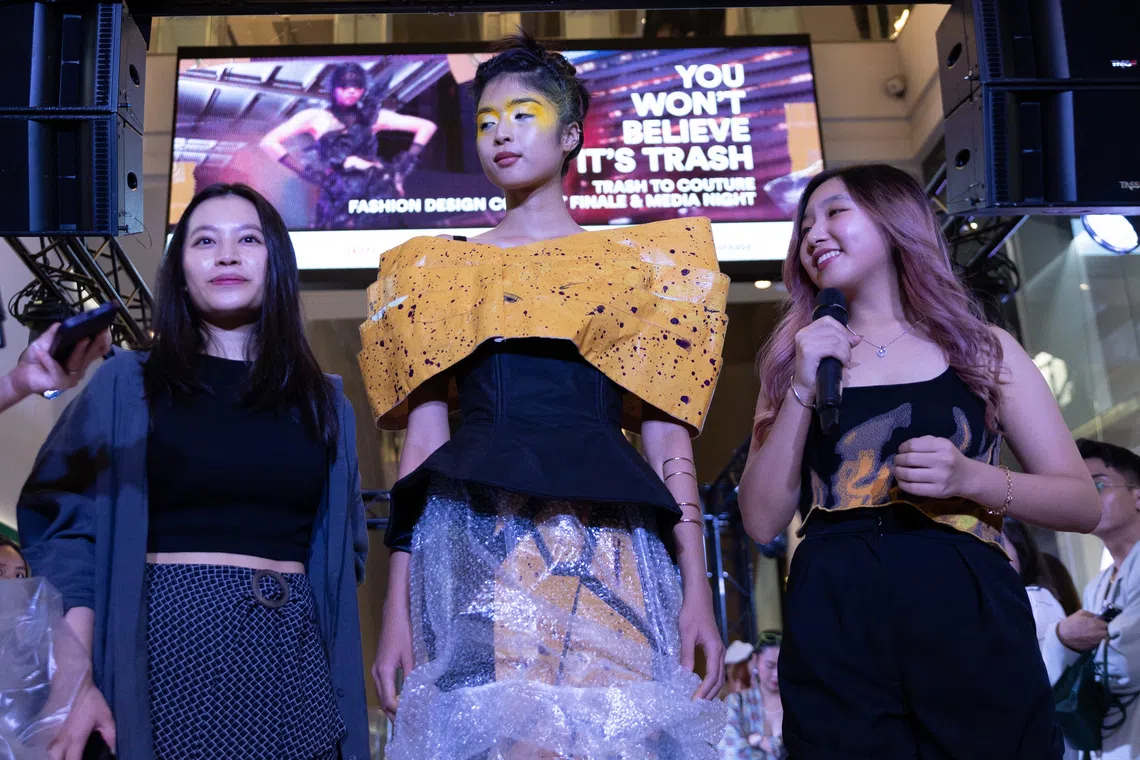
Taking their moment in the spotlight to discuss excessive consumption, Faustine and Lin explained that countless vinyl banners – typically used to promote events – are printed and discarded on a daily basis. The starkly contrasting bubble-wrap skirt was also a harsh reminder of the volumes thrown away after each online purchase delivery, they added.
The youngest finalist was 18-year-old Nur Aqilah Arman. The second-year student at Temasek Polytechnic says the competition has stoked her interest in a career in sustainable fashion: “Coming into this as a student, I was not fully sure – but after going through it, I feel this is something I would really like to pursue.”
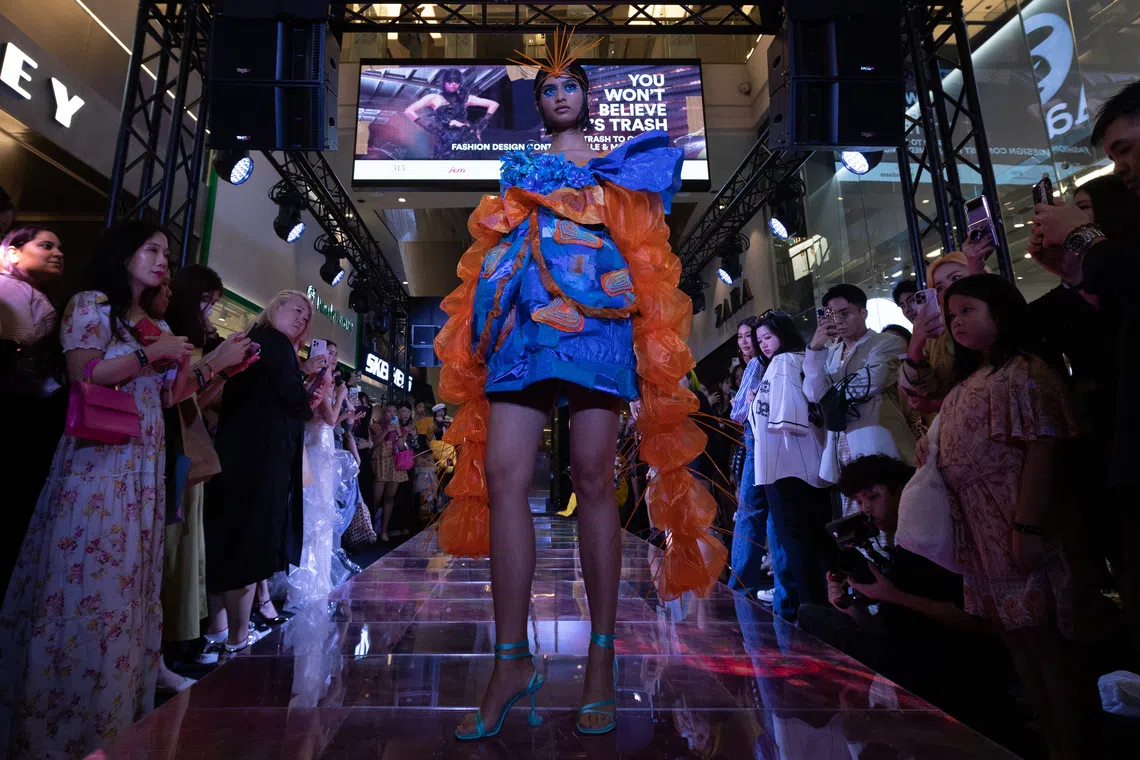
Her blue-and-orange creation – a cornucopia of Ikea bags and plastic scraps – drew applause and cheers from last Thursday’s crowd. Explaining the story behind the flouncy garment, she drew attention to ocean noise pollution, an issue that is, quite ironically, rarely heard of.
“Noise pollution can even affect jellyfish,” she says, referring to the organ damage that can happen to undersea invertebrates when exposed to excessive noise, from sources such as passing ships.
Sustainable clothing, sustainable business
The designs showcased on the runway won’t make it to stores. They’ll instead be put on a roving exhibition at various Lendlease malls as part of its wider “You Won’t Believe it’s Trash” campaign.
However, fashion’s green transformation must involve eco-conscious designs at the consumer level, not just in the conceptual ether.
Of course, going green is far from a one-and-done deal. Just last month, BT spoke with Outfyt founder Stephanie Colhag-Yeo, who shared some of the difficulties she faced in turning her brand into a sustainability-focused one. While she’s managed to turn those tribulations into triumphs, there’s no denying that the bottom line is ultimately what prevails when making business decisions.
Among others, costs are a big hurdle that businesses face when trying to reduce their environmental impact. Semun Ho, chief executive officer of the Singapore Fashion Council (SFC), tells BT that the limited availability of sustainable materials can drive up prices from the get-go.
“Materials tend to cost more, which means the final retail price of goods goes up, and at times, this translates to consumers who are not willing to pay more for goods.”
Still, the SFC notes in its Zero Fashion Waste Study 2022 report that a focus on sustainability can help brands defend their pricing strategy. “Brands that communicate the use of higher-quality or more sustainable raw materials are often able to command a premium on their products,” the council notes.

Perhaps, then, brands can take a leaf out of Trash to Couture’s book, by repurposing and reducing waste during production to minimise costs while maximising impact and their attractiveness to consumers.
Octavia Delima, another finalist of the competition, says that as the owner of a womenswear boutique, she reduces textile waste in her daily work through practices such as repurposing scrap materials.
Her teammates, Connie Hua and Amy Tan, add that it is certainly possible for local brands to incorporate waste-reduction habits into their modus operandi, and that doing so can make business sense.
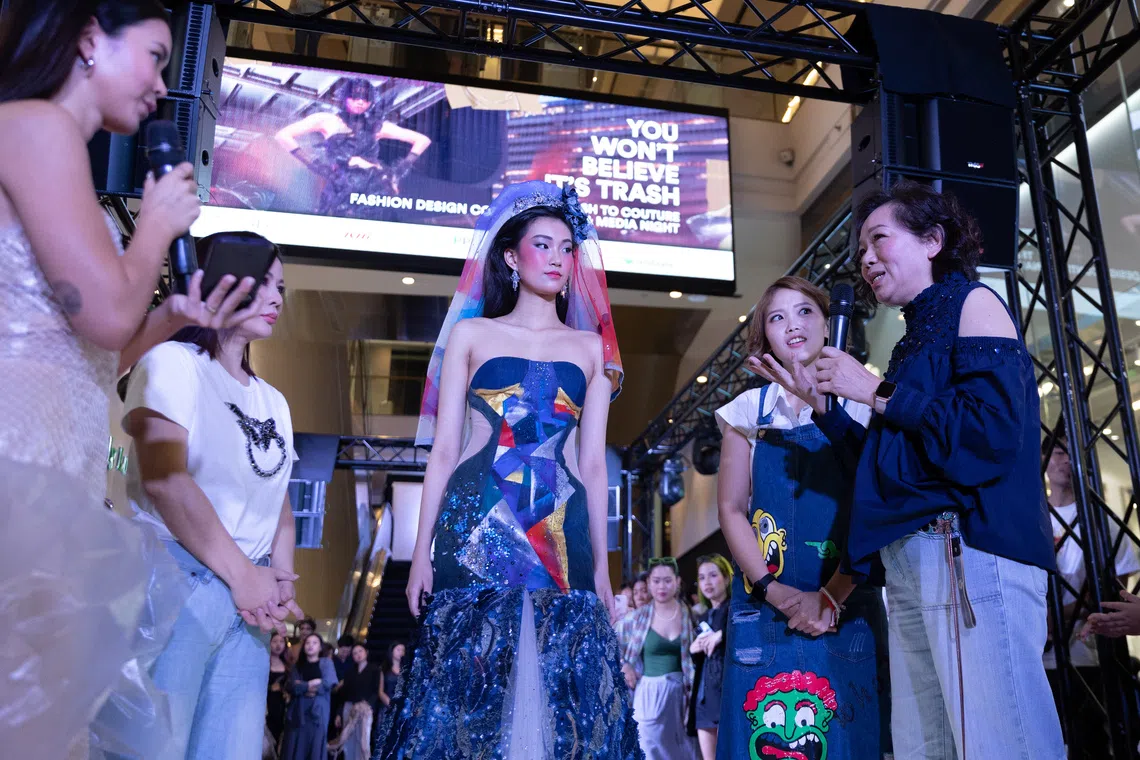
Putting words into practice, the trio of denim enthusiasts presented at last Thursday’s finals a stunning wedding gown made of fabric scraps that they had collected. With its vibrant colouring and fine detail, the piece felt like a witty reinvention of “something borrowed, something blue”. Denim swatches were hand-cut and frayed into feathers, hundreds of which covered the gown’s skirt and train. As the look came down the runway, it would have been impossible to tell that it was made of waste material.
“We wanted to make a wedding gown, since it’s something that many women wear only once,” Tan explains. The senior graphic designer adds that the team’s piece flips the script from would-be waste to once-was waste.
Hua, a senior operations manager at workwear supplier Nice Thot, says the idea of reworking “unwanted” fabrics into new items isn’t just limited to avant-garde pieces, and that it’s certainly possible to approach commercial products in the same way. She notes that companies can pave a road to sustainability by simply starting conversations: “We can approach our clients with these ideas and see what they say.”
Concurring, Ho says: “The best thing for brands to do is to start and be educated about what really makes an impact… Even if they make a little contribution, it makes a difference, so it’s more about starting somewhere.”
Decoding Asia newsletter: your guide to navigating Asia in a new global order. Sign up here to get Decoding Asia newsletter. Delivered to your inbox. Free.
Copyright SPH Media. All rights reserved.