

Sushi worth a moment's wait
Chotto Matte's $100 omakase offers value for money if not stellar quality, says JAIME EE
Jaime Ee
NEW RESTAURANT
Chotto Matte
54 Blair Road
Tel: 6222-8846
Open Mon to Sun from 5pm till late
SUSHI. Such an innocent, delicious word, but which in Singapore can generate the kind of debate usually reserved for partisan politics. Who do you stump for? The well-scrubbed Japanese born-and-trained chef who carries the authenticity card and probably factors the cost of his one-piece cypress wood counter into his omakase pricing? Or his free-wheeling local counterpart who is not averse to the virtues of plywood veneer, thinks everything tastes better grilled with mentaiko cream and knows that the path to the Singapore diner's heart is paved with the words "value for money"?
Whichever way you swing, the truth is this: You can't hope to eat the quality of Shinji for the price of an omakase at Teppei. It's not to say one is better than the other - you're talking Thai honey mango versus US$3,000 "egg of the sun" variants airlifted from Miyazaki in south Japan. Same same, but very different.
But - what strikes us is how this raw fish dichotomy has shaped the way we eat Japanese food here. On one end, you have the home team - local chef-driven sushi joints selling the pipe dream that you can get more for less money. On the other, Nippon-philes with elasticised wallets are putting their money on the "foreign talent", who continually push the boundaries of just how much they can charge before it becomes plain audacious.
Making a quiet entry into this arena is two-week-old Chotto Matte - which is Japanese for "please wait a moment". The semi-casual eatery which pitches for the local cohort, takes up pretty substantial space in two back-to-back shophouses in the pleasant residential ambience of Blair Road. If you're just there to lounge over drinks and a bite, the bar-bistro in front fits the bill. But if you want something a little more serious, check out the sushi bar at the back, which is what we do.
Compared to the open concept bistro, the sushi bar resembles a speakeasy, with its entry through a narrow side door that opens into a tiny room painted an unconventional burnt orange with a blackboard menu that's more coffee bar than serious sushi counter. The counter itself can only seat six in a pinch - but that suits head chef Roy Chee just fine because it allows him to focus on his guests.
There is a main menu that's served at both the sushi counter and in the bistro - typical Japanese-fusion fare from sashimi to maki rolls, yakitori and yes, grilled cod with mentaiko mayo - but what you want is chef Chee's $100 omakase.
First, $100 for omakase is an extremely friendly price, so we're not expecting much, until it turns out that chef Chee is really a Japanese sushi chef in a Singaporean's body. Or at least, he has that similar intense approach to his fish sourcing, explaining the finer details between farmed and wild tuna, telling you how local conveyor belt sushi joints get their farmed tuna from Indonesia, dyed with artificial colouring to make it look more red. "If you look at the plate, you might even see the red colouring left on it," he warns you.
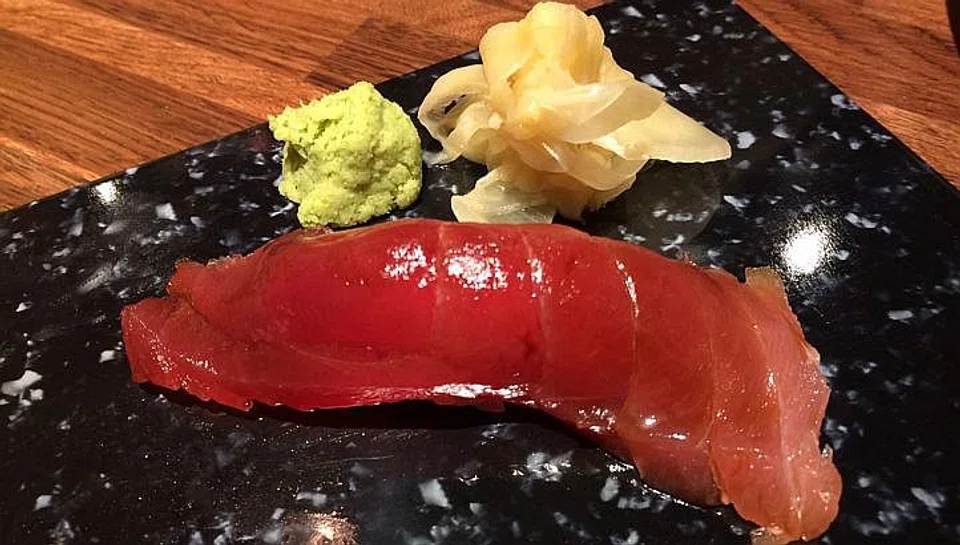
He, on the other hand, knows a guy who knows a guy in Japan who gets his hands on wild caught tuna, the flesh of which is glistening, firm and almost chewy - as he demonstrates by laying a generous long slice over a tiny portion of rice for you. It doesn't have a lot of flavour, but we like the clean freshness and the story - be it tall or short - behind it.
Unlike other local sushi outfits, chef Chee doesn't follow the usual routine of offering a few pieces of passable sashimi and sushi and following up with a roll call of grilled and cooked items to make up the low price and cover up the lack of true freshness in their repertoire. The bulk of his menu is raw, and even if it isn't stellar quality, you have to appreciate the effort he puts into sourcing the best that he can.
He kicks off with a fat fresh oyster, naked except for a lemon wedge and a smidgen of spicy grated daikon. All you need is a drop of juice to enjoy the meaty creamy specimen. Then, he surprises with a generous slice of shima aji that dwarfs the rice it's draped over, continuing with equally large - albeit not the most skilfully cut - slices of hamachi, scallop and the aforementioned bachi - the wild caught big eye tuna.
The only oddity we're not sure that we like is what he calls shiro maguro, or white tuna. We first see it in his display case - an unnatural looking block that could either come from a real fish or a fishcake factory. It turns out to be home-smoked cod and it tastes like a bland white fish that nipped out for a quick Marlboro light. But chef Chee says his high-end stockbroking regulars love it, so what do we know.
We're less ambivalent about his uni - which is a rich, very fresh bafun (as opposed to the more prized murusaki) without that strong, "off"-tasting tang this specimen is known for. And his otoro - seared with a blow-torch on one side to burn off the excessive fat - is too cold on the bottom and cloyingly oily, but in terms of sheer size of the fish, you can't complain.
What we don't like is the sushi rice. It's tasteless with no hint of seasoning, but it might be his way of showcasing the purity of the water he uses to cook the rice in. There's an oxygen tank-like contraption in one corner that he says he personally carried back from Japan, which supposedly turns our piped water into soft spring water. He pours us a glass and it is nice. But nice could be better if he added a little more salt, vinegar and mirin to the cooked grains.
Of the few cooked options he offers, there is familiar dobinmushi or teapot soup, made by boiling down fresh fish bones into a sweet, nourishing broth that's better than garden variety dashi which is just reconstituted bonito flakes. And he does a very credible grilled wagyu tongue and beef on a skewer. The tongue is tender enough that it almost has the texture of lightly cooked kidney - so if you like both that's a double treat. The Tajima wagyu cubes are thick and chewy but good.
Chef Chee is a latecomer to the local scene compared to his peers - he comes from the batch of chefs mentored by veteran Yoshio Nogawa, but spent more than a decade working in Switzerland and then in China before coming back to Singapore to start Standing Sushi Bar. He implies that he's just laying the groundwork for Chotto Matte before one of his "boys" takes over. But like his peers, he subscribes to the notion that good sushi doesn't have to be overpriced, and he's putting his money where his mouth is with his $100 omakase - it isn't a lot of food but you're full by the end.
Still, is it good enough to swing voters to his side of the sushi divide? It may take a little longer than Chotto Matte would imply, but when he does, it won't be a moment too soon.
Rating: 6.5
WHAT OUR RATINGS MEAN
10: The ultimate dining experience
9-9.5: Sublime
8-8.5: Excellent
7-7.5: Good to very good
6-6.5: Promising
5-5.5: Average
Copyright SPH Media. All rights reserved.
TRENDING NOW
Simba admits exceeding spectrum limits amid failed M1 deal; full-year profits surge 277%

He built the Vingroup empire. Now South-east Asia’s richest man is handing some key roles to his sons
What’s on the agenda when Xi and Trump meet in Washington

Ex-execs of CW Group, Allied Tech charged with offences linked to lawyer’s S$76 million misappropriation

