A taste of sustainable drinking at Fura
The ‘future-forward’ gastropub incorporates planet-friendly ingredients in its cocktails

THE phrase “future food” might conjure up images of liquid nitrogen and technological frills, but at gastrobar Fura, the key to the future is sustainability.
Nestled on the second floor of an Amoy Street shophouse, Fura’s central culinary concept focuses on using readily available ingredients with a low carbon footprint, such as legumes, fungi and locally produced fruit and vegetables.
Sasha Wijidessa, Fura’s co-owner and the curator of its drinks menu, said: “A lot of the way we eat and drink in Asia is very generational – we have the same diet that our mothers and grandmothers did. However, our food resources are very different now from 50 years ago, and we are also feeding an increasing population.”
It would not be sustainable to raise more livestock and fish more, she said. “We wanted to use our space to introduce a new way of eating and drinking that makes sense for the climate we are in now.”
Trained in pharmaceutical science, she had initially planned to become a dentist, but changed her mind after a part-time stint at a pub while she was a student. She was part of the founding team of former speakeasy Operation Dagger, and eventually became its head bartender. She then left to do product development at Copenhagen-based distillery Empirical.
In the Danish capital city, she met Christina Rasmussen – who used to be head forager at world-renowned Danish restaurant Noma. In her foraging trips in Denmark’s wilderness, Rasmussen had seen the damage done to the environment by human activity.

The two became partners and, with a shared interest in sustainability and their complementary expertise in drinks and cooking, decided to open a gastrobar in Singapore after Wijidessa’s role with Empirical required her to relocate to Asia.
They tested the concept with pop-up plant-based bar Mallow, which had a nine-month run at InterContinental Robertson Quay from February 2022. Building on feedback from patrons, they launched Fura last October, with a menu titled “A Journal of Future Food”.
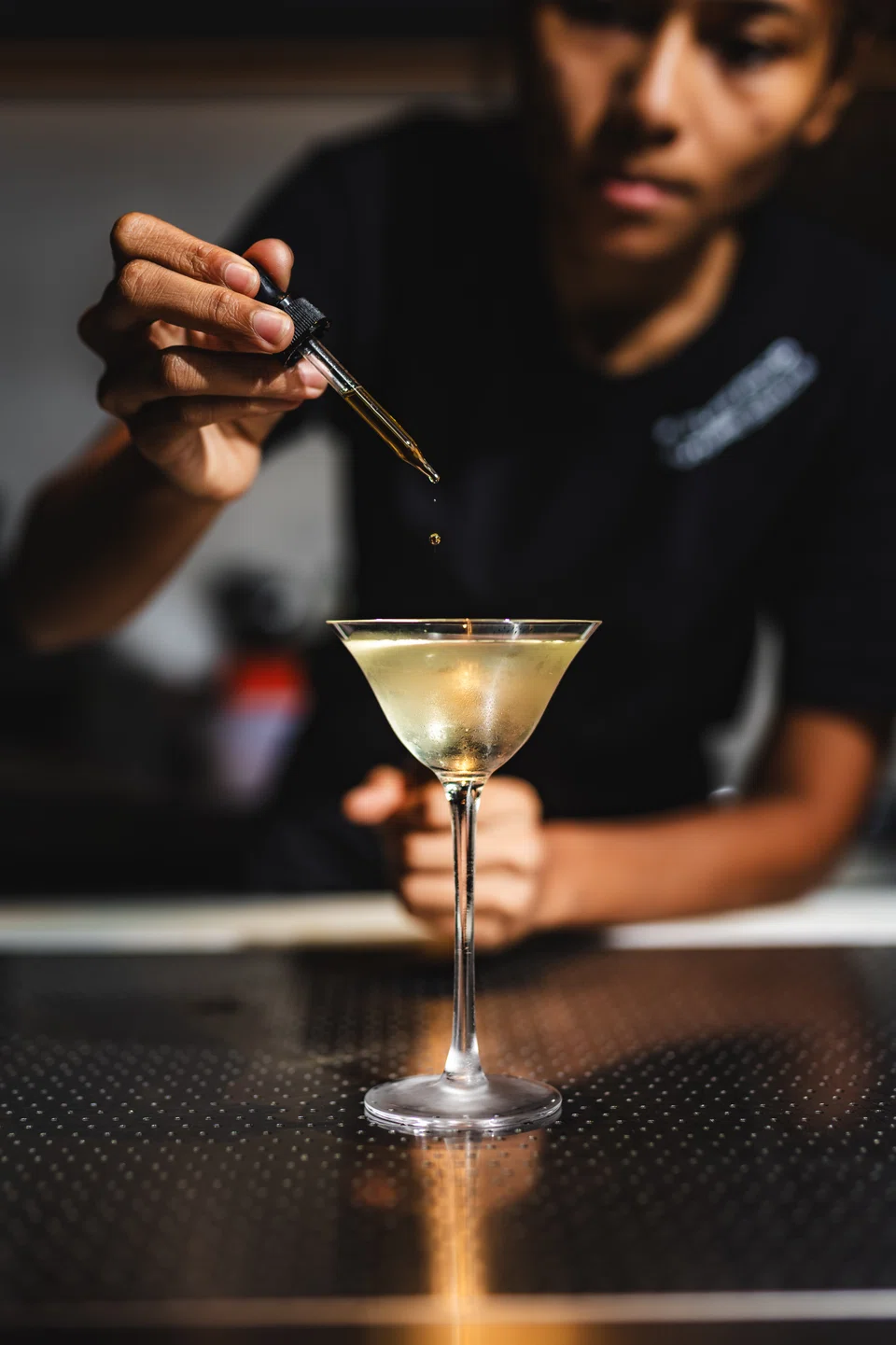
One highlight is the Jellyfish Martini, a dry martini that incorporates an invasive species of jellyfish. Gin is infused with jellyfish arms, creating an “ocean-y, savoury” freshness, said Wijidessa.


Added Rasmussen: “It encompasses exactly what we’re trying to do – highlighting ingredients that are either abundant, invasive or prevalent, all in one concise drink, and in a classic format that resonates with people.”
Many of Fura’s cocktails use “future food” ingredients that are more sustainable than traditional ones. About half are based on the one-of-a-kind spirits created by Empirical.
Instead of cow’s milk – as livestock-rearing results in significant carbon emissions – Got Milk?, a Fura cocktail, uses cell-cultured milk produced in bioreactors, along with pandan and honeydew juice, with a base of the fruity Empirical Soka spirit.
Tiramisu-esque Pick Me Up, with a smoky Empirical Ayuuk base, uses Fura’s coffee alternative – made from roasted burdock root, pu’er tea and toasted malt grains – instead of coffee beans, the production of which is water-intensive and may involve ethical sourcing issues.
Another section of the drinks menu, Ugly Delicious, finds “alternative ways to use ingredients rather than letting them go to waste”, said Wijidessa.
Local online grocer freshveggies.sg supplies Fura with blemished fruits and vegetables that cannot be sold and would otherwise be thrown away. These are then fermented in-house to create wine.
“Fermentation creates new flavours that cannot be found otherwise,” added Wijidessa.
The food menu, designed by Rasmussen, similarly incorporates planet-friendly options such as insect proteins and cell-cultivated meat, as well as ingredients abundant in South-east Asia, such as gongura, fish leaf and borage – all leafy vegetables – grown by local hydroponic farms like GreenLoop Farms.
“These ingredients can be quite intimidating, so we want the workspace to be transparent to create a better connection with our customers,” said Wijidessa. To that end, Fura has an open kitchen and bar, with a lower-than-usual counter for a more “at-home” feeling.
“Ultimately, we hope the takeaway from the menu is that our customers will be a bit more conscious in their consumption choices.”
Jellyfish Martini
47.5 ml jellyfish-infused gin 12.5 ml fish leaf distillate 10 ml green spirulina vermouth Garnish with three drops of roasted kombu oil
Decoding Asia newsletter: your guide to navigating Asia in a new global order. Sign up here to get Decoding Asia newsletter. Delivered to your inbox. Free.
Copyright SPH Media. All rights reserved.