

The themes of this 'Monkey Business'
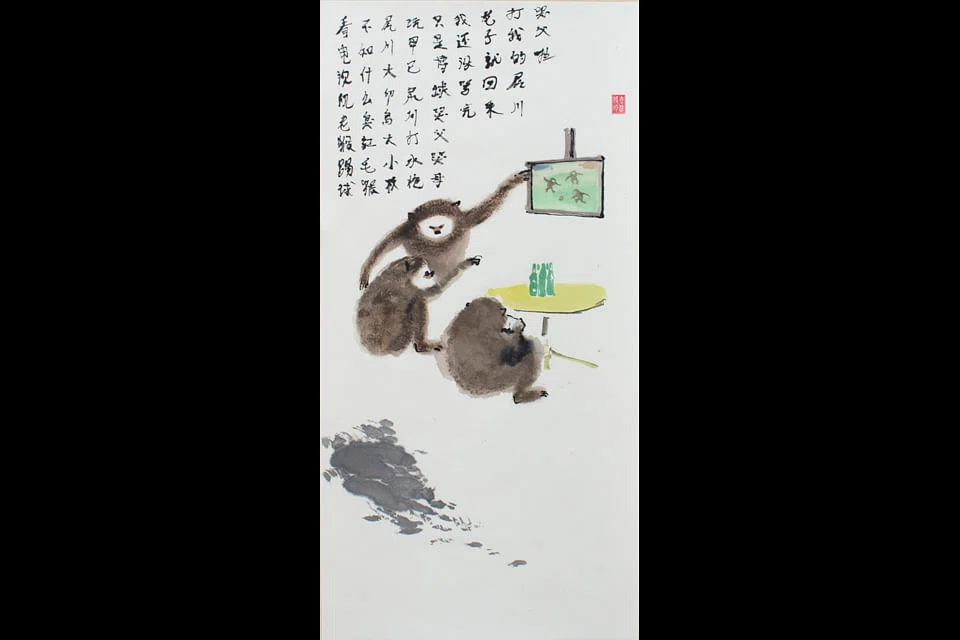
Monkey see, monkey do. That pretty much explains artists Justin Loke and Samuel Chen who literally go ape over primates in their latest works.
Titled "Monkey Business", the paintings on the walls look very much Chen Wen Hsi-inspired - until you see the furry gibbons taking on "human business" instead.
Yes, that would be the papa/mama gibbon taking their backpack-toting kids to school, or apes queuing up to buy 4D, watching TV, or even just lounging about with cigarettes in their fingers.
There are also Chinese poems at the corners of the paintings, very much like how Chen - a first generation Nanyang artist known for incorporating local culture into traditional Chinese painting - would have executed his paintings.
Not that the two youthful artists are taking the mickey out of the Singapore master. In fact, it's a homage because Chen Wen Hsi is so widely recognised and also revered.
Borrowing the gibbon motif, says Chen, is a statement they're trying to make. It's about art as a commodity and whose name is on - or not on - it, points out Loke, 37, who is also a member of the art collective Vertical Submarine. He and Chen, 27, with whom he'd collaborated before on okto channel's "Watch This Space Season 2", came up with this concept.
"Monkey Business" is also billed a "group" show because Loke and Chen commissioned unnamed artists to paint the works. "So we don't say who created the work," explains Loke. This leads to the question of Chen Wen Hsi fakes - as the late artist's works are widely forged because of the market rate he commands.
"We wanted to deliberately upset the usual art-making and production process," Loke adds. In the process, the instruction given to the group of artists is to be spontaneous in their work - so it's clear that they simply derive from Chen's style rather than follow his technique religiously.
"This is a parody of Chen's works, and we wanted to make that obvious. We didn't want to make the works very refined - and even the poems themselves aren't lyrical or written in beautiful calligraphy."
"Monkey Business" is also a statement of how many Singaporeans - such as Loke and Chen - are detached from this culture of traditional Chinese painting.
While there is a tongue-in-cheek element, Loke says he'd like to downplay that in favour of a serious question they're posing - such as how society attaches a value to what is "real".
"Some forgeries can be very good. There's no real science in how experts figure out real and fake paintings from just looking at technique and so on," Loke points out.
More than the final artworks themselves, Chen says, it's about the narrative they've created. "And we also try not to take ourselves too seriously."
Share with us your feedback on BT's products and services
TRENDING NOW
If Europe goes to war, the fallout will be felt in East Asia

Government to bring forward raising of retirement age, give employers more financial support to create flexi-load jobs
Indonesia stocks suffer worst plunge in nearly 30 years as MSCI proposes standalone status
Mapletree Industrial Trust posts 6.6% drop in Q2 DPU to S$0.0297

