Is there life on Mars? Maybe, and it could have dropped its teddy
 Add BT as a preferred source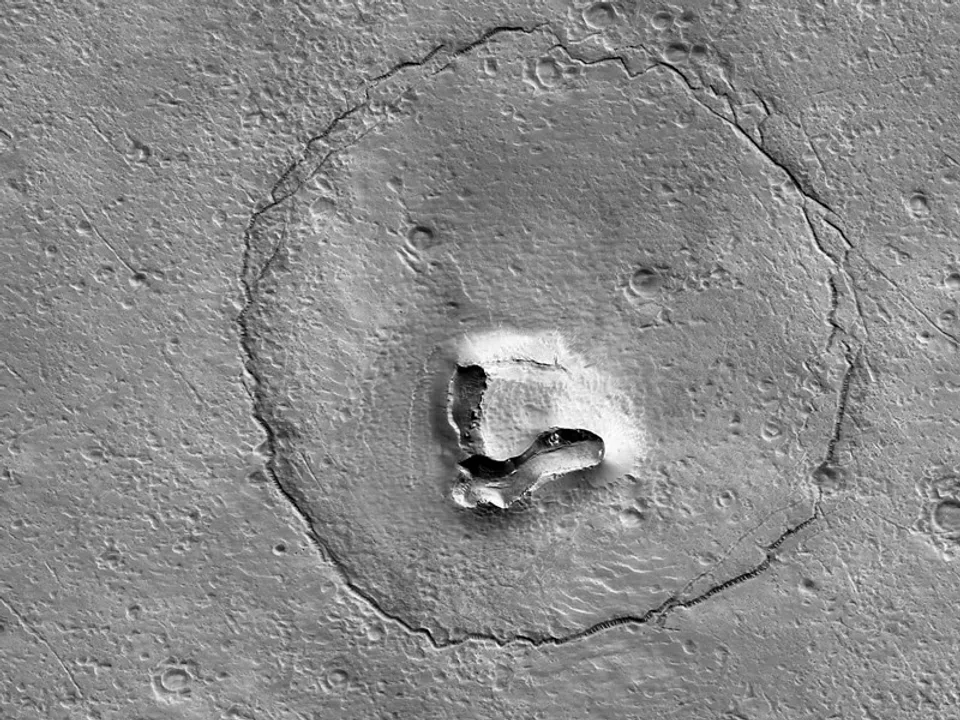
DeeperDive is a beta AI feature. Refer to full articles for the facts.
YOGI, Paddington and Winnie the Pooh move over. There’s a new bear in town. Or on Mars, anyway.
The beaming face of a cute-looking teddy bear appears to have been carved into the surface of our nearest planetary neighbour, waiting for a passing satellite to discover it.
And when the Mars Reconnaissance Orbiter passed over last month, carrying aboard the most powerful camera ever to venture into the Solar System, that’s exactly what happened.
Scientists operating the HiRISE (High Resolution Imaging Science Experiment), which has been circling Mars since 2006, crunched the data that made it back to Earth and have now published a picture of the face.
“There’s a hill with a V-shaped collapse structure (the nose), two craters (the eyes), and a circular fracture pattern (the head),” said scientists at the University of Arizona, which operates the kit.
Each one of the features in the 2,000-metre-wide face has a possible explanation that hints at just how active the surface of the planet is.
Navigate Asia in
a new global order
Get the insights delivered to your inbox.
“The circular fracture pattern might be due to the settling of a deposit over a buried impact crater,” the scientists said.
“Maybe the nose is a volcanic or mud vent and the deposit could be lava or mud flows?”
HiRISE, one of six instruments aboard the Orbiter, snaps super-detailed pictures of the Red Planet helping to map the surface for possible future missions, either by humans or robots.

Over the last ten years, the team has managed to capture images of avalanches as they happened, and discovered dark flows that could be some kind of liquid.
They’ve also found dust devils twirling across the Martian surface, as well as a feature that some people thought looked a lot like Star Trek’s Starfleet logo.
One thing they have not found, however, is the little green men who were once popularly believed to inhabit the planet. AFP
Decoding Asia newsletter: your guide to navigating Asia in a new global order. Sign up here to get Decoding Asia newsletter. Delivered to your inbox. Free.
Share with us your feedback on BT's products and services