

These European cities say they have too many tourists. Why are their airports growing?
Airports generate government revenue, but their growth hinders efforts to restrain overtourism
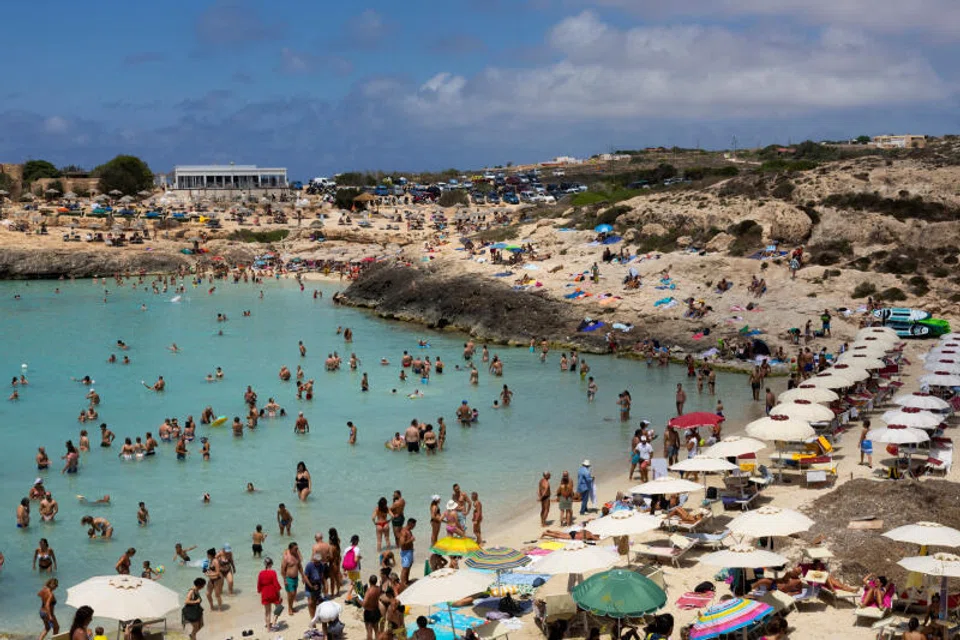
OUTSIDE the Santa Lucia train station in Venice this summer, officers equipped with QR scanners stopped visitors to make sure they had paid the day-tripper fee intended to curb overtourism.
Yet just miles away, construction was underway on an expansion at Marco Polo Airport, which will eventually serve 20 million passengers a year, up from 11.6 million.
Venice is hardly alone in this paradox. Across Europe, airports are expanding to meet growing travel demand, even while the cities they serve struggle to contain the flood of visitors with tourist taxes, short-term rental bans and carbon-reduction initiatives.
For example, in Amsterdam, Schiphol Airport is building a 592,000 sq ft boarding gate area that will open in 2027. An ongoing expansion at Athens International will increase its capacity from 26 million to 40 million passengers a year.
And in Barcelona, where a new commissioner for sustainable tourism is rolling out policies to diminish tourists’ impact on residential life, the Spanish airport authority’s plans to expand El Prat Airport prompted opponents to schedule a demonstration for Sep 20.
“It definitely is a contradiction,” said Alex Chapman, head of economic and environmental policy at the New Economics Foundation, a progressive British think tank in London.
“There are cases like Barcelona where you have got a population that is almost on the streets in revolt at what they perceive to be unsustainable and unfair tourist-industry practices. To be proposing another huge expansion of the airport alongside that is just really hard to reconcile.”
Competition from within
The clashing efforts stem from competing authorities. In general, national governments in Europe oversee their airports, while the areas most affected by overtourism, like housing and sanitation, fall under the purview of municipal or regional authorities.
As citizens have begun protesting tourism’s impact, those local governments have been obligated to respond.

“But the most they can do is reduce the number of accommodations or impose a tourist tax,” said Tolo Deya, the dean of the tourism school at the University of the Balearic Islands in Spain.
“Whereas controlling or reducing the number of flights is in the hands of the central government.”
And for central governments, Deya added, “airports are a very important source of revenue”.
Although more flight connections can boost the economies of countries such as Italy that receive a lot of tourists, Chapman said, “you are also bringing a lot of other social costs”, such as housing shortages and pollution.
In an effort to reduce noise and other disruptions for residents near Amsterdam’s airport, the Dutch government in 2025 capped Schiphol flights at 478,000 annually, but that cap was overturned in court.
On Sep 9, a new one, which will allow flights to gradually increase to 500,000 so long as noise and environmental restrictions are upheld, received preliminary approval from the Dutch Council of State.
According to Stefan Donker, a Schiphol spokesperson, the additions underway at the airport are not intended to increase flights but rather to meet the reality of the increasing number of passengers, which has grown to 70 million from 42 million in the past 20 years.
For many airport management companies, expansion projects enable modernisations such as updating baggage handling systems, improving energy efficiency, and installing new technologies like Europe’s entry-exit system, which went into effect this summer.
But the companies also say that their obligation is to adapt to the increase in travel, not regulate it.
Aena, the public-private company that manages Spain’s major airports, is planning to expand not only Barcelona’s airport but also those in Madrid, Malaga and Bilbao. “Airports, like any infrastructure, cannot be the controller of demand,” Maurici Lucena, Aena’s president, said.
Airport growth can erode the effectiveness of local efforts to restrain overtourism and can even enable more tourists to come, experts say.
“When you look at Mallorca, for example, the number of hotel beds has been frozen for many years, and vacation rentals are strictly controlled,” Deya said. “But the number of arrivals keeps going up.”
A struggle for balance
Mallorca is one of the hot spots of tension between local and national authorities. Crowded public spaces, bad behaviour from tourists and lack of affordable housing have prompted protests for three successive summers (one in July drew 25,000 to the streets of Palma).
At the same time, 2024 and 2025 saw record numbers of passengers arrive at the island’s airport, and 2026 is on track to surpass those figures.
Like many airport construction projects, Mallorca’s has been cast as a renovation rather than a physical expansion. But Margalida Prohens, the region’s president, said she learned in 2026 that Aena was also increasing the number of gates.
She has since complained to Spanish Prime Minister Pedro Sanchez about the lack of coordination. “It cannot be that while local institutions are working together on a strategy to contain tourism on our islands, Aena plans for continual growth,” Prohens said.
In an attempt to gain a voice in the process, the Balearic regional parliament passed a bill in the spring intended to grant it greater power over airport management.
Other local authorities also want a voice. In Lisbon, where tourists and digital nomads have priced locals out of the city’s housing, Humberto Delgado Airport, near the city centre, is undergoing an expansion while a new and larger airport, some 32 km away, is planned for 2034.
“Noise, air quality, mobility, land use and quality of life are all local concerns,” said Lisbon mayor Carlos Moedas, who supports both airport projects for their economic benefits but wants to see them carried out in a “balanced” way.
“Lisbon’s residents must have a voice in decisions that affect them.”
And then there is climate change
Overtourism is not the only contradiction.
A study released Sep 15 by Transport and Environment, a climate advocacy organisation based in Brussels, shows that planned expansions of the 20 largest airports in Europe will cause their host countries to surpass the national carbon budgets required to hold global warming to 1.7 degree Celsius.
Denmark, whose Climate Act legally binds it to a 70 per cent reduction in carbon emissions by 2030, has positioned itself at the forefront of the climate fight.
Yet Copenhagen Airport, which is owned by the Danish government, is building a 645,000 sq ft extension to its terminal that critics say will increase pollution in the urban neighbourhoods nearby and worsen its carbon footprint.
“You have a government who is using our climate green politics as a diplomatic branding strategy across the world,” said Leila Stockmarr, a member of Parliament and transportation spokesperson for the left-wing Enhedslisten party.
“And you have the state going through with the expansion project, which means that the government, de facto, earns a profit from undermining its own green politics.”
In Barcelona, pressing concerns about both overtourism and climate impact are behind the protest planned for Sep 20 against the airport’s expansion, which is awaiting final approval from the Spanish government. (Airport expansion protests are also planned in Mallorca and Ibiza.)
“At a critical moment in all the crises we confront,” said Daniel Pardo, an activist whose neighbourhood group belongs to Zeroport, a consortium that is organising the demonstration, “this decision is going to shape Catalonia’s economic model for the next 20 years.” NYTIMES
Decoding Asia newsletter: your guide to navigating Asia in a new global order. Sign up here to get Decoding Asia newsletter. Delivered to your inbox. Free.
Share with us your feedback on BT's products and services
TRENDING NOW

DBS, OCBC, UOB rout lops billions off STI as inflation, rate concerns spook investors

Grab CEO’s wife Chloe Tong on life with Anthony Tan and finding her purpose

OCBC sheds S$8 billion in value as shares close nearly 6% down; analysts cautious on banks

Deal between tycoon friends sparks scrutiny of Philippine power sector

