

Business travel faces hit even post-pandemic; ESG is another factor

Singapore
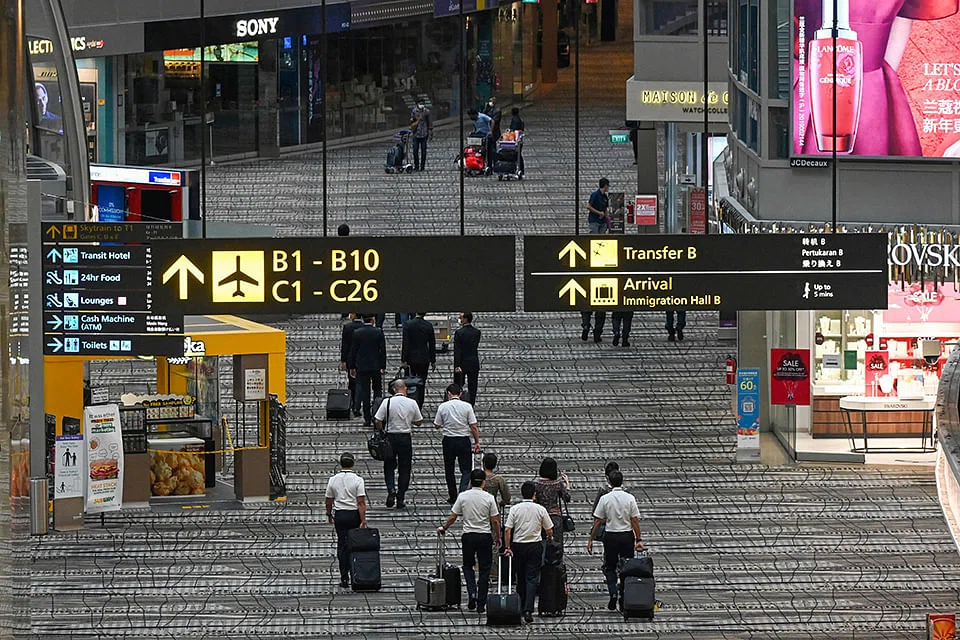
AS corporates become accustomed to video-conferencing and appreciate its benefits, market watchers expect this to hit the demand for business travel when it is safe to fly again.
Also, climate concern could be a broader impetus for organisations to reduce business travel as part of their environment, social and governance (ESG) initiatives.
However, observers are unable to project the quantum of decline in business travel.
Ernst & Young Asean's workforce advisory leader Samir Bedi told The Business Times that he thinks airlines will lose a percentage of business travel because "we have learned new ways to do it (business) virtually".
But he is unable to state how much lower business travel will be post-pandemic as it depends on the organisation itself, which will weigh the cost and return of staff doing business travel.
He sees video-conferencing likely to replace business travel to a certain extent for internal meetings, but less so for meetings with clients. He noted that in-person meetings could help parties develop relationships as one has the opportunity to observe the prospect's body language and modify one's pitch if necessary.
Shukor Yusof, founder of Aviation consultancy Endau Analytics, said business travel will take a while to recover post-pandemic - if at all. According to him, the economic situation in the United States and Europe will stay stagnant, or even decline, thereby affecting the appetite for long-haul business travel.
Some carriers are expecting business travel to resume to pre-Covid levels in three to four years' time, but Mr Shukor doubts this as certain global financial and social indicators suggest the next few years will be excruciatingly painful for many corporates and countries.
Ram Lakshminarayanan, advisory partner at KPMG in Singapore, expects travel to Europe and North America to reduce drastically and it is highly likely that it may never return to pre-pandemic levels.
"Bill Gates has predicted a 50 per cent reduction in travel while a recent study shows that there will be a permanent reduction between 20 per cent (and) 30 per cent in global business travel. As such, we do anticipate more stringent health declaration requirements when travelling between countries to have a bearing on people's interest to travel," he noted.
Mr Lakshminarayanan also thinks that overseas training and seminars will reduce significantly while travelling for business development is likely to return.
He, however, anticipates significant demand for business travel within Asia though it may take a while for the situation to return to pre-pandemic levels. He noted the culture of doing business in Asia is underpinned by strong personal relationships that cannot be replaced easily by virtual meetings.
Relationships aside, a study from Harvard's Growth Lab has interestingly identified business travel as a driver of economic growth. It noted moving knowhow - the tacit knowledge accumulated and transferred from brain to brain through a long process of imitation, repetition, and feedback - is critical to economic growth, and business travel plays a key part in that process.
Rico Merkert, professor of transport at the University of Sydney, thinks much of the drop in business travel will be temporary. "Perhaps it will not bounce back 100 per cent to where it was with lots of corporates now using technology more intensely when communicating with clients, partners and suppliers," he said. "But even if it bounces back 80-90 per cent, FSCs (full-service carriers) should be fine mid to long term."
The revenue FSCs derive from corporate travellers could be as much as 40 per cent.
The charter market has not suffered nearly as much as the traditional airline market, observed Prof Merkert. Some corporate travellers are still flying and they pay more for it than before, but they seem to have a preference for privacy and safety to avoid crowds.
The academic said: "If the traditional carriers can satisfy or address that demand once the majority of the global population is vaccinated, then they should be back in business."
Mainboard-listed Sembcorp Industries is one company that expects its staff to travel less, having learnt to work better remotely. The conglomerate has to date conducted over 180,000 virtual meetings.
"When it is safe to travel internationally again, some essential business travel will resume, though likely at a lower level compared to pre-pandemic days," said its spokesperson.
Ernst & Young Singapore and Asean's managing partner Max Loh said his firm has a new global ambition to be carbon negative in 2021, with one of the key elements being to reduce business travel emissions by 35 per cent by FY25 against a FY19 baseline.
Mr Loh added: "This does not mean that we will cut out business travel completely. During the pandemic, leveraging our continued investments in technology and business transformation, EY teams have implemented workplace changes, including flexible working and increased use of remote working technologies.
"As the pandemic eases and travel resumes, we will do so as well, but in a balanced way - taking advantage of the new and innovative ways of working and hybrid models of virtual and in-person collaboration."
Sam Kok Weng, markets leader at PwC Singapore, said the firm is relooking its way of doing business since it made a global commitment to be net zero greenhouse emissions by 2030. The pandemic has, he said, led the firm to put more attention on the health and safety of its clients, staff and the wider community, as well as accelerate its focus on sustainability, including its ESG goals.
Mr Sam noted: "Our air travel policy is being reviewed with these two factors in mind."
Other companies have yet to come to a final decision on the level of business travel in future, though. Deloitte & Touche is one such firm that is reviewing its policy, while OCBC will adapt its approach accordingly when border controls ease.
Francisco John Celio, head of group corporate security at OCBC, said it has not changed its pre-pandemic approach, that is, it has always been on a need-to basis, where physical presence is required, and the safety of its staff.
He stated that staff are currently only allowed to travel internationally for business-critical purposes only, such as closing contracts and special investigations that are time-critical.
In countries where there is heightened risk, it has also imposed appropriate restrictions for domestic business travel.
TRENDING NOW

If Europe goes to war, the fallout will be felt in East Asia
Shanmugam urges CEOs to let firms be assessed for haze links; government to table changes to haze law

Indonesia stocks suffer worst plunge in nearly 30 years as MSCI proposes standalone status

Keppel seeks US$1 billion for Vietnam investments as it joins country’s international financial centre

