

UK spy thriller author John le Carre, 89, dies
 Add BT as a preferred source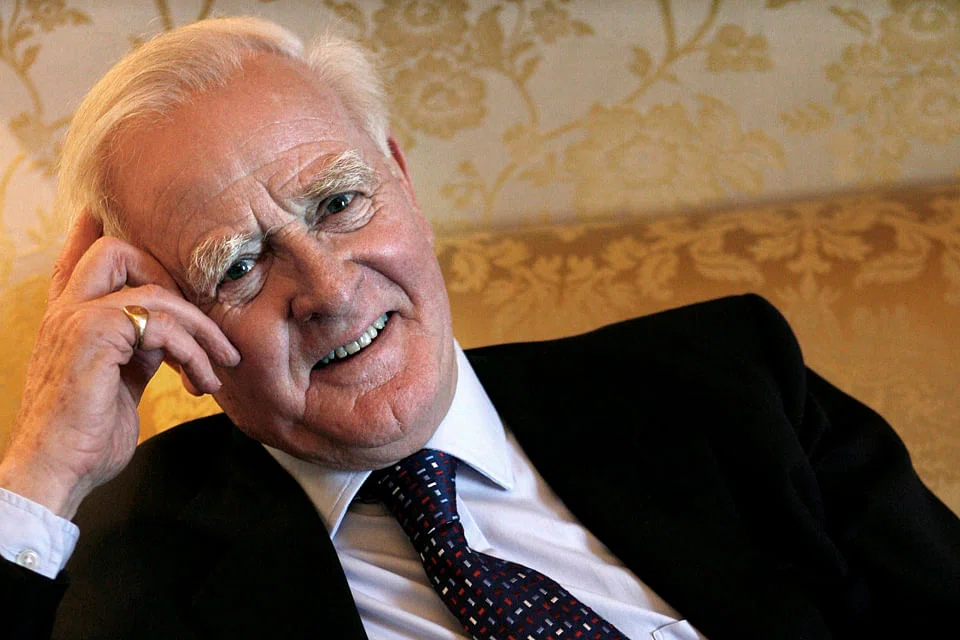
London
JOHN le Carre, the British novelist who captured the cloak-and-dagger intrigue of Cold War espionage in best-selling books such as The Spy Who Came In From the Cold and Tinker Tailor Soldier Spy, has died. He was 89.
A former spy with UK intelligence agency MI6, le Carre wrote more than 20 books in a career spanning six decades. His tales of treachery, betrayal and duplicity made George Smiley one of the genre's most well-known secret agents through novels by "the pre-eminent spy writer of the 20th century", as le Carre was once described in the New York Times.
Le Carre died on Saturday evening in Cornwall, where he lived. His wife of nearly 50 years, Jane, and sons Nicholas, Timothy, Stephen and Simon, said in a statement he died from pneumonia after a short battle with the illness."We all grieve deeply his passing," they said, thanking staff at the hospital in Cornwall, south-west England, for their care. "We know they share our sadness," they added.
The author, whose real name was David John Moore Cornwell, wrote 25 novels and one memoir in a career spanning six decades, selling some 60 million books worldwide. He was born on Oct 19, 1931. in Dorset, England, to Ronnie and Olive, though his mother, despairing at the infidelities and financial impropriety of her husband, abandoned the family when he was five years old. Mother and son would meet again decades later though the boy who became le Carre said he endured "16 hugless years" in the charge of his father, a flamboyant businessman who served time in jail.
At the age of 17, he left Sherborne School in 1948 to study German in Bern, Switzerland, where he came to the attention of British spies. After a spell in the British Army, he studied German at Oxford, where he informed on left-wing students for Britain's MI5 domestic intelligence service. He was a nom de plume adopted while he was working in diplomatic postings for the British government, which prohibited him from publishing under his own name. Le Carre was awarded a first-class degree before teaching languages at Eton College.
Navigate Asia in
a new global order
Get the insights delivered to your inbox.
He also worked at MI5 in London before moving in 1960 to the Secret Intelligence Service, known as MI6. Posted to Bonn, then capital of West Germany, he fought on one of the toughest fronts of Cold War espionage: 1960s Berlin. As the Berlin Wall went up, le Carre wrote The Spy Who Came in from the Cold, where a British spy is sacrificed for an ex-Nazi turned Communist who is a British mole.
Unwilling recipient of numerous awards
An unwilling recipient of numerous awards, le Carre didn't compete for literary prizes while accolades flowed from his peers. American writer Philip Roth called A Perfect Spy (1986) "the best English novel since the war", and UK author Graham Greene said his 1963 breakthrough work, The Spy Who Came In From the Cold, was "the best spy story I ever read".
"In the old days, it was convenient to bill me as a spy turned writer," le Carre wrote on his website. "I was nothing of the kind. I am a writer who, when I was very young, spent a few ineffectual but extremely formative years in British intelligence."
Le Carre's characters chronicled the amoral methods employed by Western and Communist-bloc intelligence services to expose double agents during the Cold War. The author, who made espionage terms such as "mole" and "honey trap" popular, adapted his plots after the 1989 fall of the Berlin Wall, giving them more contemporary settings. The Constant Gardener in 2001 linked corporate corruption to the murder of a UK diplomat's wife in Kenya, while 2008's A Most Wanted Man addressed the war on terrorism and money laundering after the Sept 11 attacks.
In his final work, Agent Running in the Field, published in 2019, le Carre's writing was more angry than in past novels. He channelled his deep indignation at Brexit and visceral dislike of the British government that enabled it to happen. Leaving the European Union was, according to the book, "an act of self-immolation" led by a "bunch of rich, elitist carpetbaggers posing as men of the people." And in describing the foreign secretary in the book as an "Etonian narcissistic elitist without a decent conviction in his body bar his own advancement", le Carre left little to the imagination about whom he was describing. Shortly before the book was published, Boris Johnson was UK foreign secretary.
The novelist Robert Harris called le Carre "one of those writers who really was not only a brilliant writer but he also penetrated popular culture - and that's a great rarity". Mr Harris told Sky News television le Carre was a "brilliant novelist" and said The Spy Who Came In From The Cold was a masterpiece. "It's an incredibly engrossing tale and very deep, and it transformed the writing of spy fiction. It was a brilliant, psychological portrait of spying and of betrayal and of the decline of British power."
Jonny Geller, le Carre's literary agent, called the author "an undisputed giant of English literature. His like will never be seen again, and his loss will be felt by every book lover, everyone interested in the human condition. We have lost a great figure of English literature, a man of great wit, kindness, humour and intelligence. I have lost a friend, a mentor and an inspiration." AFP, BLOOMBERG, REUTERS
Decoding Asia newsletter: your guide to navigating Asia in a new global order. Sign up here to get Decoding Asia newsletter. Delivered to your inbox. Free.
Share with us your feedback on BT's products and services
TRENDING NOW

Thai and Vietnamese farmers may stop planting rice because of the Iran war. Here’s why

US-China rivalry and the Kindleberger Trap: Why inaction – not escalation – is the biggest risk

Subaru e-Outback review: Japan’s best EV uses one key Chinese component

As Singapore squeezes, Malaysia tempts F&B operators across the Causeway

