SUSTAINABILITY

Understanding your ‘enough’: An economist changing lives

The winner of the Rolex Awards for Enterprise explains why her clothing brand is not about the label, or even its clothes 

Corinne Kerk
Published Thu, Mar 14, 2024 · 06:00 PM
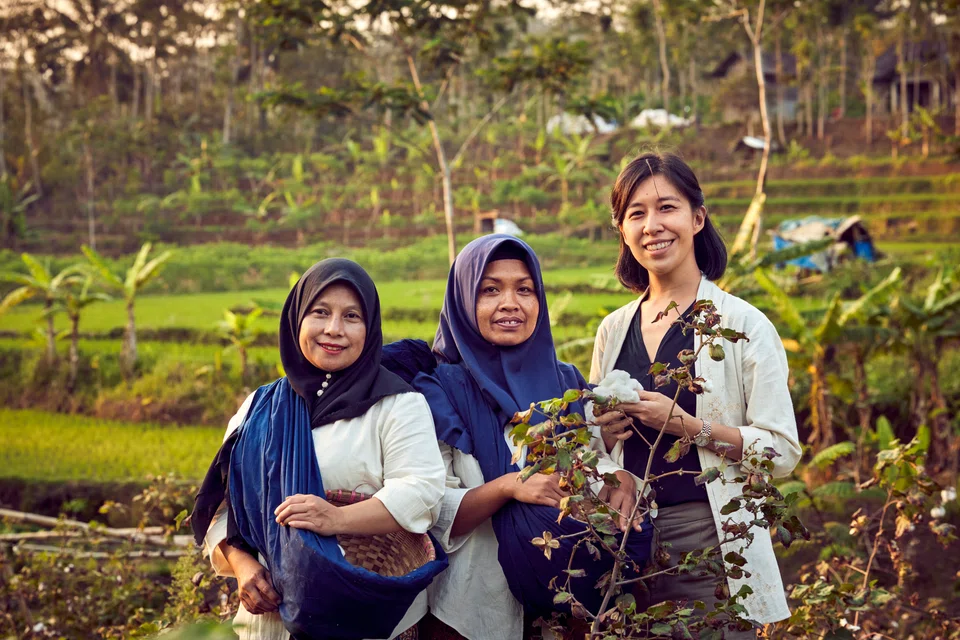
    • Rolex Awards for Enterprise laureate and founder of SukkhaCitta Denica Riadini-Flesch (extreme right) holding cotton harvested on a farm near Central Java, Indonesia, by two local women.
    • Rolex Awards for Enterprise laureate and founder of SukkhaCitta Denica Riadini-Flesch (extreme right) holding cotton harvested on a farm near Central Java, Indonesia, by two local women. PHOTO: ROLEX/SEBASTIEN AGNETTI

    DENICA Riadini-Flesch runs SukkhaCitta, a social enterprise selling handmade apparel. She considers the business a success if it helps people downsize their closets, so they keep only the pieces that are meaningful to them, such as those that were handed down or bought from an artisan.

    This seemingly perverse logic is because her efforts are aimed at solving problems, not selling massive piles of clothes.

    “SukkhaCitta has never been about a brand. It’s never been about the clothes,” says Riadini-Flesch at a media interview on Wednesday (Mar 13), after having been named last month as one of five recipients of the Rolex Awards for Enterprise. The awards support individuals and organisations using science and technology to achieve a sustainable future.


    “It’s always been about how we change the way clothes are made, all the way from the farm to the closet. That’s so we can ensure that each choice supports the lives of those who made them, while at the same time healing our planet.”

    One of the world’s first regenerative farm-to-closet clothing supply chains, SukkhaCitta is centred on empowering rural artisans in Indonesia, using traditional and sustainable techniques to craft high-end products. PHOTO: ROLEX/SEBASTIEN AGNETTI

    It’s quite a departure for the former assistant professor, who graduated as an economist from Rotterdam’s Erasmus University. Riadini-Flesch returned to her native Indonesia to work as a development economist and consultant to the World Bank, only to be faced with an uncomfortable truth.

    “Artisans are forced to compete with machines printing fabrics that use their traditional motifs, but at a fraction of the cost,” she says. “Because of that, these women can’t earn a living out of it. A library of culture is burning before our eyes and we’re not even realising it.”

    Asean Intelligence

    Get insights into businesses across South-east Asia

    Get the free report

    It also dawned on her that these women in rural areas did not need aid. They have the skills and determination to change their own lives, but just need fair wages for their work.

    Finding happiness

    So in 2016, she founded SukkhaCitta (meaning “happiness” in Bahasa Indonesia), a farm-to-closet social enterprise that pays artisans a fair, living wage for crafting clothing that is sold directly to customers in over 30 countries through its website.

    Riadini-Flesch started by seeking out, living and working with craftswomen in villages. In the process, she also learnt about two other major problems facing the clothing industry – the use of toxic dyes, as well as unsustainable cotton-growing practices.

    Solutions were eventually found in the traditional farming techniques of the rural communities, where cotton is grown as part of a diverse ecosystem so crops no longer compete for the same nutrients, and soil health is restored. SukkhaCitta also began using 100 per cent natural dyes made from plants that it cultivates.

    SukkhaCitta uses only 100 per cent plant-based, natural dye on its garments. To get the colour blue, Strobilanthes cusia leaves are fermented in mountain spring water for 48 hours. PHOTO: ROLEX/SEBASTIEN AGNETTI

    Starting with three women, SukkhaCitta now works directly with more than 450 craftspeople and smallholder farmers, impacting over 1,500 lives. At its schools, women are taught traditional crafts and business skills.

    This model has been so successful that women working with the social enterprise have recorded a 60 per cent average increase in earnings. This has also encouraged a younger generation of rural craftswomen to take up traditional crafts, with the average age of the women going down from 60 to 28 years old since the company was started.

    Ibu Sri and Ibu Muntiani prepare a bath for dyeing fabrics in one of SukkhaCitta’s craft schools in East Java. The textiles hanging behind them have been decorated with a floral batik design. PHOTO: ROLEX/SEBASTIEN AGNETTI

    “It gives them pride, makes them realise the value of their worth as women, as artisans,” says Riadini-Flesch. “Now, they want a better life for their children and at the same time, they don’t want the children to leave their heritage. So we’re equipping the next generation of artisans to be financially literate, to elevate their quality, so the international market would buy, and to create a fully sustainable, farm-to-closet, rural, self-sufficient economy.”

    The brand is also the first fashion label in the world to be certified ethically handcrafted by Nest, a non-profit supporting the responsible growth and creative engagement of the artisan and maker economy. 

    Being self-sufficient

    With the help of the Rolex award, Riadini-Flesch plans to multiply her craft schools, digitise the training curricula and reach 10,000 lives by 2030. She is also working with international brands seeking to incorporate impact in their supply chain. 

    Riadini-Flesch with the batik craftswomen at one of SukkhaCitta’s craft schools, where women are taught traditional crafts and business skills. PHOTO: ROLEX/SEBASTIEN AGNETTI

    The numbers are impressive for the multiple award-winning SukkhaCitta and its founder. But the biggest hurdle – apart from the steep learning curve involved in establishing a clothing brand – was transforming mindsets.

    Given that people were used to “clothes being as cheap as your coffee”, they baulked at having to pay over S$100 for SukkhaCitta’s shirts.

    “But the true cost of our clothes is higher than what we pay in terms of the retail price,” she points out. “And somewhere, someone is paying for it: the women who can’t earn a living wage, the environment that’s polluted with toxic chemicals and deforestation. What we’re trying to do is internalise all these externalities, so that our prices reflect the true cost of making something the right way.”

    SukkhaCitta’s Ibu Kasmini, an Indonesian farmer who inherited her farming practices from her grandmother, using a spinning wheel to turn cotton into threads. Behind her, Ibu Karmini prepares the cotton. PHOTO: ROLEX/SEBASTIEN AGNETTI
    A woman embroiders flowers on fabric in one of SukkhaCitta’s craft schools in Central Java. PHOTO: ROLEX/SEBASTIEN AGNETTI
    Batik artisans draw intricate patterns on textiles using wax, so that when the clothes are dyed, a stark imprint of the design is left on the garment. PHOTO: ROLEX/SEBASTIEN AGNETTI

    Still, Riadini-Flesch is a realist.

    “The mistake that a lot of social entrepreneurs make is they forget the entrepreneurship aspect,” she says. “So from Day One, I wanted this to be self-sufficient and sustainable, that we weren’t just selling a sad story and asking for donations. Ultimately, consumers don’t buy sustainable products. You have to make sure you create things that solve their problems. And that’s how you create a sustainable model for change: you bring consumers into the equation.”

    Going on a different path

    What’s more, this is a blueprint that can be implemented in any industry.

    “We’re trying to show that a different path is possible. That it’s possible to run a successful business based on commercial merit, by empowering women, restoring biodiversity and funding indigenous communities through regenerative farming programmes.”

    Reflecting on her journey thus far, Riadini-Flesch says her training as an economist is the cause of many issues the world faces today.

    “We were trained to see that everything has to be efficient, everything has to grow and grow, onwards and upwards infinitely, without understanding that nature is finite,” she says. “But you cannot sustain infinite growth on a finite planet.”

    Riadini-Flesch (extreme right) in a cotton field near Central Java, Indonesia. PHOTO: ROLEX/SEBASTIEN AGNETTI
    Ibu Srikanthi drawing batik patterns in her home near one of SukkhaCitta’s craft schools in East Java. SukkhaCitta supports artisans who work from home so they can earn a living wage while caring for their families. PHOTO: ROLEX/SEBASTIEN AGNETTI

    The biggest thing she’s learnt is from the elder craftswomen – on what it means to live a fulfilling, meaningful human life.

    “We over-complicate things in our heads when in reality, it should be simple,” she concludes. “It should be about taking care of others and ensuring we take responsibility for any impact we create. It’s not in what we make or what we have. It’s really understanding what is your ‘enough’.”

    Decoding Asia newsletter: your guide to navigating Asia in a new global order. Sign up here to get Decoding Asia newsletter. Delivered to your inbox. Free.

    Copyright SPH Media. All rights reserved.