Venice and the memory of water
The essential ingredient of life is also a conduit for human connection
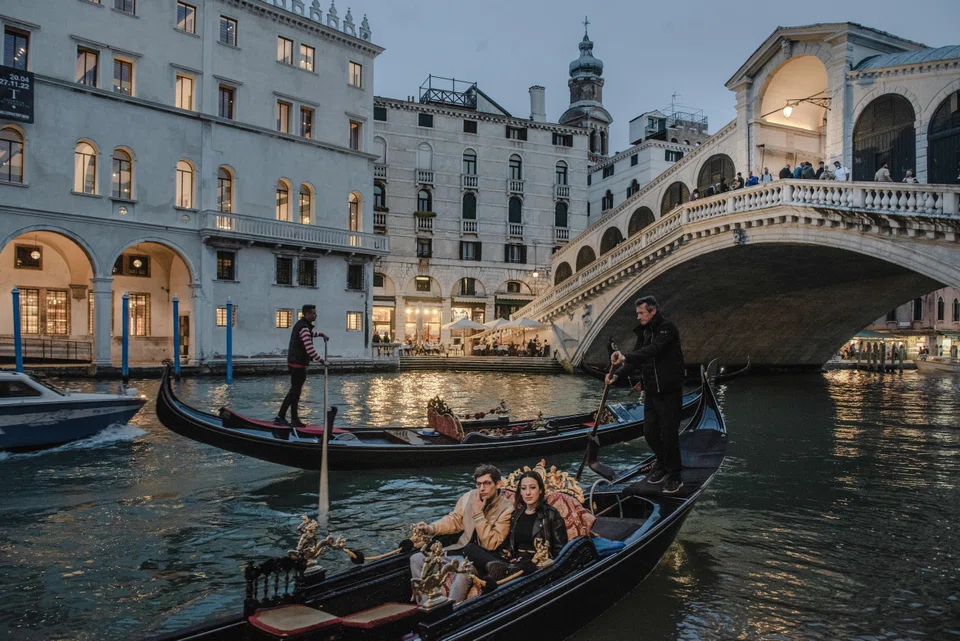
LAST week I was in Venice for the opening of the 60th Venice Biennale, titled Stranieri Ovunque (Foreigners Everywhere). There were indeed foreigners everywhere, and lots of thought-provoking encounters with art and with people.
It was an overwhelming trip. I am still processing a lot of my experiences, and I know they will seep into my writing over the next few months.
But while there, despite the crowded streets, the sudden cold, rainy days, and the queues to get into pavilions, I kept reminding myself that I was in Venice, this magical city that people have been walking and floating through since at least the fifth century.
Given the city’s more than 150 canals, it is hard to take two steps without a view of water. Like everyone else, I kept my eye on it: the way the surface could change suddenly when the sun peeped out of the clouds, or when illuminated by lights in the evening.
As someone who loves to be by the water, a stay in Venice is always dreamlike for me. And yet, I have never once in all my visits seen a single human body dipping or standing or playing in it.
As beautiful as the canals are, it’s illegal to swim in them, which is not surprising given all the boats and the fact that for centuries the sewage system was basic. But it did get me thinking about our relationship with water.
Whether or not we live close to rivers, seas, canals, or oceans, water is central to our own survival, but it’s striking how the amount of mental energy we give to thinking about water tends to be dependent on the precariousness of our access to it.
And this is so often related to where in the world we live. Humanity relies on the health of the rest of the natural world, yet how easy it is to forget that.
The 18th-century Venetian artist Giovanni Antonio Canal, known as Canaletto, was renowned for his paintings of his home city. His 1740 work The Grand Canal with S Simeone Piccolo, which is housed at the National Gallery in London, is such a quiet and serene image. Between the clear teal and grey coloured water and the soft blue sky, it is hard to tell exactly what time of day it is.
But the canal is busy enough with passenger boats and gondolas carrying Venetians going about the business of their day. The water is calm and clear and the pink facades on the left bank remind me of walls I placed my own palms against just a few days ago.
Having just recently walked around Venice, what intrigues me about this painting is how, if you were to replace the boats with modern versions, this image could have been painted recently.
In so many ways, Venice seems like a city lost in time.
And yet, as I stopped to watch the waterways again and again, I kept thinking about the claim made in the late 1980s by immunologist Jacques Benveniste that water holds memory.
The theory, in brief, is that water maintains patterns of whatever molecules have passed through it. Whether true or not, I like to think that water holds stories in its own unique way.
So walking through Venice, I kept trying to imagine all that these waters have seen and heard. If water holds memories and stories, are there ways we are all connected to one another through the bodies of water that feed into different parts of the world? Water as a conduit for human connection. I am smitten by the idea.
Langston Hughes’s poem, The Negro Speaks of Rivers begins: “I’ve known rivers: I’ve known rivers ancient as the world and older than the flow of human blood in human veins. / My soul has grown deep like rivers. / I bathed in the Euphrates when dawns were young. / I built my hut near the Congo and it lulled me to sleep. / I looked upon the Nile and raised the pyramids above it... ”
Here, Hughes makes a clear connection between his body, his self-understanding and the bodies of water that connect him to both his ancestral history and other histories of humanity.
It is another way of thinking about how water connects us and yet, given that Hughes is a descendant of enslaved people stolen from Africa, my mind is also drawn to how geography plays a role in our relationship to water.
In 2016, the contemporary American artist LaToya Ruby Frazier created a set of photographic images titled Flint is Family. One of the pictures, “Shea brushing Zion’s teeth with bottled water in her bathroom” is a seemingly innocuous photograph of a young girl, mouth open as she receives bottled water from an unseen hand.
I immediately think of the waters of life, how clean water nourishes and sustains us. But this image, along with the rest in Frazier’s series, is a poignant visual reminder that even something as fundamental as clean water, something we should all have equal access to, is not as commonplace as we think.
Frazier’s photographs were created to bring more awareness to the public health crisis suffered by the people of Flint, Michigan in the US. In 2014, drinking water in Flint became contaminated as a result of the city’s water source being changed from the Detroit River and Lake Huron to the Flint River.
Last week, while I was walking around the beautiful waterways in Venice, marked 10 years since the onset of the Flint water crisis, and people are still suffering the effects of having lived with a contaminated water source.
It might be tempting to think that Flint is a unique situation and far removed from the rest of the world. But in 2023, the UN World Water Development Report stated that more than two billion people globally do not have access to safe drinking water.
Frazier’s images were powerful, but her time spent creating these photographs also convinced her of the need to do more.
Her 2019 TED Talk about the water crisis garnered more than two million views, suggesting to me that many people are interested in learning about how water directly affects society. And, about the ways in which race and geography play into the dispersion and availability of safe water access.
Earlier this year I curated a group art exhibition at Hauser & Wirth gallery in New York about our human relationship with the rest of the natural world. The show was titled The Flesh of the Earth, and one of the pieces that repeatedly drew visitors’ attention was the 2023 sculpture Dark Water by German-born American artist Kiki Smith.
The artwork, forged in blue-coloured bronze, depicts the full figure of a woman held up by waves of water pouring out of her, so that it is impossible to tell where her body begins and the water ends. The two are combined to create a new being.
One of the reasons that Smith’s sculpture is so powerful is because it reminds me that our bodies grow and take shape in a sanctuary of fluid and that we begin our lives by being pushed out of a womb.
Smith’s art evokes the water deities that permeate cultures around the world. But it also reminds that for many people, through myths, stories and religions, water has been understood to be sacred, to be life-giving and sustaining, to be a site of both bodily and spiritual transformation.
It is encouraging to me that in recent years, some countries have granted new status to bodies of water that might protect them from harm and degradation.
In 2017, for example, New Zealand granted rights of personhood to the Whanganui River, respecting the beliefs of the ancestral people of the river.
And in 2019, Bangladesh also granted the status of personhood to all the rivers in the country.
Whatever the impact of such laws, their existence is an acknowledgement that we all have intimate relationships with sources of water, and the ways in which we care for or degrade them will eventually flow back into our own lives. FINANCIAL TIMES
Decoding Asia newsletter: your guide to navigating Asia in a new global order. Sign up here to get Decoding Asia newsletter. Delivered to your inbox. Free.
Share with us your feedback on BT's products and services