Timepieces from outer space
Among Urwerk’s pieces is one which tells time not in terms of hours, but by the rotational distance travelled by Earth at the Equator
MOST timepieces are inspired by worldly things, those found on planet Earth. The inspirations for Urwerk’s creations, however, are out of this world; they come from the wider universe. Yet, the designs of the watches remain very much down to earth.
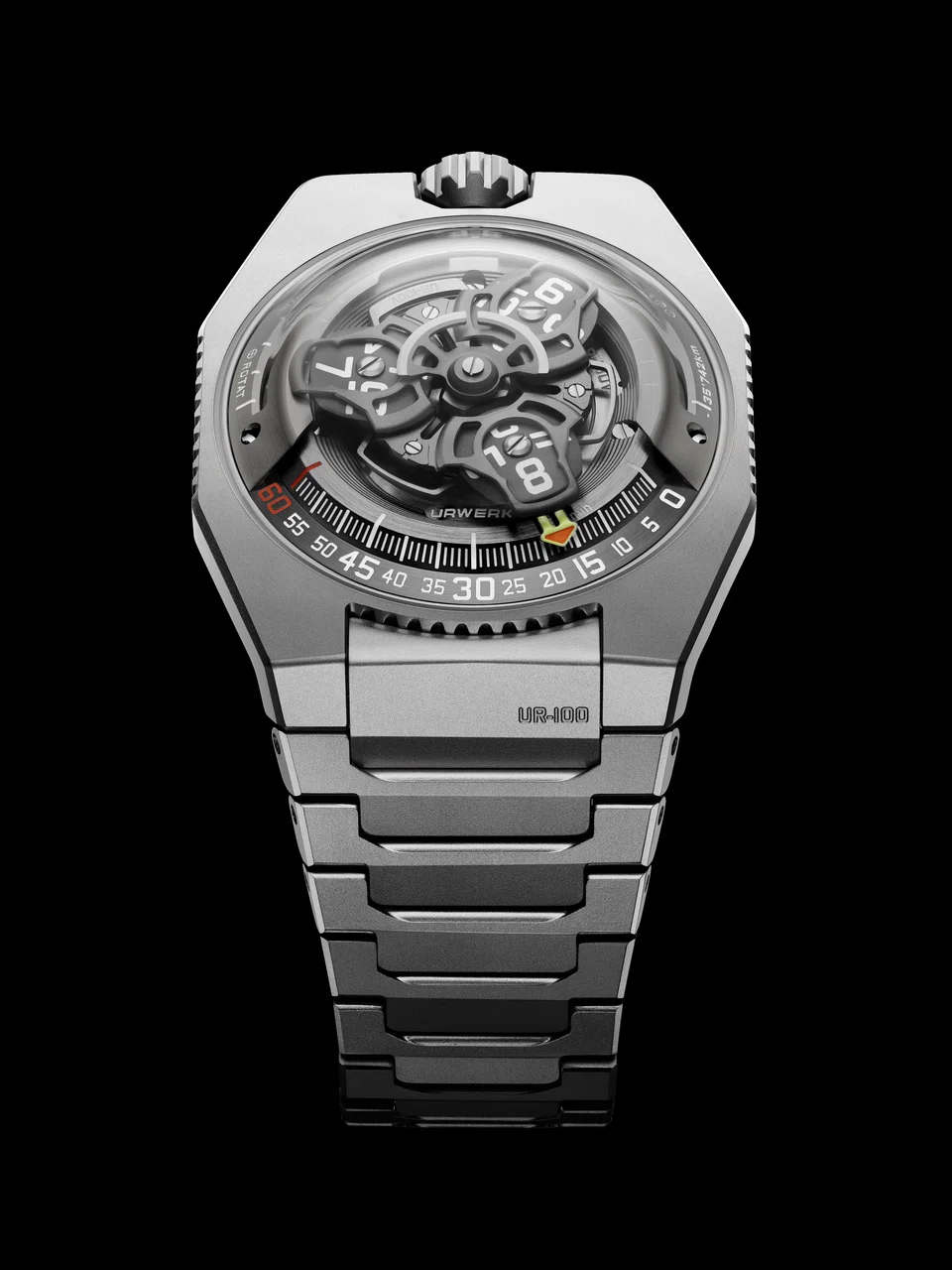
UR-100V Magic T
Going beyond titanium’s “cold” colour, this UFO-looking watch highlights the lightweight-yet-robust metal’s nuances, reflections and chromatic subtleties. From case to bracelet, the UR-100V Magic T is all about titanium and pure magic.
Urwerk’s artistic director and co-founder, Martin Frei, states that this timepiece offers scope for endless interpretations. “We have created a watch that assumes the role of our ‘classic’ – a versatile timepiece that changes mood and appearance over time.”
Titanium lends itself to the finest finishes, and thanks to light refined shot-blasting, its brilliance is fully displayed on the watch. “All the beauty of the metal is there,” says Frei.
Not forgetting that the UR-100 Magic T is essentially a timepiece, Urwerk has also enhanced its legibility by adding complexity to the dial, which is broken down into several elements to give it more structure. “Try to distinguish between the many different levels of this 3D creation, and you will discover that everything has been thought through to the smallest details, pushing the limits of perceptibility,” says Urwerk’s master watchmaker and co-founder, Felix Baumgartner.
New methods have been reinvented in the UR-100 Magic T, bringing life to Urwerk’s wandering hours – the principle of a hands-free hour and minute display based on satellites moving along a graduated arc, an extrapolation from a 17th-century clock.
More explicitly than all other Urwerk creations, the UR-100 Magic T is entirely bound up with the realm of space. On the sides of the watch’s satellite carrier are two long recesses. The first is a counter for kilometres travelled – those on Earth along its own axis in 20 minutes: 555 km.
The other counts, also in kilometres, those travelled by Earth around the Sun during the same time: 35,740 km.
SEE ALSO

UR-120 Lost in Black Space
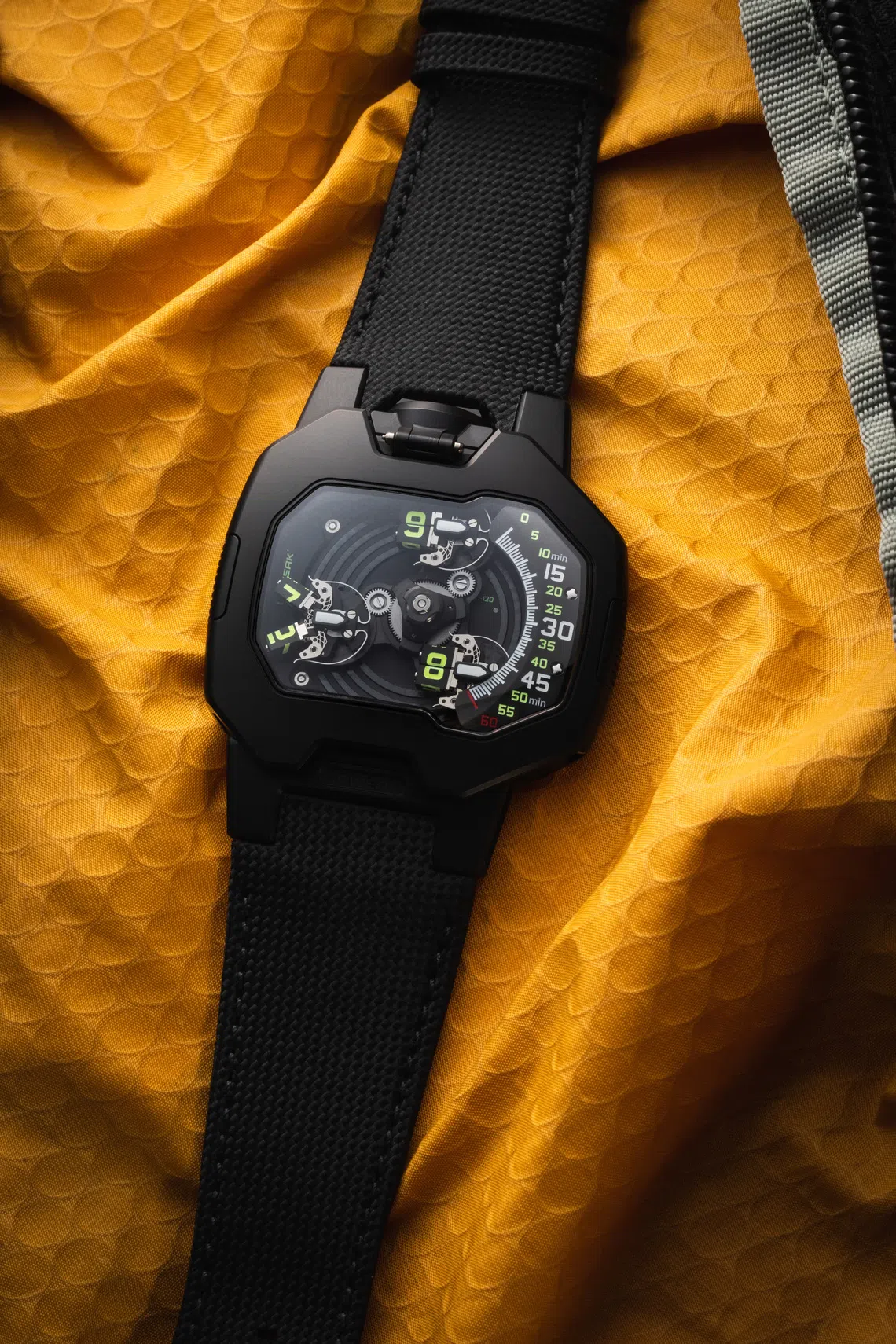
As its name suggests, this all-black creation in the shape of a mini spaceship showcases the power of black in design. “The use of black not only exudes elegance, but also fundamentally transforms our perception of the object,” says Frei.
The 44 x 47 x 15.8 mm black cosmic timepiece combines advanced technology, celestial aspiration and a touch of science fiction.
Time on the UR-120 is indicated by a new revolving satellite complication that displays analog minutes and a split-open digital hour satellite in the form of a V-shaped open hand mounted on planetary gears.
The watch is powered by a movement with a three-armed central carousel. Spinning on a central axis, the carousel carries satellites that bear hour markers on all four sides. As the satellite traverses the minute track, it reaches the left part of the case, setting in motion a sequence of movements. This splits open the satellite to reveal two rectangular studs that take on a V-shape reminiscent of the Vulcan salute. Once separated, both studs spin on their own axes and shut to display the new hour unit.
UR-100V Lightspeed
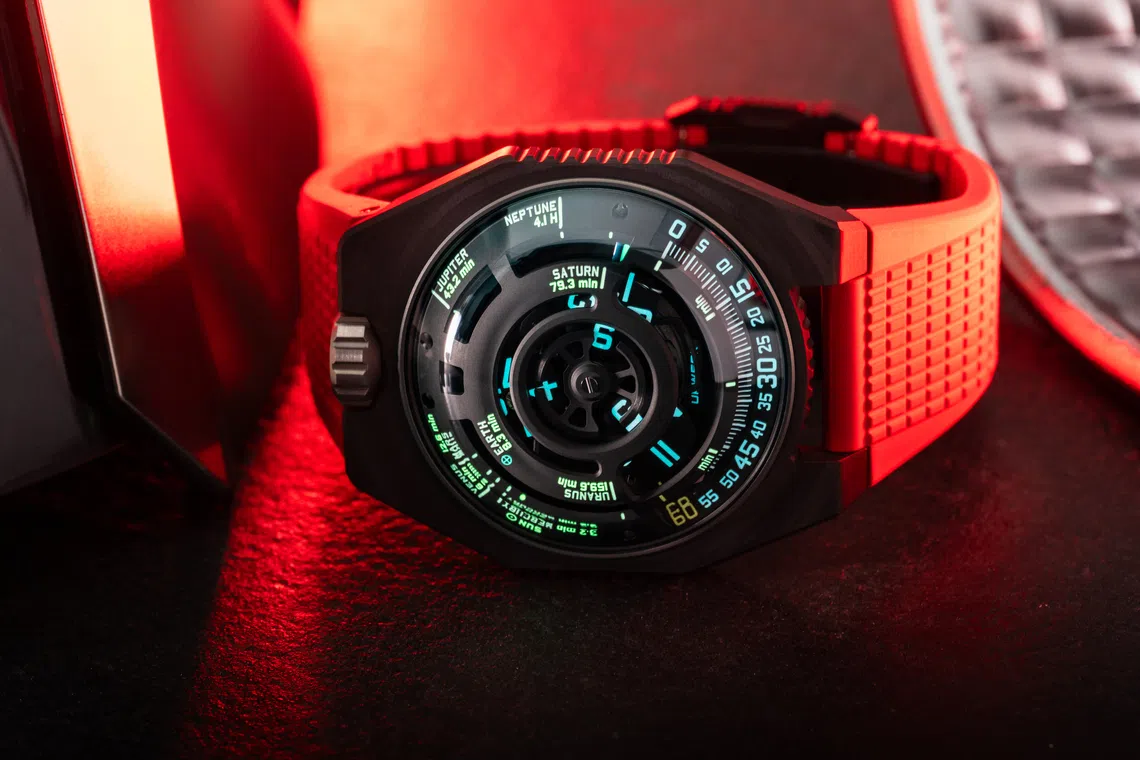
The Lightspeed is where time, space and light come together in one place. “Wearing this creation is like having a piece of the universe on your wrist – a vision of the cosmos in miniature on a human scale,” says Urwerk’s artistic director Frei.
The futuristic timepiece houses a 3D planetarium with eight celestial bodies from our solar system as reference points. Its ultimate reference is the sun, which inspires the rotor on the back of the watch. “Starting from the sun, we calculated and illustrated the time taken for a ray of light to reach each planet,” says Urwerk’s master watchmaker Baumgartner. “The sun’s rays take 8.3 minutes to reach Earth, and reach Jupiter 35 minutes later. It’s like a journey through space and time with light as the medium.”
Like the UR-100V Magic T, the UR-100V Lightspeed has no hands, but features a “satellite” hours and minutes display to tell time. A satellite moves along an arc of a graduated circle: one carries hours, and the other, minutes. When an hour satellite has covered its minutes, another bearing the next hour appears before the minutes index.
UR-230 Eagle
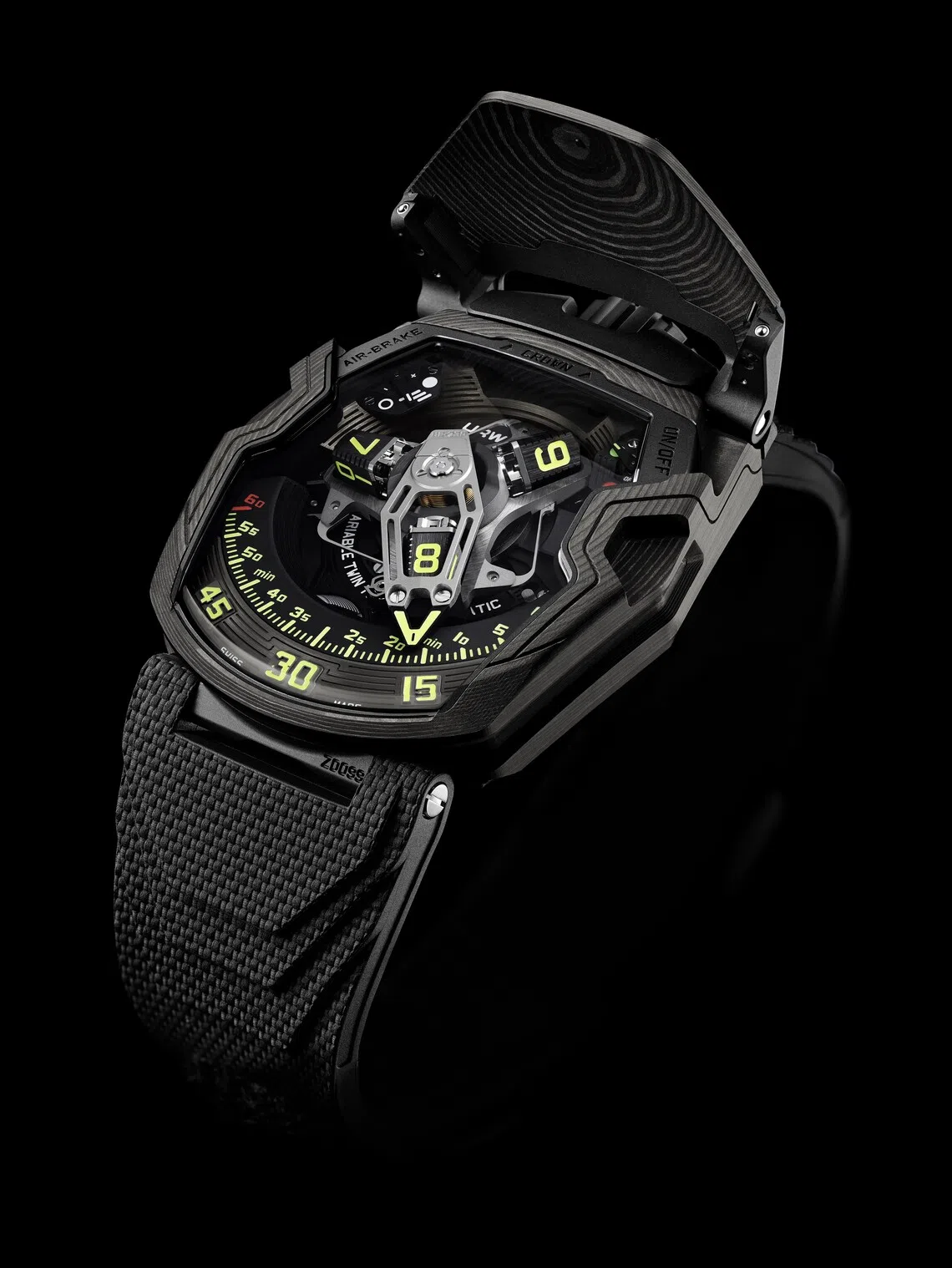
The UR-230 Eagle comes from Urwerk’s UR-200 collection and is identified by its dual variable geometry turbine, double shock absorber and hybrid winding system. A follow-up to the UR-220 launched a decade ago, this latest model has received an engine upgrade and high-tech makeover, but retains key features such as satellite display, wandering hours and retrograde minute hand.
The UR-230 flaunts a complex half-hunter case in a trapeze shape with pronounced elongation, including a protective cover. The case is crafted from finely layered carbon, and its back is made of black DLC titanium.
This watch also showcases world-first shock absorbers that guarantee robustness and durability; an “air brake” that modulates winding power according to wearer’s activity level; and a switch to disengage the rotor for manual winding mode.
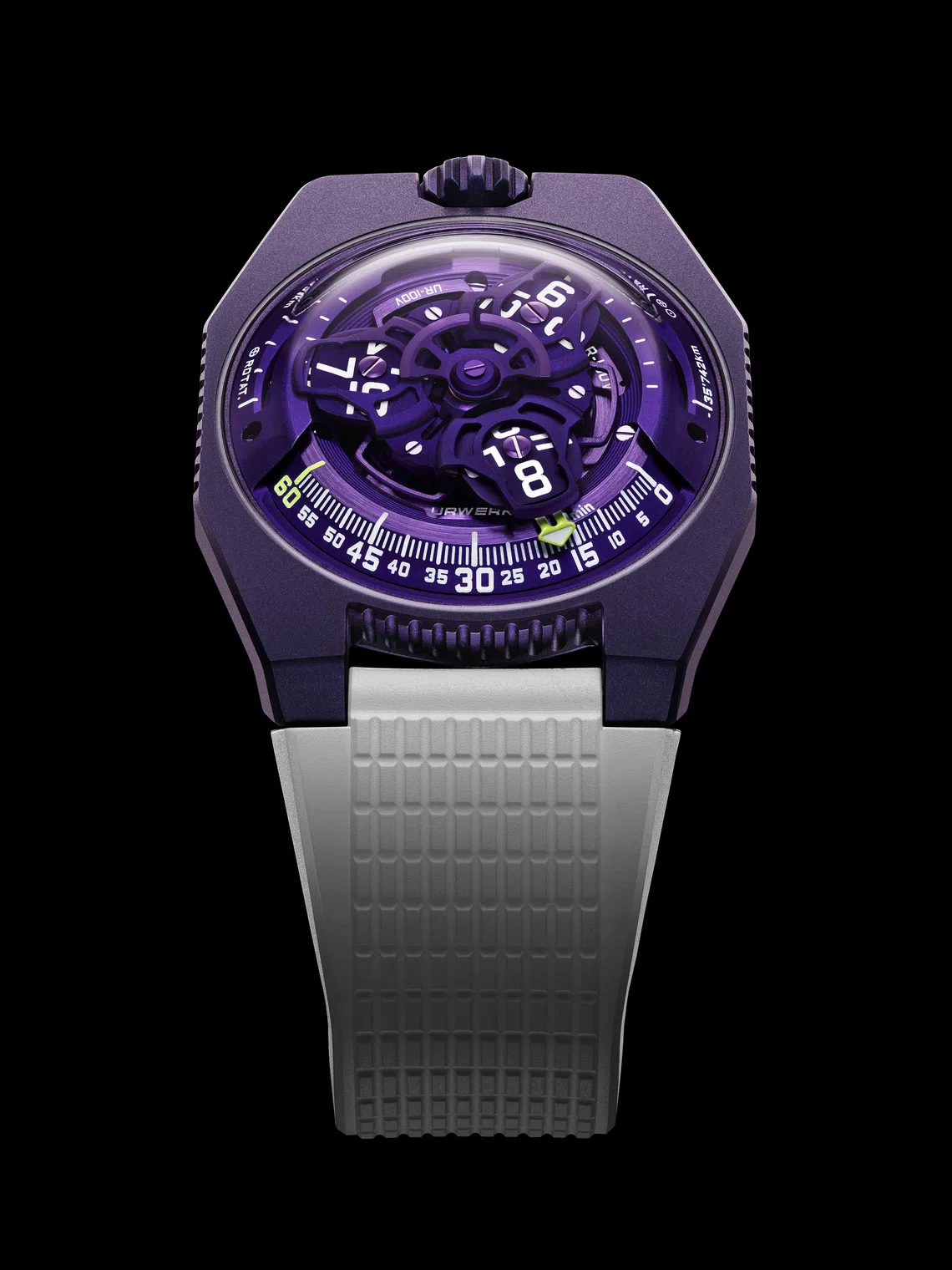
UR-100V Ultraviolet
The colour spectrum visible to humans ranges from red to violet; anything beyond violet lies outside perceptible colour. The UR-100V Ultraviolet celebrates this boundary – this tipping point – from perceptive to imperceptible, says Urwerk’s artistic director Frei.
Paired with a rubber strap, this watch features a satellite hours and minutes display that indicates not just time, but also distance travelled. Upon reaching 60 minutes, the minutes indicator disappears, only to reappear as a kilometre counter illustrating 555 km travelled every 20 minutes by every inhabitant on Earth – the average speed of Earth’s rotation at the Equator.
Opposite this is Earth’s revolution around the sun: 35,740 km every 20 minutes. On the face of the UR-100V Ultraviolet, hours and kilometres share equal status, equal value scale.
“This creation was inspired by a gift from my father: a clock made for the 1893 World Exhibition, which indicates not hours, but rotational distance travelled by Earth at the Equator,” says Urwerk’s master watchmaker Baumgartner.
Decoding Asia newsletter: your guide to navigating Asia in a new global order. Sign up here to get Decoding Asia newsletter. Delivered to your inbox. Free.
Share with us your feedback on BT's products and services