What a massive new crater means for future moon bases
At a whopping 222 metres wide, the newfound basin hints at the risks that impact events may pose to planned human outposts
[NEW YORK] We may think of the moon as a silvery, silent realm. But in truth, it’s a war zone. Asteroids and comet shards slam into it all the time, giving the surface new scars to accompany its wealth of ancient craters.
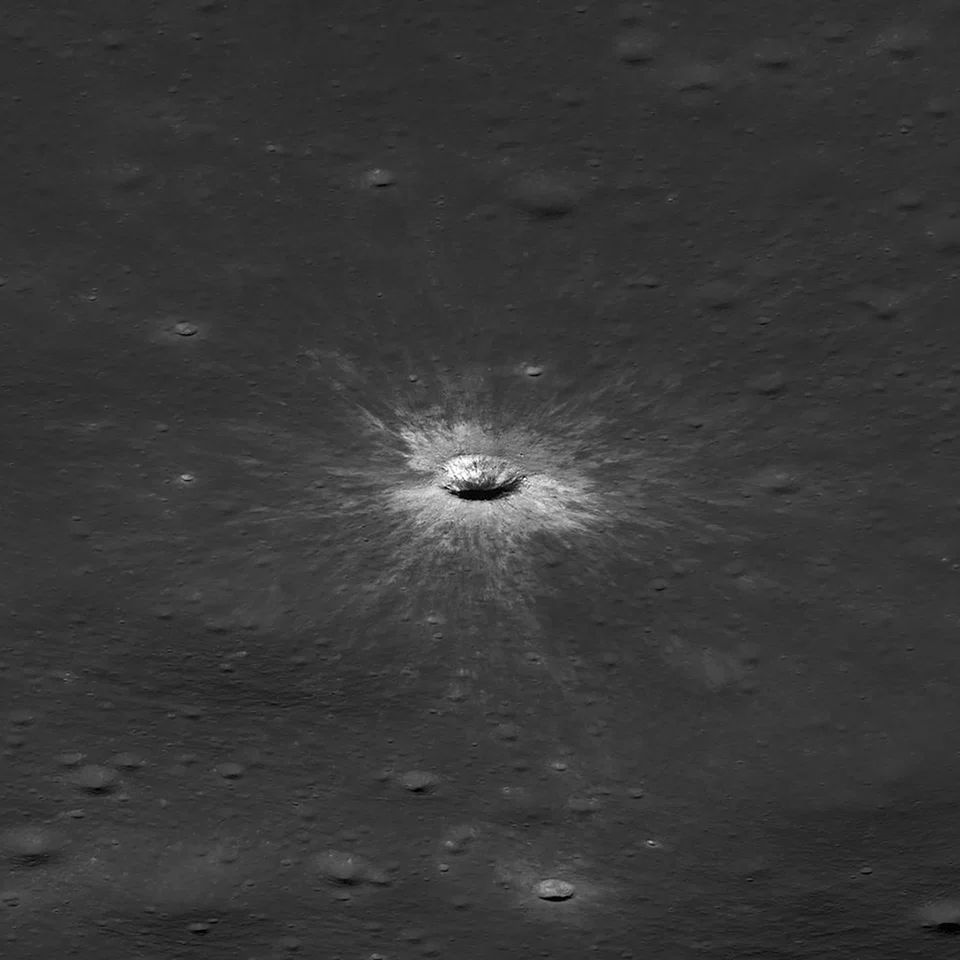
Now, Nasa says that it has found the largest fresh crater seen on the moon since at least 2009 – a basin so big that the impact that created it can be expected to happen just once every 132 years. Such an event may be a rarity, but the discovery has important implications for humanity’s future in space.
While perusing photographs taken by Nasa’s Lunar Reconnaissance Orbiter, astronomers spotted a previously unseen lunar crater that’s a whopping 222 metres across, more than twice the length of an American football field.
“That’s a monster of a crater, at least in modern times,” said Nicholas Schmerr, a planetary geophysicist at the University of Maryland, College Park.
By comparing older satellite images to more recent ones, scientists have concluded that an object 9 to 21 metres across ploughed into the moon at a blistering speed sometime in the spring of 2024. The impactor would have caused a luminous explosion comparable to one made by 15,500 tonnes of TNT.
The basin, named the McGetchin crater after a lunar scientist, Tom McGetchin, can be found near the edge of the Sea of Crises, a 555-km-long expanse of frozen lava on the moon’s eastern edge. Its discovery was reported in two studies published on Sep 16 in the journal Science Advances.
Finding such a large cavity in the lunar surface is “very interesting and exciting”, said Mark Boslough, a physicist and expert on impact events at the University of New Mexico, who was not involved with the new studies.
Nasa and China are racing to send astronauts to the moon. If they stick to their plans, at some point in the 2030s there will be multiple nuclear-powered bases at the lunar south pole, each of them home to astronauts sojourning for several weeks, if not months, at a time.
Determining how often asteroids and cometary fragments punch holes in the moon, then, is of paramount importance.
Earth itself is also constantly pummelled by asteroid and comet pieces. But its atmosphere slows down and burns away objects up to around 30 feet in diameter. Anything larger exploding in midair can unleash a fierce pressure wave, which can damage both buildings and people nearby.
The moon, lacking much of an atmosphere, is defenceless against cosmic vandals of all sizes. It’s sometimes damaged by spent rocket boosters falling to its surface, and it’s regularly thwacked by space rocks.
Lunar satellites, telescopes on earth and even the astronauts of the Artemis II mission have seen brief flashes of light popping up all over the moon. Based on this data, scientists estimate that objects the size of monster truck tyres carve out 9-m-wide lunar craters 140 times per year.
The day-to-day odds of a moon base being pancaked by an impactor this size, or punctured by far smaller rocky bullets, all of which travel tens to hundreds of thousands of kilometres per hour, are low. The chances of a larger object crashing into a base are lower still – but not zero.
A lunar base could always get supremely unlucky. “I absolutely think that this is a significant risk to long-term operations on the moon,” Boslough said.
The moon’s new dimple makes something else distressingly clear. An asteroid doesn’t need to strike a lunar settlement directly to cause a catastrophe.
During an impact event, “the ejecta blanket will be made up of a range of sizes of rocks that in turn make their own craters”, said Elisha Jhoti, a doctoral student at the University of California, Los Angeles, and an author of one of the two new papers. But how far can that debris travel?
As can be seen around this recent lunar indentation, “most of the debris is deposited near the crater rim”, said Julie Stopar, a staff scientist at the Lunar and Planetary Institute in Houston, and another author on one of the new studies.
But the chasm is also surrounded by a Jackson-Pollock-like splatter of ejected matter, with trails radiating outward for more than 97 kilometres. This debris – consisting of a handful of big rocks and plenty of smaller stones – has roughed up parts of the moon extremely far from ground zero.
Unlike heftier asteroids, objects just tens of feet across, like the one that created this new crater, are notoriously difficult to spot in advance of an impact. That means spaceflight missions designed to deflect or vaporise asteroids might be incapable of deploying in time to fend them off.
In other words, a moon base in the crosshairs of a miniature-but-menacing space rock may not come out of the impact unscathed. “The risk from smaller stuff is very real,” Boslough added. NYTIMES
Decoding Asia newsletter: your guide to navigating Asia in a new global order. Sign up here to get Decoding Asia newsletter. Delivered to your inbox. Free.
Share with us your feedback on BT's products and services