Why the fearsome Dragon’s Tail makes Sentosa’s Serapong golf course so revered
This stretch of testing, twisting holes requires pinpoint accuracy in order to emerge unscathed
[SINGAPORE] What makes the Augusta National Golf Club course – the permanent venue for the US Masters every year – so extraordinary?
The answer is the “Amen Corner”, a notorious three-hole stretch consisting of holes 11, 12 and 13 where many Masters tournaments have been won or lost over the decades.
The nickname was given by the late American sports writer Herbert Warren Wind. Amen Corner is a section of the course that’s known for swirling winds, water hazards and plenty of drama whenever a golfer has to navigate it.
Many of golf’s greatest stars have competed at the Masters and found themselves in prime position to win the coveted Green Jacket, only to see their hopes dashed by those very three holes at the start of the back line.
The most famous collapse was that of Jordan Spieth, the defending champion in 2016 who held a commanding lead after the ninth hole. He ended up making a double bogey on the 11th and an astonishing quadruple bogey on the 12th.
Spieth never recovered from those setbacks, and Englishman Danny Willett overtook him to take the championship.
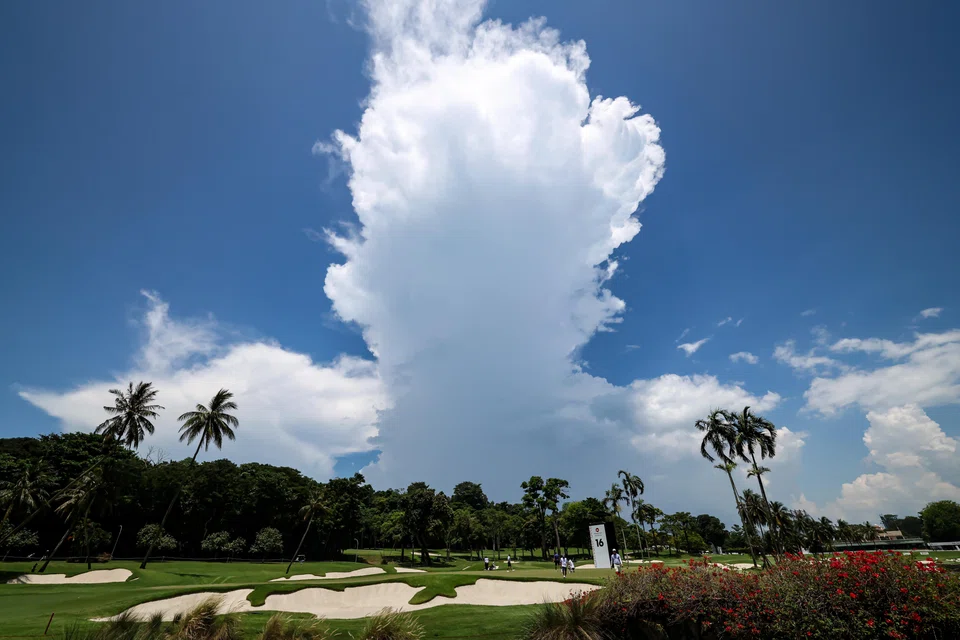
Drawing a parallel with Augusta is Sentosa Golf Club’s award-winning Serapong course with its “Dragon’s Tail”, a testing, twisting stretch between the third and seventh holes where pinpoint accuracy is a necessity in order to emerge unscathed.
Serapong has won many accolades over the years, including being named Asia’s Best Golf Course from 2022 to 2024, and ranked in the top 55 of Golf Digest’s World’s 100 Greatest Golf Courses list.
This year’s Singapore Open presented by The Business Times, a US$2 million tournament, took place from Apr 23 to 26 at Serapong.
SEE ALSO






The par-four third – named the Dragon’s Feet – is reckoned to be the hardest hole at Serapong. It has the distance, the high landing area from where you have to find the bunker-laden green from about 200 metres.
The par-five fourth is known as the Dragon’s Leg, a serpentine edge that stretches all along water on the left. One needs a perfect tee-shot over water; a golfer typically can find the green in two with some accuracy and a long iron.
The par-four fifth is called the Dragon’s Body and regarded as one of the toughest holes, requiring two extremely precise shots to reach the undulating green.
If a golfer manages to overcome those obstacles, a challenging par-four sixth called the Dragon’s Tongue awaits. It calls for an accurate drive to a narrow fairway leaning towards water on the right and a nice second shot past a rock on a bunker.
The par-five seventh features a World War II bunker, offering players a small glimpse of Singapore history. The drive has to land on a longish fairway along the Singapore Strait.
If done right, the tempting second shot to a tricky, winding, long green is possible. But if overhit, you may find water beyond.
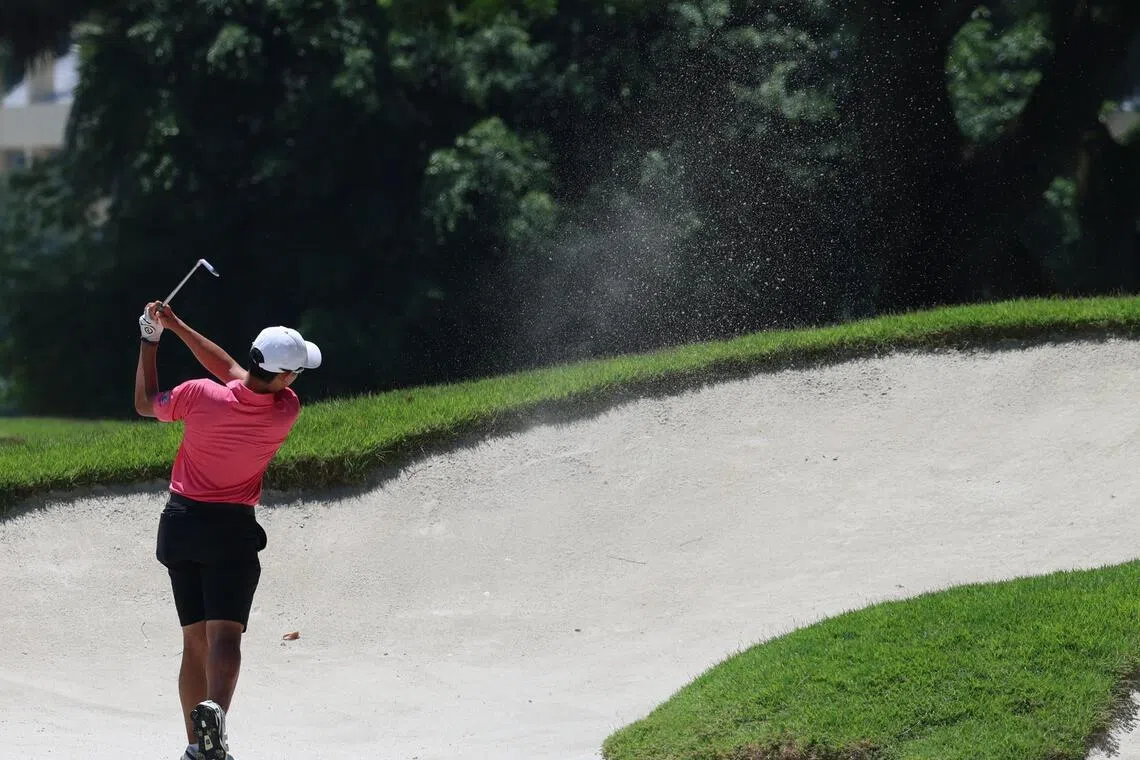
103 bunkers
Serapong is a par-72, 6,765-metre championship course that provides dramatic views of the Singapore skyline, fast greens, and a high-stakes layout with water hazards and 103 bunkers.
Opened in 1982 and designed by Ron Fream, it underwent a S$12 million upgrade in 2007. The course saw another major upgrade in 2020 with enhanced bunkers, greens and fairways, increasing playability and design quality.
Holes 1 and 2 are very interesting; the par-four first is a dogleg right with a blind approach requiring a calculated tee shot to avoid trees and bunkers on the right.
The second hole is a beautiful short par-three, providing a panoramic view of Singapore’s Central Business District skyline, but heavily guarded by bunkers. It is a short downhill hole needing accuracy with short irons.
Hole 15 is a tough 393-metre par four which some consider to be the toughest on the course with a handicap index of one, demanding a good drive down the right to avoid water at the harbour on the left.
The par-five, 496-metre 18th hole offers golfers a superb finish, with a risk-reward possibility with water running all along the left.
It was on this very hole that the crowd went into delirium when American Paula Creamer sank a 75-foot eagle, downhill putt that won her the HSBC Women’s Championships in 2014.
Creamer’s miraculous putt curled across the green and then rolled slowly down the slope and directly into the hole. She ran across the green, then fell to her knees and put her head on the ground, laughing and pounding the grass in joy.
Australian Major winner Adam Scott, a three-time Singapore Open champion, has a commemorative plaque on the par-five fourth hole, which serves as a reminder of his achievements at the national event.
Scott is often referred to as the “Sorcerer of Sentosa” because of his dominance at what is known as “Asia’s Major”.
Serapong has served up countless memories and tales that will last a lifetime, and it’s certain that there will be many more stories that will be told and retold in the years to come, especially on the course’s infamous Dragon’s Tail.
Decoding Asia newsletter: your guide to navigating Asia in a new global order. Sign up here to get Decoding Asia newsletter. Delivered to your inbox. Free.
Share with us your feedback on BT's products and services