

Issue 104: Palm oil investors don’t care about the green; MAS, BIS take on climate data gap

In this issue: Palm oil companies with better ESG transparency command lower valuations, while Singapore’s financial regulator tries to improve climate risk assessments.
South-east Asia
Shunning green palm oil
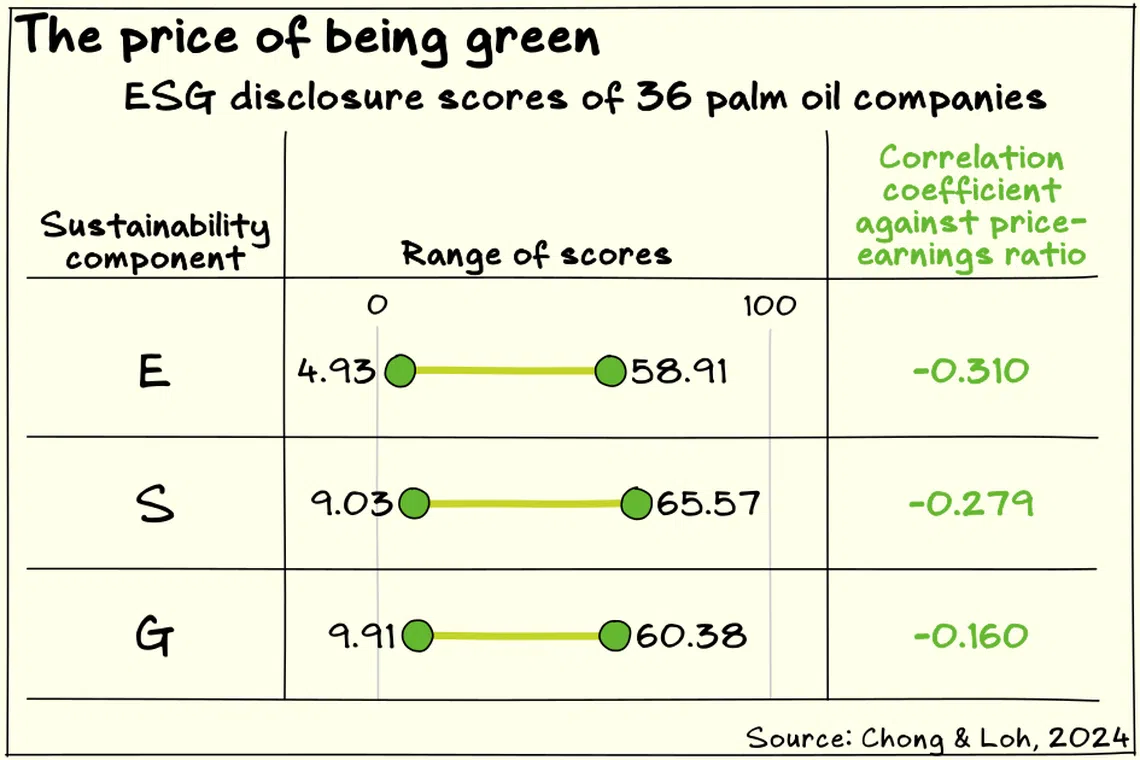
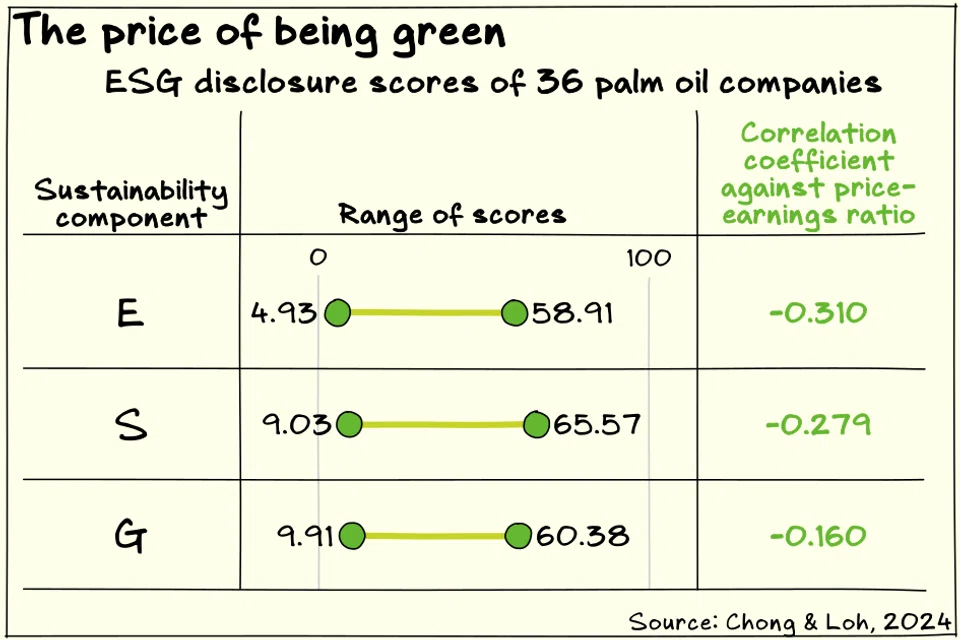
Are sustainable palm oil companies undervalued in the market?
A study by researchers at the National University of Singapore found that palm oil companies with better ESG transparency tended to trade at lower price-earnings ratios (PERs). The larger the company in terms of revenue or assets, the stronger the negative correlation between ESG transparency and PER.
While the finding is provocative, it’s unlikely that palm oil companies with poor ESG transparency are better investments.
The study looked at 36 publicly listed palm oil companies, among which at least 31 have operations in Indonesia and Malaysia. Twenty-nine of the companies are members of the Roundtable on Sustainable Palm Oil (RSPO), an industry sustainability certification body.
The quality of ESG transparency was based on the 2021 Zoological Society of London’s Sustainability Policy Transparency Toolkit (Spott) scores, an annual assessment of ESG-related public disclosures by soft commodity producers, processors and traders. Companies’ PER, revenue and asset values were based on latest available data as at July 2022.
It’s helpful to acknowledge some of the limitations of the study:
- Correlation isn’t causation. Just because better ESG transparency is associated with lower PER doesn’t mean one causes the other.
- The PER values in the study come from a single point in time, in July 2022. A more comprehensive analysis over a longer period of time is needed to determine if the correlation holds over a longer period.
- The study did not examine whether the differences in valuations were justified, which could have offered insight into why the negative correlation exists. In other words, whether higher valuations among the palm oil companies were reflected in higher returns or lower volatility.
A lower market valuation suggests lesser demand. The authors hypothesise that the discount imposed on the more sustainable palm oil stocks reflects the higher level of scrutiny placed upon those companies and therefore increased ESG risk.
Should an investor in the sector buy the smaller, less transparent palm oil companies instead of the larger, more transparent ones? Are the companies that put more effort into sustainability and sustainability-related disclosures actually more risky?
It’s probably important to distinguish between market risk and operational risk. If the report’s authors’ hypothesis about the root cause of the valuation differences is correct, then the market is discounting the more visible palm oil players because of concerns about share price volatility driven largely by market sentiment.
It’s not clear, however, that the market is properly accounting for the operational risk faced by palm oil companies, which operate in a sector that is increasingly subject to stringent environmental rules and to demanding stakeholders.
Perhaps the more transparent palm oil companies are subject to greater scrutiny and therefore greater volatility, but that is the price that must be paid in order to continue selling in Europe or to continue attracting institutional capital.
The less transparent players may be less volatile in the short term because they fall below the radar, but there might be a greater risk of them falling off a cliff in the future since their ESG progress cannot be easily ascertained.
There are also other considerations about the attractiveness of a stock than its PER. Liquidity is important as well, and it’s a good bet that it’s easier to get in and out of positions in the larger and more transparent companies. Unfortunately, the study did not look into the liquidity of the stocks.
Big investors – who are major price setters in the investable portion of the stock markets – aren’t going to be dabbling in the small, opaque parts of the palm oil sector just because PER might be higher there.
In fact, the lower PER among the more sustainable palm oil players might be interpreted as better value and therefore more attractive investments.
The ultimate question for investors boils down to returns, but the study did not offer any information on that front. The jury is out on whether ESG performance correlates to better stock performance, although companies with better ESG performance should typically represent lower risk given how strongly material risk mitigation features in ESG frameworks.
Of course, from the companies’ point of view, not being rewarded by the market for ESG transparency isn’t great. It’s possible that the discount could discourage some palm oil companies from improving their ESG disclosures.
Companies don’t care only about the price of their shares, though, especially since they only have limited control over how the market wants to value their shares. Companies ultimately want to make money, and slacking off on ESG matters might improve the PER but also mean lost business.
Other South-east Asia reads
- Indo-Pacific partners ink clean economy deal with new programme on nuclear energy
- Vietnam eyes greener power but banks on coal to avert blackouts
Singapore
Closing regulators’ data gap on climate resilience
A financial sector regulator such as the Monetary Authority of Singapore (MAS) needs to ensure its financial system is resilient against climate change.
Climate change is a complex issue that is especially challenging for financial sector regulators, though. Data gaps abound, especially in emerging markets.
There is also uncertainty about how to model climate risk given the uncertainties in projecting future outcomes and the complexities of variables such as policy responses to climate change.
MAS has therefore teamed up with the Singapore arm of the Innovation Hub of the Bank of International Settlements, the global financial institution controlled by central banks, to create a blueprint for an international climate risk platform.
Dubbed Project Viridium, the initiative envisions a solution that allows regulators to share data, such as the geographical distribution of assets and emissions of regulated entities. The hope is that this will also facilitate the harmonisation of risk assessment and scenario analysis.
The project notably uses a “roughly right” approach that seeks to provide flexibility amid uncertainties so that climate risk assessment is not bogged down by the lack of perfect data.
The work will matter not just to MAS and its peers but to the banks as well. One reason for performing climate risk assessment is to assess whether the banks’ portfolio of loans and investments can withstand climate risks.
A bank with a riskier portfolio might need to be remedied, perhaps with the requirement to buff up its capital reserves. Logically, a bank with a more resilient portfolio might therefore be able to hold a lower amount in its reserves.
If a financial system is able to assess climate risk with enough confidence to account for it in banks’ reserve requirements, that could be a significant catalyst to accelerate decarbonisation in the broader economy since banks would have an unambiguous economic incentive to green their books.
Other South-east Asia reads
- Construction of S’pore’s largest floating solar farm at Kranji Reservoir to begin in 2025
- Tough stance on board renewal has helped to spur recruitment of more women directors






