ESG Insights

Issue 108: Temasek’s inaugural sustainability report; Sarawak waves a green flag

Kenneth Lim
Published Fri, Jul 12, 2024 · 07:00 PM
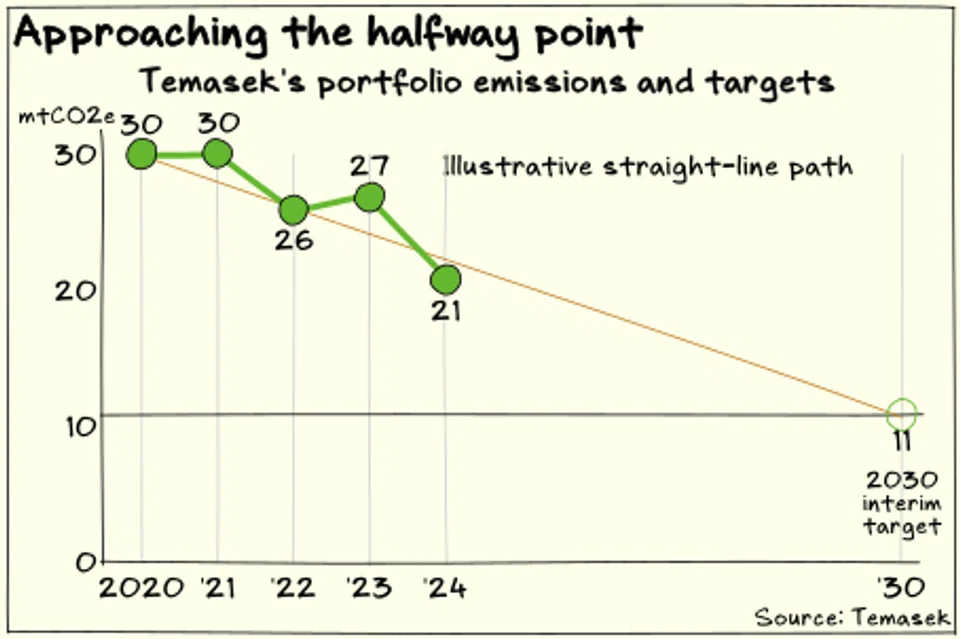
    • Temasek is on track for its 2030 emissions target after it cut portfolio emissions to 21 million tonnes in FY2024.
    • Temasek is on track for its 2030 emissions target after it cut portfolio emissions to 21 million tonnes in FY2024. ILLUSTRATION: KENNETH LIM

    In this issue: Temasek reveals creation of portfolio to chase both sustainability and returns, while Sarawak revs up a growth engine in the green economy.

    Singapore

    Temasek pulls back its sustainability curtain
    Temasek’s first-ever sustainability report offers the most detailed look yet at how the Singapore government-owned investment firm integrates environmental, social and governance (ESG) factors into its portfolio.

    There were a number of interesting insights, including a new dual-mandate fund, a proprietary climate risk indicator and a test set of rules for social behaviour.

    Temasek’s returns-and-sustainability fund

    One of the most important questions in ESG is whether sustainability makes for good investments. Temasek set its quantitative strategy team to work and found that outperformance on certain environmental, social and governance metrics was positively linked to returns outperformance based on historical data. To test the link under live portfolio conditions, Temasek created an equity portfolio this year with the double goal of “superior sustainability metrics” and outperformance against a benchmark of global equities. The portfolio is sector and country-neutral against the benchmark. Temasek did not provide further details when asked.

    Carbon spread

    Temasek uses a proprietary metric called a “carbon spread” to measure potential future climate risk. It is based on Temasek’s internal carbon price and represents a spread above the risk-adjusted cost of capital. Temasek’s internal carbon price is set at US$65 per tonne of carbon dioxide equivalent in 2024. Reviewed every two years, the internal carbon price is expected to reach US$100 per tonne by 2030.

    Asked for details, Temasek explained that the risk-adjusted cost of capital takes into account country, industry, capital structure and ESG risk, but those don’t include the carbon price required to align with a net zero outcome, which is what Temasek uses to set its internal carbon price. Put another way, the carbon spread reflects the additional returns requirement above the risk-adjusted cost of capital that would be required to address potential climate transition risk and the possible future cost of carbon.

    A target company with a high carbon spread could be more vulnerable to climate transition risks if it needs to start internalising its negative climate impact; this would trigger the need for deeper analysis of the company’s climate transition and decarbonisation plans, Temasek says.

    Social Baseline Expectations

    It turns out that Temasek has been experimenting with a moral backbone. In 2023, Temasek piloted a set of Social Baseline Expectations comprising “a set of core business practices related to social issues that we expect investment targets and portfolio companies to adopt in their own operations, supply chains, and stakeholder interactions”.

    The practices cover human rights, labour practices, diversity, equity and inclusion, talent management, product quality and safety, data privacy and security and supply chain responsibility.

    Where companies did not meet all of the baseline expectations, Temasek would conduct more in-depth assessments to determine the “nature and severity” of the gaps.

    Temasek said it uses a single universal set of baseline expectations since these are “foundational practices”. However, in applying the expectations to businesses, Temasek takes into account geographical context where relevant. Temasek also said the pilot helped to identify “material potential social risks”.

    Of course, anyone could claim to be applying a set of socially responsible rules. Temasek has not shared the specifics about the baseline expectations, although doing so could perhaps insulate against suspicions of greenwashing and contribute to the development of social sustainability among more companies.

    Temasek’s net zero progress

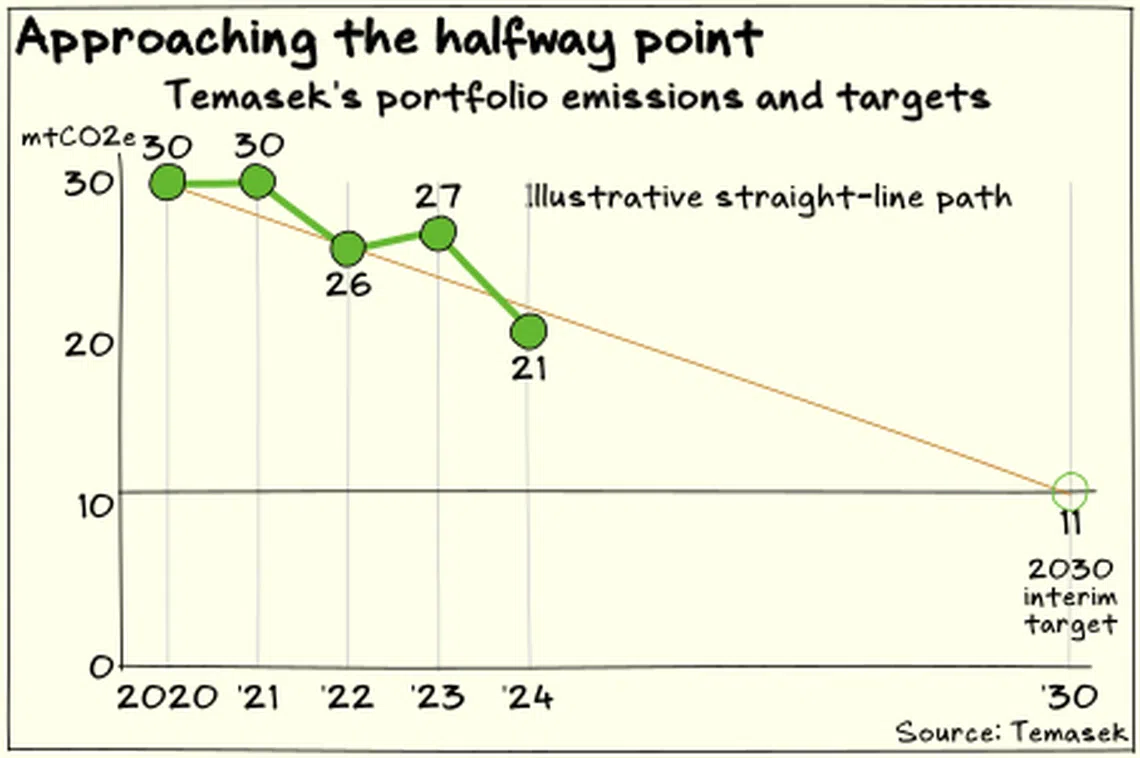
    Temasek is aiming to cut the greenhouse gas emissions of its portfolio to half of 2010 levels by 2030, and to net zero by 2050. Total portfolio emissions for fiscal year 2024 was 21 million tonnes of carbon dioxide equivalent, down by just under a quarter from FY23’s 27 million tonnes. That puts Temasek ahead of pace for its 2030 target of 11 million tonnes.

    One thing to note is that Temasek’s portfolio emissions only count the Scope 1 and 2 emissions of Temasek’s direct investments in public and private equities, which account for 77 per cent. Scope 1 refers to emissions directly generated by a company, while Scope 2 covers emissions indirectly generated through a company’s use of electricity, heating and cooling. Temasek’s targets exclude portfolio companies’ Scope 3 emissions, which are emissions indirectly caused by the companies along their supply chains.

    This method of emissions accounting is aligned with widely adopted industry standards, such as the Task Force on Climate-related Financial Disclosures guidelines. However, it might not fully capture the emissions impact of Temasek’s portfolio companies, many of which have Scope 3 emissions that are significantly higher than their Scope 1 and 2 outputs.

    For example, among Temasek’s listed portfolio companies, Scope 3’s total share of total emissions is 95 per cent for commodities group Olam, 78 per cent for offshore and marine group Seatrium, and 61 per cent for energy company Sembcorp.

    Of course, Scope 3 reporting is notoriously challenging and complex, and there’s a risk of significant error if the portfolio companies are not ready to measure such emissions in their supply chains. To its credit, Temasek has said that Scope 3 reporting is an area it is looking to improve. Regardless of reporting practice, Temasek does take Scope 3 emissions into account, when applicable, to inform its investment decisions, the firm said.

    Other Singapore reads

    South-east Asia

    Sarawak’s green ambitions

    Sarawak is going big on environmental business opportunities.

    The East Malaysian state’s foreign direct investment agency, InvestSarawak, has laid out a strategy to enter the carbon trading business to take advantage of Sarawak’s wealth of natural resources.

    A major pillar of the carbon trading plan appears to be supporting businesses that are aiming to sell carbon offsets by sequestering carbon.

    That revenue avenue may be more complex than the marketing spiel makes it sound. For instance, some of the carbon sequestration solutions are looking to store carbon in geology or oil and gas regions. However, some of those solutions have drawn concerns about leakages and earthquakes.

    Additionality is also a key requirement for carbon offsets. In essence, a carbon credit must represent a reduction in carbon that would otherwise not occur so that when the credit is used to offset emissions, there isn’t a net increase in carbon.

    For all of Sarawak’s forests and natural ecosystems, forestry-based carbon project developers will only be able to sell credits for additional activities like growing new forests or saving existing forests from credible threats of deforestation. That would be only a percentage of all the forested lands in the state.

    The bottom line is that a plan to grow the carbon trading ecosystem requires strong policy support, especially given the critical need for credible projects in the carbon credits market.

    Much will hinge on how Sarawak can balance its traditional resource industries with the sensibilities and needs of growing a green economy.

    Other South-east Asia reads

    Other good reads