

Issue 115: Banks confront facilitated emissions; South-east Asia’s sustainable jet fuel potential

This week in ESG: Making sense of emissions from banks’ capital market deals; optimising South-east Asia’s potential for fuelling green flights
Banking emissions
The weight of facilitation
The push for banks to account for their facilitated emissions is picking up. But as the industry confronts the question of how to do so, it’s important to help stakeholders understand the metric and to avoid unintended consequences.
Sustainability consulting firm Asia Research and Engagement (ARE) analysed the net-zero strategies of nine leading banks in Asia’s advanced economies – three banks each in Japan, Singapore and South Korea.
All the banks had net zero targets for financed emissions – emissions attributable to the loans and investments on the banks’ balance sheets – in key sectors. But only the Singapore banks had targets that incorporated facilitated emissions – emissions attributable to services provided by the banks, including capital market activities such as bookrunning.
ARE’s recommendations for the banks included integrating facilitated emissions into their decarbonisation strategies.
Inclusion may happen sooner rather than later. Major industry groups have already started to lay down expectations for banks to include facilitated emissions in their reporting. The Partnership for Carbon Accounting Financials (PCAF) in December 2023 laid out a set of reporting standards for facilitated emissions. The Net-Zero Banking Alliance in March adopted new guidelines to extend targets where possible to cover facilitated emissions.
The banking sector will have to confront a number of challenges as it begins to account for facilitated emissions.
The first is explaining to stakeholders what facilitated emissions are and what the numbers mean.
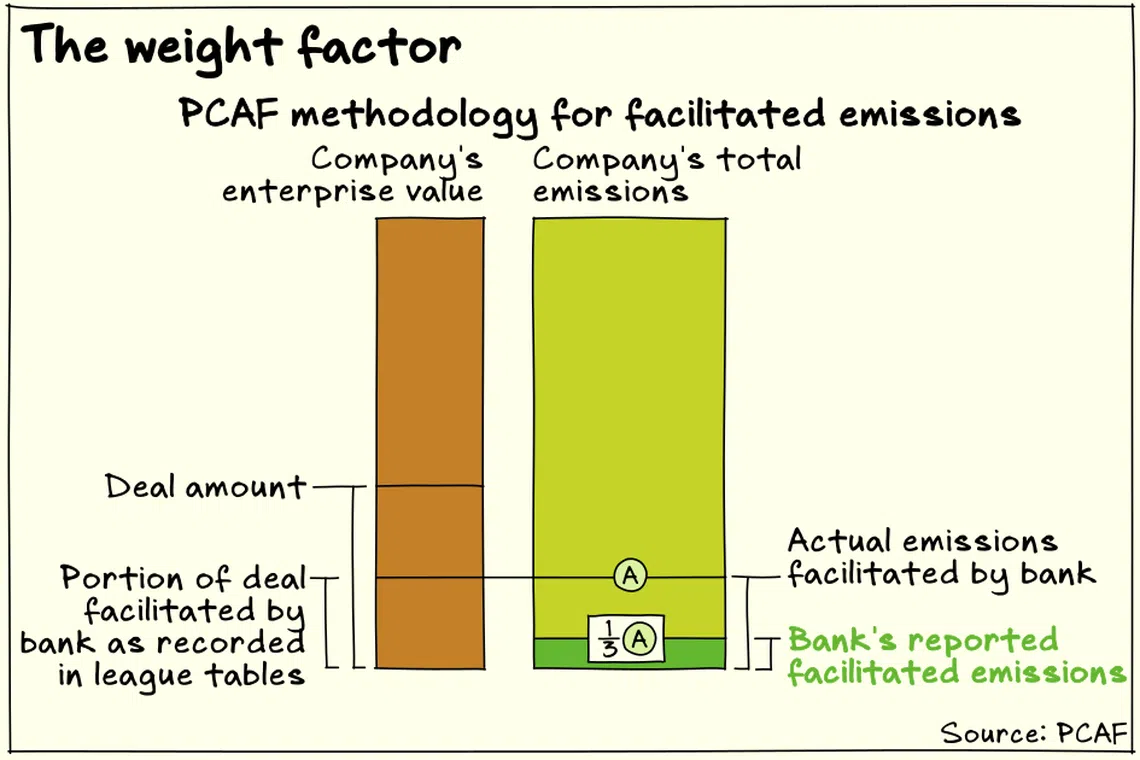
The basic concept for calculating financed and facilitated emissions are quite similar: Work out how much of a company’s value is financed or facilitated by the bank, and attribute that same percentage of the company’s total emissions to the bank.
But the banks argue that there’s a key difference between financed and facilitated emissions that lies in whether a bank’s own capital is used. Financed emissions are produced from assets that sit on the banks’ balance sheets, such as a bank loan to an energy company, so the banks’ ownership of those emissions is much easier to understand.
However, when a bank runs the books on a bond offering, the bank doesn’t buy those bonds; it merely helps other people to lend their money to the borrower. It’s like the difference between the landlord who allows the tenant to use the flat as a drug den versus the property agent who brought the landlord and tenant together. From the banks’ perspective, if someone were tallying up misdeeds, the agent would be much less guilty than the landlord.
That difference manifests in the PCAF standards as a weighting factor. After working out the emissions from their share of capital-market deals, banks need only attribute one-third of that to themselves as facilitated emissions. For financed emissions, however, the weighting is 100 per cent. The 33 per cent weighting takes guidance from an early Basel approach to assessing banks’ risk.
There’s understandably some controversy about the one-third weighting for facilitated emissions. When the banks report their numbers, they will have to explain the distinction in all its complexity to stakeholders. For instance, DBS’ tracking of its net zero progress currently accounts for both financed and facilitated emissions as a combined total and accounts for 100 per cent of its facilitated emissions from its equity and debt capital market underwritings. When it adopts the new PCAF standards, those numbers could change.
The other challenge that the sector may face is unintended consequences from the complexity of the accounting.
For example, the standards require that the facilitated emissions be based on the fundraising company’s emissions in the year of facilitation. But that does not necessarily reflect how the proceeds were used, especially if the proceeds are deployed after the reporting year. An oil and gas company could use proceeds from an equity offering to acquire a renewable energy business a year after the deal, for example. In this case, the bank’s reported facilitated emissions would not properly reflect the greenhouse gas impact of the transaction.
Reported in the right spirit and consumed with proper understanding, facilitated emissions can shed light on a bank’s impact on climate change and on its exposure to climate risk. But those conditions are not a given. After going through all the trouble of reporting those numbers, it would be a waste for the banks if that information doesn’t improve stakeholders’ understanding of the business.
Sustainable aviation fuel
Export or hoard?
If South-east Asia fully taps its abundance of biofuel feedstock and decides to keep all of its sustainable aviation fuel (SAF) for itself, the region could supply all of its own jet fuel needs, says Boeing’s Asia-Pacific sustainability lead Robert Boyd.
Boyd’s idea may be theoretically possible, but it’s probably also not the optimal approach for South-east Asia.
From a climate change perspective, it makes no difference to global warming whether the sustainable flight takes place in South-east Asia or in another part of the world. If there is sufficient SAF in the world for only half of all flights, the same amount of greenhouse gases will be emitted whether the sustainable half of flights take place in one part of the world or another.
Perhaps the South-east Asian airlines would be able to boast about having sustainable flights, but that’s about it.
If there’s a global scarcity of SAF, it’s probably better for producers in the region to sell into the international market, assuming that they can get the best possible price by exporting the fuel.
That’s because the scarcity premium they can extract through exports is good money that can be deployed to areas of need. For instance, export tariffs could be used to subsidise SAF prices domestically, or to build renewable power infrastructure. That latter option would be even better for climate change than hoarding SAF, since there would be additional decarbonisation on top of the sustainable flights.
The same principle goes for carbon credits, especially in the regulated Article 6 market. The hope is that countries that export scarce carbon credits can receive more than it costs them to produce those credits, and the surplus money can be used to drive further development and decarbonisation in the exporting country.
Other ESG reads
- Sembcorp unit signs agreement to import piped natural gas from Indonesia
- Wooing foreign investors? Heat resilience may be a new key factor for cities
- S’pore’s climate targets still ‘highly insufficient’, even after clean energy push: Research group
- Morgan Stanley quietly walks away from plastics financing goal
- SP Group makes its largest solar investment in China with 240-MWp project
- SMEs must adopt ESG reporting to get ahead, say industry experts
TRENDING NOW

Demand, tech capabilities position Apac and AI as Skyscanner’s next growth frontiers: CEO Bryan Batista

Motoring tycoon Peter Kwee is back in court: Here are his previous legal battles

South-east Asia has lost Nvidia’s best salesman

Could Jensen Huang work for Elon Musk? It would be ‘a titanic ego death match’, says biographer

