Issue 135: Wishing for clear ESG rules in Singapore Budget 2025; new 2035 goals to shape policies now

This week in ESG: Big Four’s green wishlist for Singapore Budget 2025; Singapore’s 2035 climate targets
Singapore Budget 2025, Part 1
Greenwishing for ESG solutions
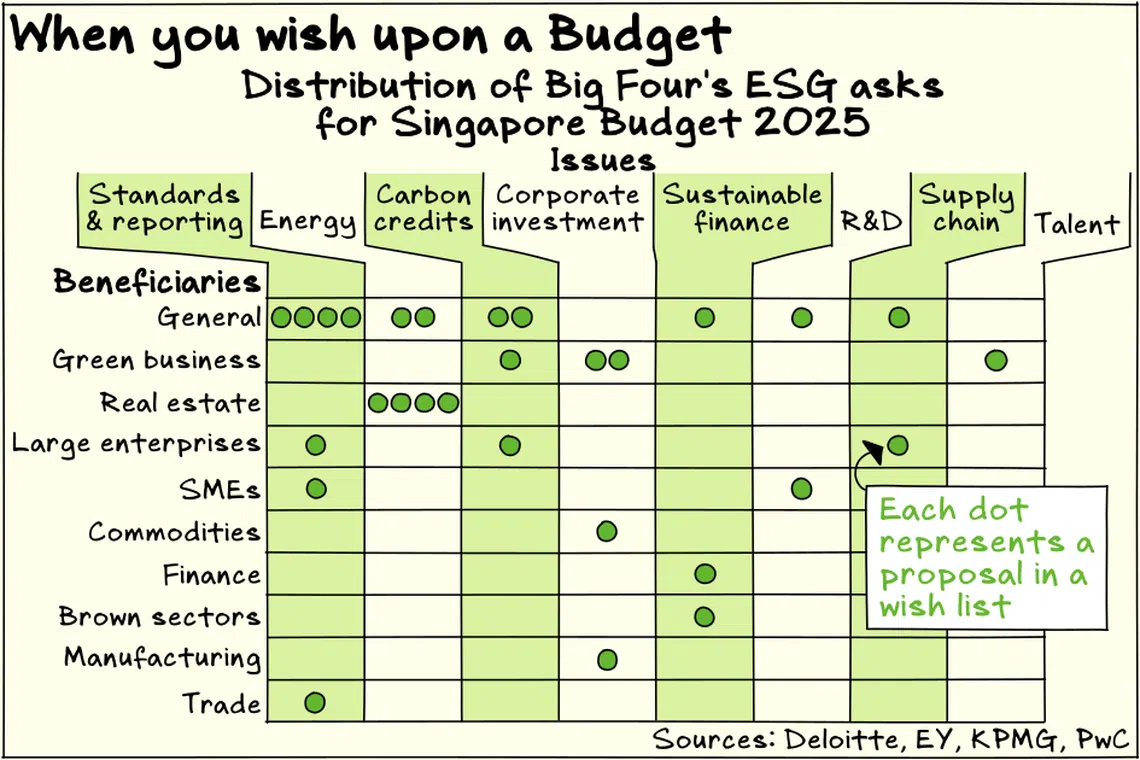
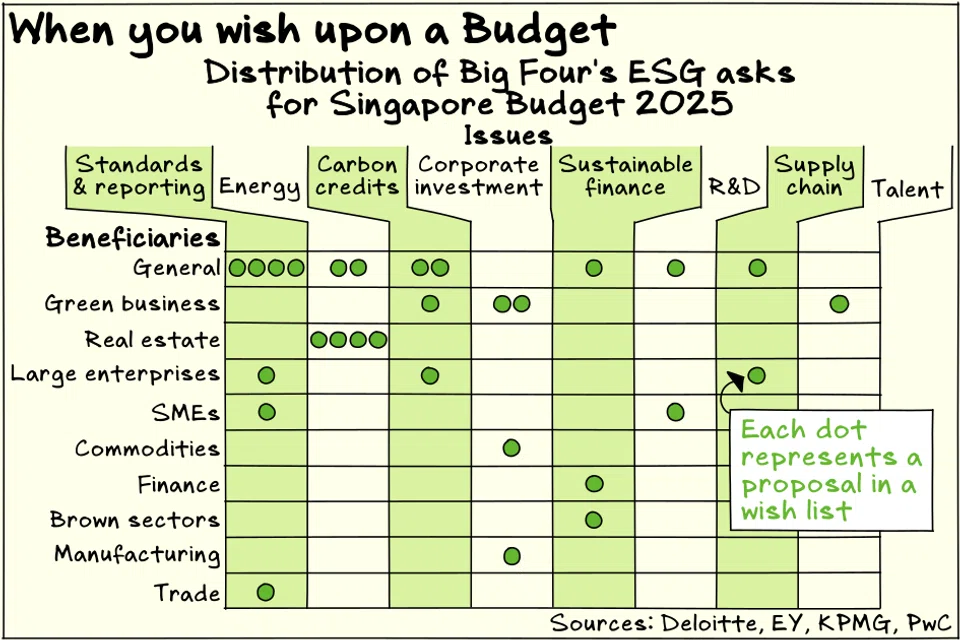
Supply chains, rules on social impact reporting, carbon credits, research and development and income from rooftop solar lead the key sustainability issues that accounting consultants are hoping the coming Singapore Budget will address.
Singapore Prime Minister and Finance Minister Lawrence Wong will announce the government’s budget for the coming year on Feb 18.
As usual, the Big Four accounting consulting firms of Deloitte, EY, KPMG in Singapore and PwC have published “wishlists” ahead of the Budget. The Singapore government is not obliged at all to grant any of those wishes, so it’s probably not a good idea to place any bets on what will be announced in the Budget based on these lists.
However, the lists reflect problems that the firms’ clients face on the ground, and issues that show up on more wishlists are probably more commonly encountered by businesses. In the case of KPMG and PwC, their lists were co-authored with the Singapore Institute of Directors (SID) and the Singapore Business Federation (SBF), which adds additional perspective from those industry bodies.
Clear rules
Businesses might be looking for regulatory clarity on a number of sustainability-related matters, with at least four wishes related to environmental, social and governance (ESG) standards, frameworks and reporting.
PwC-SBF asked for a framework to help Singapore’s trading companies understand and manage their tax incidence when they export to markets with a border carbon tax, such as Europe’s Carbon Border Adjustment Mechanism (CBAM). The authors also sought industry-level decarbonisation roadmaps that can be adopted by small and medium enterprises (SMEs) without the resources to develop their own roadmaps.
KPMG-SID proposed the creation of an ESG reporting hub, which can serve as a repository of data and methodologies to improve the quality and ease of reporting on ESG matters. The hub can also include information and resources on corporate governance.
Deloitte urged clearer rules to allow tax deductibility of costs incurred for carbon offsets. The firm cited uncertainty about whether voluntary offsets count as revenue expense if there is no compliance requirement for the expense, and whether investments in offsets need to be classified as non-deductible capital expenditure.
Social awareness
Businesses might be looking past reporting on the environmental and governance pillars of ESG and towards the third pillar of social impact. PwC-SBF and KPMG-SID asked for a unified national framework for reporting on social sustainability.
PwC-SBF explained that companies currently have to navigate multiple frameworks, which include the Sustainability Philanthropy Framework, Singapore Exchange Core ESG metrics, the Tripartite Alliance for Fair and Progressive Employment Practices, the Ministry of Manpower’s Fair Consideration Framework and the National Volunteer and Philanthropy Centre’s Corporate Purpose Framework. Converging onto a single framework will reduce confusion and improve accountability, the authors said.
KPMG-SID said guidelines can address how to integrate social sustainability into core business strategy, how to report and measure social impact, and how to align corporate social responsibility with business goals.
Developing credit
Businesses seem to want more support to develop markets for carbon credits.
Beyond its call for clearer tax rules on carbon offsets, Deloitte also suggested that Singapore raise its 5 per cent limit on the amount of taxable carbon emissions that may be offset.
PwC-SBF proposed reducing the Goods and Services Tax (GST) costs for sellers of carbon credits by allowing sellers to recover GST paid in their business expenses. The buying of carbon credits is currently exempt from GST.
KPMG-SID asked the government to provide more transparency on how collections from Singapore’s carbon tax are allocated.
Green chains
Companies, especially larger ones, may be looking more seriously at greening their supply chains. Doing so could improve the competitiveness of exports that are subject to the CBAM tax on goods headed to Europe. It would also place companies in a better position to comply with looming requirements to report on the greenhouse gas emissions of their supply chains – also known as Scope 3 emissions.
KPMG-SID and PwC-SBF asked for incentives – tax or financial – to support companies undertaking sustainable supply chain practices.
Money from above
Real estate investment trusts listed in Singapore have been at the forefront of greening their buildings to improve the sustainability of their portfolios.
A popular strategy is to place solar panels on roofs, which not only provide renewable power for buildings but can also provide some income when excess power is sold to the grid.
KPMG-SID and PwC-SBF recommended that Singapore allow ESG-based income, including money received from selling rooftop solar power to the grid, to receive tax transparency treatment.
KPMG-SID also suggested tax incentives to encourage more green buildings in Singapore. Financing costs and rental of green properties could receive a 200 per cent tax deduction. The tax rate for green commercial and industrial properties should also be lowered.
Singapore Budget 2025, Part 2
Aiming for 2035
The coming Singapore Budget, which will be announced on Feb 18, could contain substantial measures on climate action.
Singapore on Monday submitted to the United Nations a new set of climate goals under the Paris Agreement, aiming to reduce greenhouse gas emissions to between 45 and 50 million tonnes of carbon dioxide equivalent (MtCO2e) by 2035.
The new targets establish the next set of goals after the current plan to peak emissions at around 64 MtCO2e in 2028 and are along a pathway towards net zero by 2050.
They also set the context for Singapore’s climate strategy. Following the Budget announcement, Senior Minister and Coordinating Minister for National Security Teo Chee Hean, who also chairs the Inter-Ministerial Committee on Climate Change, will discuss the nation’s climate action approach and the 2035 targets during the Committee of Supply Debate.
The biggest challenge for Singapore lies in decarbonising its energy mix, which is currently still highly reliant on fossil fuels, especially natural gas. As a land-scarce and growing country, Singapore has limited capacity for renewable technologies such as solar and wind.
Technological solutions are still nascent, with green hydrogen, nuclear and geothermal solutions still highly speculative. Singapore has awarded agreements on electricity import, but these deals have yet to reach the delivery stage, and reliability and progress are affected by other countries’ circumstances. A large portion of the determinants of Singapore’s energy decarbonisation outcomes are, therefore, outside of Singapore’s control.
An opportunity for increased spending could lie in climate adaptation, with possible investments in more efficient cooling solutions, improved water and food security, or protection against flooding. Climate adaptation is becoming more important and urgent with the increased likelihood of global warming exceeding key thresholds for limiting climate damage.
No surprise that the amount of money that Singapore will be spending on decarbonising the country is substantial. Following the 2024 Budget, Singapore set up the Future Energy Fund with an initial S$5 billion injection. The Monetary Authority of Singapore also plans to sell two tranches of green infrastructure bonds in 2025, according to the central bank’s auction calendar. Based on historical sales, each offering could raise north of S$1 billion.
Other ESG reads
- HSBC buys stake in Singapore EV charging operator SP Mobility
- Asmi launches plan to establish Singapore as green maritime and offshore hub
- Sustainability concerns will shape Singapore’s priorities in attracting investments: EDB chairman
- Low adoption of South-east Asia’s transition taxonomies due to inconsistent standards: report
- China’s green bond debut is chance to capitalise on US retreat
- Green free trade in a protectionist age
TRENDING NOW
Three ex-employees of Envy group join Ng Yu Zhi in bankruptcy
He built the Vingroup empire. Now South-east Asia’s richest man is handing some key roles to his sons
Grab CEO’s wife Chloe Tong on life with Anthony Tan and finding her purpose
Incidence of civil servants buying property near unannounced MRT stations ‘a concern’, but may not establish misconduct: PSD