Issue 16: SME vs ESG; looking past greeniums

In this issue: The Singapore Business Federation takes aim at smaller businesses’ readiness on sustainability, while ESG bonds don’t seem to get much of a green premium in Asia.
Singapore
SME resistance to ESG
The Singapore Business Federation is running a series of workshops and events to help Singapore’s small and medium-sized enterprises (SMEs) improve their sustainability.
Among the offerings: case studies on greenhouse gas emissions reduction, and tools for measuring energy consumption and carbon footprints.
It’s probably fair to say that a significant proportion of SMEs in Singapore, and possibly in South-east Asia, don’t see the point of sustainability, especially with respect to climate and carbon reporting.
There are two ways to think about climate and carbon reporting: in terms of business strategy, or in terms of accountability.
The business strategy approach comes naturally to industry and markets, which explains why a lot of effort to improve adoption and implementation has tried to sway resistance with the lure of business value.
For instance, GIC sustainability head Rachel Teo said: “Companies that are poorly rated on sustainability ratings may lose out on gaining large corporate accounts as their clients”.
That is an accurate assessment of the state of things for businesses that want to continue engaging with large corporations and banks. But many SMEs are not in the supply chains of large corporations. Many SMEs are not borrowers, and so won’t benefit from providing environmental information to the banks trying to green their loan books.
For these SMEs, the necessity argument is irrelevant. They understandably see climate reporting as pure cost.
The business strategy argument also leads to questions of fairness. Even SMEs that need to undertake climate reporting to qualify for contracts or loans may do so only because they have to.
Such SMEs probably feel that asking for climate reporting is terribly unfair to them. They do not perceive climate risks as material to their businesses; especially compared with the immediate, existential concern of remaining a going concern. Why should they spend time and effort on something that’s chiefly for the benefit of someone else’s net zero ambitions? Furthermore, the margin of error on the metrics reported by these SMEs could be significant if the SMEs don’t put in effort to improve accuracy or pay for independent assurance – which makes the utility of those disclosures questionable.
The business strategy lens can lead to the conclusion that climate reporting should be optional.
I raised these points in a recent conversation with some regulation experts, and was struck when one of them stated matter-of-factly: “It’s a matter of accountability.”
The problem with the business strategy approach is that it relies on an inadequate accounting framework to weigh the costs and benefits of climate reporting. Businesses do not, and haven’t had to, account for their impact on climate change because that isn’t required under our current financial rules. If you only count the cost of climate reporting but don’t weigh that against the externalised cost of a business’ greenhouse gas emissions and carbon footprint, of course climate reporting would seem unfair and unnecessary.
The inadequacy of our current financial accounting extends beyond climate change to many other aspects of the ESG factors that have traditionally been externalised, including biodiversity and labour.
The accountability argument is that businesses need to perform ESG reporting because until they do so we have only an incomplete understanding of those businesses. And that incompleteness is hampering efforts to adapt and mitigate global problems of the day, such as climate change. In this light, it becomes clearer that ESG reporting shouldn’t be optional.
The business strategy arguments remain important in trying to improve acceptance and adoption of ESG reporting among SMEs. But too much focus on that approach can distract from the fact that our current corporate reporting models are no longer enough for our times.
It really is a matter of accountability.
Other Singapore stories
- Extended Producer Responsibility frameworks embody ‘polluter pays’ principle: Grace Fu
- Singapore court rejects appeal to gain control of US$1.5b sustainable development fund
South-east Asia
The greenium puzzle
If you’re the chief financial officer for a company looking to sell bonds for a green project, do you choose unlabelled, vanilla paper, or green-labelled notes?
Your first consideration will probably be the cost of capital, and in this respect the green bonds are going to start at a disadvantage. Green bonds frameworks come with compliance obligations. This could mean hiring or outsourcing to come up with a corporate green financing framework; and then appointing a second-party opinion provider; then maintaining ongoing monitoring, reporting and disbursement safeguards.
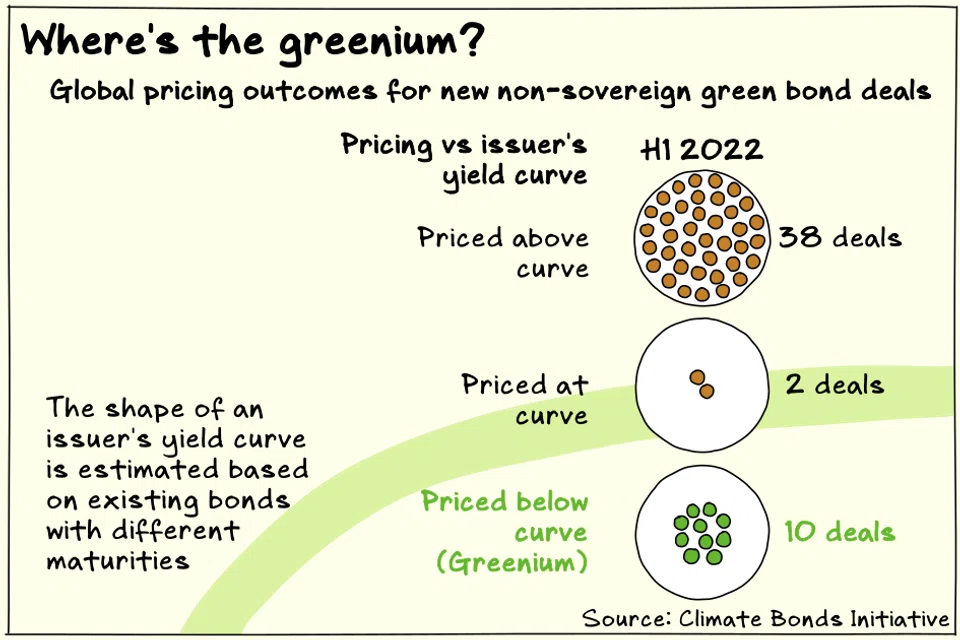
If cost of capital was the only consideration (and it very often is a very important one), a green bond would only make sense if it is able to attract a yield that is lower than the yield on an unlabelled bond; in other words, if the green bond had a green premium, or “greenium”.
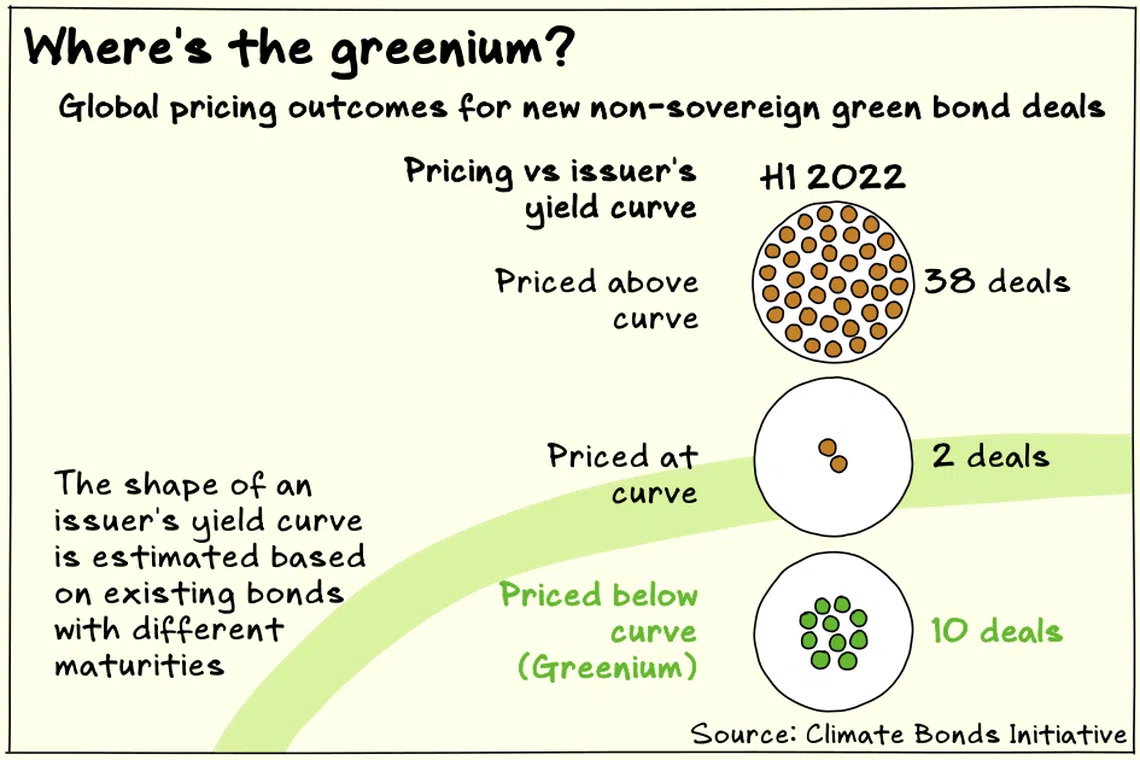
Bond greeniums are more apparent in certain developed markets, such as Europe. In Asia, however, there isn’t enough consensus in the market that greeniums exist.
And yet issuers, both corporate and sovereign, continue to issue labelled bonds in this part of the world.
One reason, as DBS head of fixed income Clifford Lee put it, is that issuers are willing to pay for “a right of access” to the green bond market. There are investors that are only interested in green bonds, whether it is because of portfolio targets or because of investment mandates, and it is prudent for an issuer to maintain access to this source of capital.
Why aren’t greeniums more apparent in Asia? A lack of greeniums could suggest investors aren’t pricing impact into the bonds, or that the market doesn’t view greenness as having an impact on default or liquidity risks. In other words, it might not matter to the market if the underlying project reduces carbon emissions by 100 tonnes a year or 1,000 tonnes a year.
Another possibility is that the market cares about greenness, but is sceptical that the labelled bonds in Asia are as green as they claim to be.
Other South-east Asia reads
- ESG investing: Asia more focused on real-world impact, while Europe is ticking boxes
- Asean needs to triple investments in renewables to meet climate goals by 2050