

Issue 161: SGX extends climate reporting deadlines; Piyush Gupta banks on blended finance, carbon markets

This week in ESG: Market regulator unveils tiered rollout of reporting requirements; former DBS CEO sees market mechanisms lowering decarbonisation costs
Sustainability reporting
More time is not enough
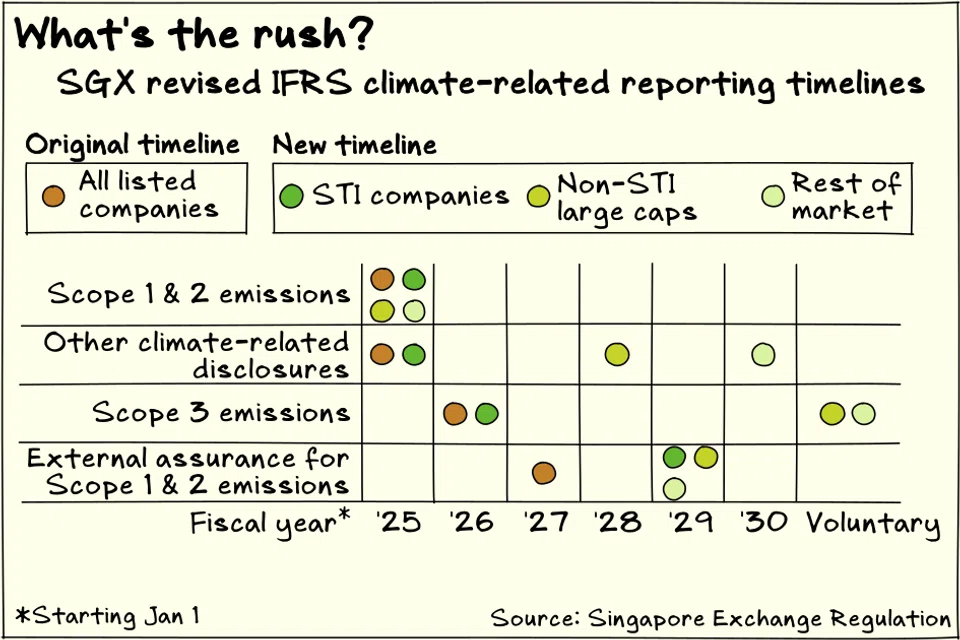
Between April and May this year, Singapore Exchange Regulation (SGX Regco) and the Singapore Business Federation (SBF) polled close to 40 listed companies about climate reporting.
Less than 5 per cent felt “very confident” of meeting the only-months-away deadline for climate reporting using IFRS accounting standards. Even allowing for a huge margin of error in that informal survey, SGX Regco was faced with the prospect of a large non-compliance rate in 2026 when mandatory climate reporting was set to kick in. At those levels, non-compliance penalties stop being punishment and become membership fees.
Therefore, it’s no surprise that SGX Regco and Singapore’s Accounting and Corporate Regulatory Authority (Acra) are extending climate reporting deadlines for listed companies and large non-listed companies. However, while the regulators may have given the companies extra time, they also need to address the reasons why the extra time is needed, and ensure that companies are meaningfully using the extension.
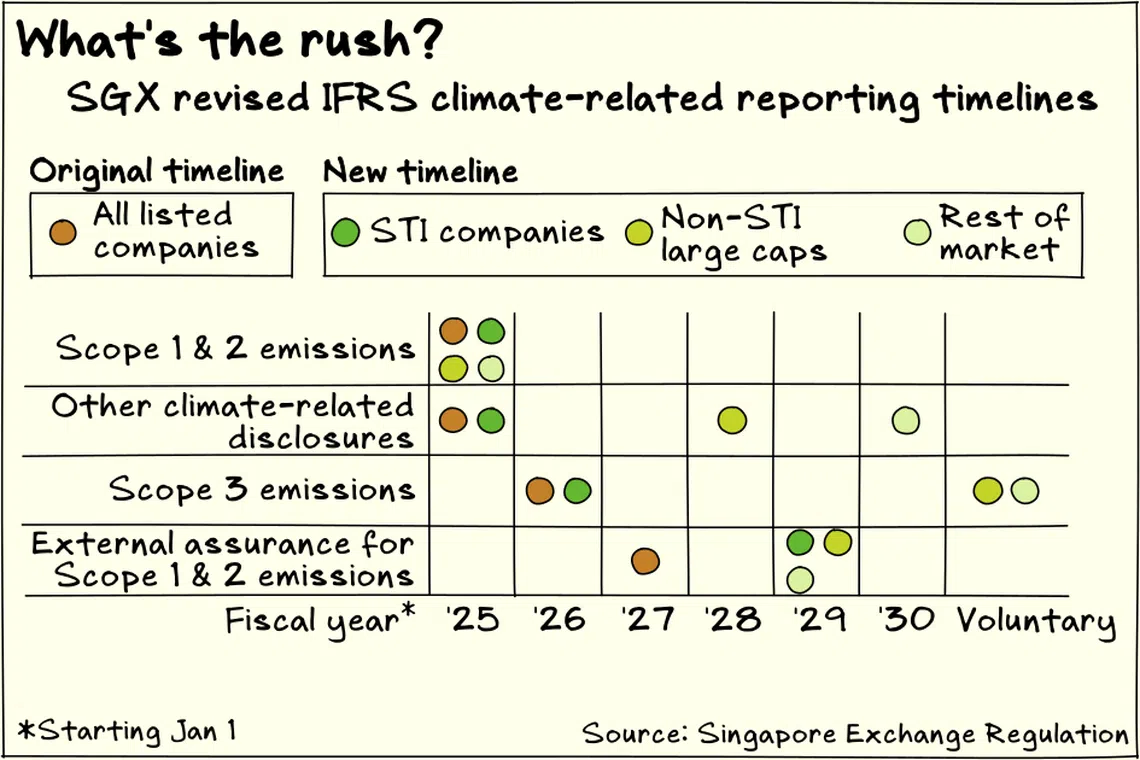
In 2024, the regulators announced that mandatory climate reporting aligned with the IFRS standards will apply to all Singapore-listed companies for financial years that begin Jan 1, 2025 and later. This would have meant that the first compulsory IFRS-aligned climate reports would be published only in 2026.
That schedule is no longer applicable.
The newly announced extensions distinguish between three tiers of listed companies:
- Straits Times Index (STI) constituent stocks
- Non-STI large market capitalisation companies with at least S$1 billion in market value
- Non-STI, non-large cap companies
The timeline for IFRS climate disclosures hasn’t changed for STI companies, but non-STI companies receive extensions of three to five years, with non-STI, non-large cap companies now required to report largely-aligned disclosures from 2031 onwards instead of 2026. Reporting on Scope 3 emissions, which refer to indirect greenhouse gases produced along a company’s value chain, will now be voluntary for non-STI companies until further notice.
All listed companies were initially required to obtain external limited assurance for their Scope 1 and 2 emissions for financial years beginning Jan 1, 2027 onwards. That has now been pushed to 2029. Scope 1 emissions are directly produced by a company, while Scope 2 emissions are indirectly produced through purchases of electricity, steam, heating and cooling.
An SGX Group spokesperson says the tiered implementation supports an end goal of “quality and accurate reports” by allowing companies to learn from the reports of bigger and better-resourced companies in the same industry.
In particular, IFRS requirements on climate scenario analysis and modeling the current and anticipated financial impacts of climate change are areas that smaller companies have identified as challenging, the spokesperson says.
The extensions are certainly generous, to the extent that marketwide alignment on SGX will now be reached after Malaysia. The regulators have not really explained why they think so much time is needed.
It’s not a given that time will solve all problems.
In 2013, a number of manipulated Singapore-listed stocks collapsed in what is now known as the penny stock crash. Singapore regulators quickly sought to improve the quality of listed companies on the stock exchange and to reduce the risk of market manipulation. It led to a 2016 rule that Mainboard-listed companies must maintain a minimum share price of 20 Singapore cents or face delisting.
One problem? Many Mainboard-listed companies were trading below the minimum trading price. The initial three-year cure period was reset once in 2017, and by the time the key June 2020 deadline approached for errant companies to raise their share prices, 54 companies were at risk of delisting and another 41 faced the same fate after June 2020.
Not surprisingly, SGX Regco scrapped the minimum trading price shortly before June 2020 arrived, wisely averting waves of mass delistings from a stock market that didn’t need another potential cut in market liquidity.
Extending the three years to four was not enough time for the companies to raise their share prices. There were many problems with the minimum trading price, but perhaps the most relevant was that companies were largely left on their own to try to cure their non-compliance. Of course, the exchange had no obligation to help the companies raise their share prices, but it certainly didn’t help to put the companies on a watchlist that effectively created an overhang over the stocks.
The lesson is that when swathes of the market are struggling to meet a regulatory deadline, time is not the only need.
To their credit, Singapore’s Economic Development Board and Enterprise Singapore offer a Sustainability Reporting Grant, but more is needed. Additional support to consider might be SBF’s call for Singapore-relevant cross-sector and sector-specific guidance to help smaller companies navigate the scenario analyses required by the IFRS standards.
Beyond providing support, the regulators also need to make sure that companies are making progress towards quality reports. Companies that aren’t reporting aligned with IFRS climate disclosure standards before the deadline should be required to provide details about their progress towards alignment.nother instructive adventure in market regulation is the effort to improve board diversity.
When corporate Singapore began a concerted effort to improve board gender diversity in 2013, women held just 8.1 per cent of all board seats in Singapore-listed companies. By 2025, that had more than doubled to 18.1 per cent.
What has greatly enabled the progress on board diversity is support from across the board. SGX provides the secretariat for the national Council for Board Diversity, which has been an effective advocate that constantly engages companies and provides resources. Investors, especially institutional players, have played a role in holding companies more accountable for board diversity.
There have also been sticks to go with the carrots. The board diversity journey has been one of ratcheting expectations. Diversity was initially a comply-or-explain mention in corporate governance reports; listing rules now require reporting on diversity policies. Regulations have been strengthened with regard to board renewal and term limits.
The lesson here? Providing support and resources to companies while adjusting the rules to remain appropriately progressive are complementary and help to create change.
A playbook of comparable ambition is needed to drive better climate reporting among Singapore-listed companies. Climate change is one of the biggest drivers of risks and opportunities in the years ahead, and there’s an urgent need to address these risks and opportunities. Time is running out, and if we’re going to give companies more time, it’s important to ensure that the extra time is not wasted.
Sustainable finance
The right tool in the right hands
Like any self-respecting banker, former DBS chief executive Piyush Gupta believes in the power of market solutions to climate problems.
At a panel organised by Singapore Management University (SMU), Gupta noted that blended finance and carbon markets are the main mechanisms that could channel capital from developed countries towards lowering decarbonisation costs in emerging markets.
But as his fellow panelists observed, sound policy is the key to unlocking the power of those mechanisms.
Blended finance refers to financing structures that rely on concessional capital from participants with higher risk appetites to mitigate the risks for commercial participants. For example, a development finance institution might offer its balance sheet to partially guarantee a project, thereby lowering the risks of the deal enough for private investors to take part in it on commercially viable terms.
Gupta observes that multilateral development banks and development finance institutions, which are important sources of concessional or catalytic capital, can act as an in-between layer that makes it politically easier for developed countries to channel money to the Global South.
As for carbon markets, Gupta says that many solutions for carbon removals and reductions lie in the Global South, and functioning carbon markets are a way to facilitate the southward flow of money.
While Gupta is correct that both mechanisms are important, the reality is that they also haven’t quite lived up to the hype. Blended finance continues to face challenges with scaling up, partly because its use case is restricted to unbankable projects (concessional capital won’t subsidise a deal that private investors are perfectly happy to finance on their own), and unbankable projects tend to be smaller and higher risk. Carbon markets are suffering because of a collapse in confidence about the quality of carbon credits.
Gupta’s fellow panelists – special representative of the UN Secretary-General for sustainable energy for all Damilola Ogunbiyi and SMU Singapore Green Finance Centre professorial research fellow Rajiv Lall – were more focused on the importance of policy.
Policy might well be the more fundamental challenge. There’s no bigger owner of concessional capital than a government, which can direct public funds towards mitigating risks for unbankable decarbonisation projects. Risk mitigation doesn’t even have to be direct financial allocations. For instance, stable and predictable feed-in tariff policies can greatly improve the feasibility of renewable projects. Improved laws and enforcement of property rights can raise confidence about nature-based carbon solutions.
Blended finance and carbon markets are nifty tools, but a tool is only as good as the hand that wields it.
Other ESG reads
- Microsoft, Rolls-Royce Power Systems push treated vegetable oils to green Singapore’s data centres
- Governments not doing enough to enable green hydrogen, says private equity investor
- Indonesia scraps coal pricing rules after pushback from buyers
- Danantara and China’s GEM to develop nickel processing hub in Indonesia
- Taking away food in CBD? Refuse the disposable cutlery at least
- How Asian businesses can endure like diamonds
TRENDING NOW

‘If there’s a price to be paid, so be it’: George Yeo says Singapore must safeguard its reputation

South-east Asia has lost Nvidia’s best salesman
CapitaLand, Far East, Sing Holdings team up for S$1.8 billion bid at S$910 psf ppr for Jurong Lake District site

Beyond the greenback, Vietnam’s big borrowers turn to Asian-currency bonds

