

Issue 163: Pentagreen-managed blended fund hits first close; small listcos, we have a problem

This week in ESG: Green Investments Partnership fund raises US$510 million; the need for climate reporting
Sustainable finance
Peering into the blended fund
Fund vehicles are the hottest thing in the world of blended finance, and Singapore is in the thick of the excitement.
Blended finance is a way to fund sustainable initiatives by shifting risk in a deal towards more altruistic investors so that commercial capital can participate. Among the various ways that blended finance is applied, blended funds have become the largest mobilisers of blended investments amid growing interest in scaling up blended finance.
The latest development in blended funds comes this week with Singapore announcing that its Green Investments Partnership (GIP) fund has reached a US$510 million first close.
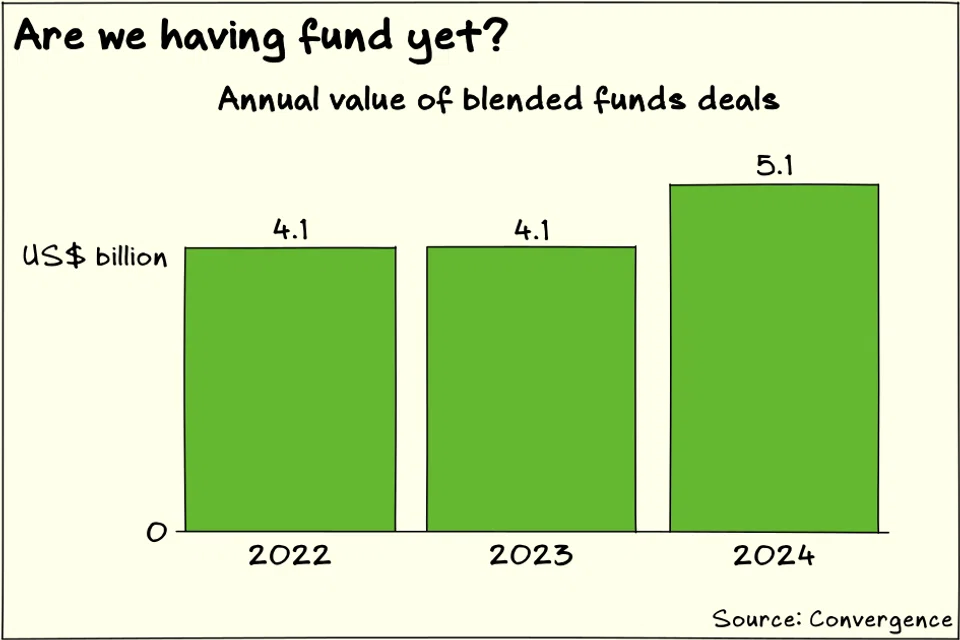
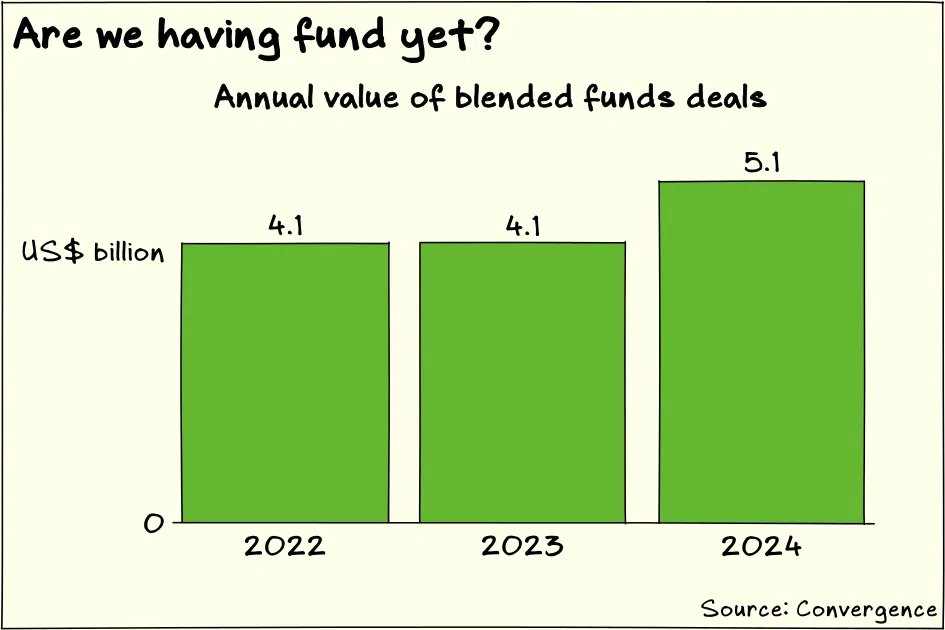
To put the deal’s size in perspective, it’s worth about 10 per cent of the US$5.1 billion that blended funds around the world mobilised in 2024, based on data by blended finance network Convergence. The deal makes fund manager Pentagreen Capital, a joint venture between Singapore government-owned investor Temasek and HSBC, one of the largest blended finance fund managers in the world.
GIP isn’t a one-and-done for Singapore and blended finance. It’s one of three programmes under the Monetary Authority of Singapore (MAS) blended finance initiative known as Financing Asia’s Transition Partnership (Fast-P). MAS launched Fast-P in 2023 with the goal of raising US$5 billion. MAS is also providing US$500 million of matching concessional capital to support Fast-P.
Singapore’s bet on blended finance has its roots in the region’s massive climate investment gap. Research by the International Monetary Fund reckons that the Asia-Pacific requires at least US$1.1 trillion of climate investments annually, and actual investment is about US$800 billion short.
The hope is that blended finance can lower the hurdle for many climate projects in the region that cannot access private capital on their own. But scaling up blended finance has been a challenge, because every project and deal has its own set of circumstances that has led to many hard-to-replicate one-off financings.
Blended funds try to overcome those challenges by pooling both concessional and commercial capital, and by delegating deployment to trusted fund managers.
For example, GIP brings together Temasek, MAS, International Finance Corp, Dutch Entrepreneurial Development Bank, HSBC, British International Investment, Bank of the Philippine Islands, Allied Climate Partners, and the Australian government, represented by Export Finance Australia. Also, the European Commission supports GIP under its Global Gateway programme.
MAS has not disclosed how GIP is structured, but blended funds typically create different risk-reward tiers to distribute cash flow from the debt they purchase with their capital.
Amundi researchers explain that such “pay-through” architecture pays cash flows to investors based on their tranches, such that investors in senior tranches get paid before investors in junior tranches. This is opposed to “pass-through” structures, where cash flows are distributed to all investors on a pro rata basis.
Concessional investors, which might include development finance institutions and philanthropies, will typically sit in the junior or equity tranche. By taking on more of the risk in the portfolio, the concessional folks allow the creation of the senior tranche, which has been de-risked to the extent that private investors can now take part without violating their mandates. In fact, because commercial institutional investors are major participants in blended funds, the senior tranches are often investment grade so that the institutional players can join. Some funds have a third mezzanine tranche that sits between the junior and senior tranches.
How the fund and the cash flows are split between the tranches is crucial. The larger the junior tranche, the better the rating of the senior tranche. The asset manager must find the sweet spot that uses as little concessional capital as possible to catalyse as much private capital as possible.
The leverage ratio shows how much commercial capital is raised for each concessional dollar. In the case of GIP, the US$102 million of concessional capital – including US$51 million of matching funds that Singapore committed – attracted US$408 million of commercial capital, a leverage of four times.
The global average as at 2024 was US$5.46 of commercial capital for every dollar of concessional capital for transactions above US$100 million, Convergence data shows. For all transaction sizes, the global average was 3.76 times.
Whether the funds can solve blended finance’s scaling challenge remains to be seen.
One problem is that fund terms tend to be long – they mostly last at least 10 years – which makes it difficult to assess the success or failure of innovations. The long life cycles of the funds can also make them less attractive to impatient commercial capital.
Another major problem is a currency mismatch. The Amundi researchers note that many blended funds are denominated in the major G7 currencies used by investors, not the local currencies earned by borrowers in the developing markets where the projects occur. Currency facilities exist, but are expensive. The currency mismatch is a “persistent barrier” to growing blended finance in developing markets, the researchers say.
Nevertheless, no solution to a problem as huge and complex as climate action is perfect. The investment gap is also large enough that every little bit counts. Even if that bit is a mere US$510 million.
Sustainability reporting
Don’t be a climate Blockbuster
The hardest part about climate reporting might well be convincing people that it’s important.
In an article about climate reporting deadline extensions for Singapore’s smaller listed companies, Audience Analytics chairman and managing director William Ng questions the requirement for small companies with low emissions to provide climate disclosures aligned with the IFRS international accounting standards. He grumbles that it’s not clear whether:
- Climate is material enough to his business analytics, events and media company; and
- It’s proportionate to ask “an office-bound service-oriented business with fewer than 100 employees” to do the full climate report
At least Ng is honest. In its latest sustainability report, Audience Analytics’ board declares that “climate change will not have a significant effect on our operations in the foreseeable future”. As a result, the board has decided not to conduct a formal scenario analysis.
It’s not difficult to see why the deadline extension has led to some cynicism about whether listed companies really deserve the reprieve. Exhibit A is a company that – with full knowledge of the coming Singapore Exchange climate reporting requirement and before the deadline was extended – determined that climate change would not have a significant effect on operations and there is therefore no need to perform a scenario analysis.
This is despite the company listing out, just after the declaration, three climate-related risks and two climate-related opportunities that would have potential financial impacts. One of those climate-related risks is “enhanced emission reporting obligations”, to which the company reported that it would “continue to adapt its operations to meet existing and new regulatory requirements”.
Climate change is a global phenomenon that is expected to profoundly disrupt many fundamental aspects of life as we know it. It’s arguably material for every business that intends to be around for at least the next decade. For example, even the “office-bound service-oriented” Audience Analytics’ first climate-related risk mentions physical risk from extreme weather, which could lead to increased expenses for events, require the purchasing of insurance and impose restrictions on where and when events can take place.
These mega-disruptions don’t happen very often, but when they do, businesses are generally better off keeping at least a step in front of the trend.
Businesses instinctively view reporting requirements as compliance burdens, but the process of producing a report is also an important health check for the company and a way to engage with stakeholders. Being deliberate in climate reporting, with all of its hassle, helps businesses to manage their exposure to a major driver of risks and opportunities. Mandatory climate reporting also improves the data landscape, which benefits other stakeholders like investors.
A good starting point for the still-unconvinced companies is to remember Blockbuster, the collapsed video rental giant caught sleeping on the Internet and Netflix. Don’t be a climate Blockbuster.
Other ESG reads
- Singapore’s blended finance platform seeks insurers’ participation: Ravi Menon
- BlackRock explores risk models to add scale to blended finance
- Nio plans US$1 billion share sale to fund EV growth
- EU clears Malaysia’s palm oil certification for new deforestation rule
- China’s Marshall Plan is running on batteries
- China’s green tech firms pour billions into overseas factories
TRENDING NOW

Simba admits exceeding spectrum limits amid failed M1 deal; full-year profits surge 277%

He built the Vingroup empire. Now South-east Asia’s richest man is handing some key roles to his sons

What’s on the agenda when Xi and Trump meet in Washington

Ex-execs of CW Group, Allied Tech charged with offences linked to lawyer’s S$76 million misappropriation

