Issue 169: Carbon credit insurance gets MAS boost; sustainable loans draw scrutiny
This week in ESG: Carbon market development grant to offset cost of insuring credits; recent ESG-labelled financing deals under spotlight

Carbon markets
Tackling integrity through insurance
The field of carbon credit insurance could get a boost from Singapore’s newly announced initiatives to support the development of carbon markets.
As part of those initiatives, the Monetary Authority of Singapore (MAS) is launching a S$15 million Financial Sector Carbon Market Development Grant to address “near-term cost barriers” faced by financial institutions.
The grant comprises two tracks.
Aimed at capability building, the first track will fund 50 per cent of eligible expenses for up to three years incurred for new headcount that is predominantly undertaking carbon credit-related work. Qualifying headcounts include carbon credit insurance underwriting and product structuring, among others. The grant amount under this track is capped at S$1.2 million.
The second track is aimed at defraying costs associated with carbon credit transactions, and will pay up to 70 per cent of eligible professional services fees incurred in carbon credit deals for one year, capped at S$500,000. Non-Singapore-based financial institutions, including international organisations such as the International Finance Corp or World Bank, may qualify for the grant under this track if they buy carbon credit insurance from Singapore-based insurance brokers and insurers.
Inclusion in the grant reflects the growing importance of insurance in addressing some of the biggest problems with carbon credits.
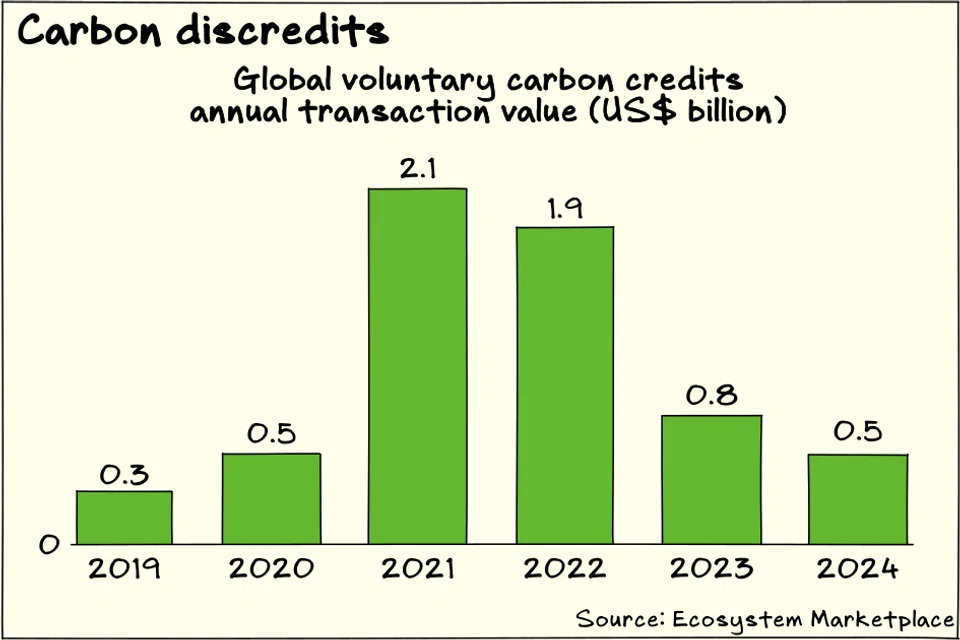
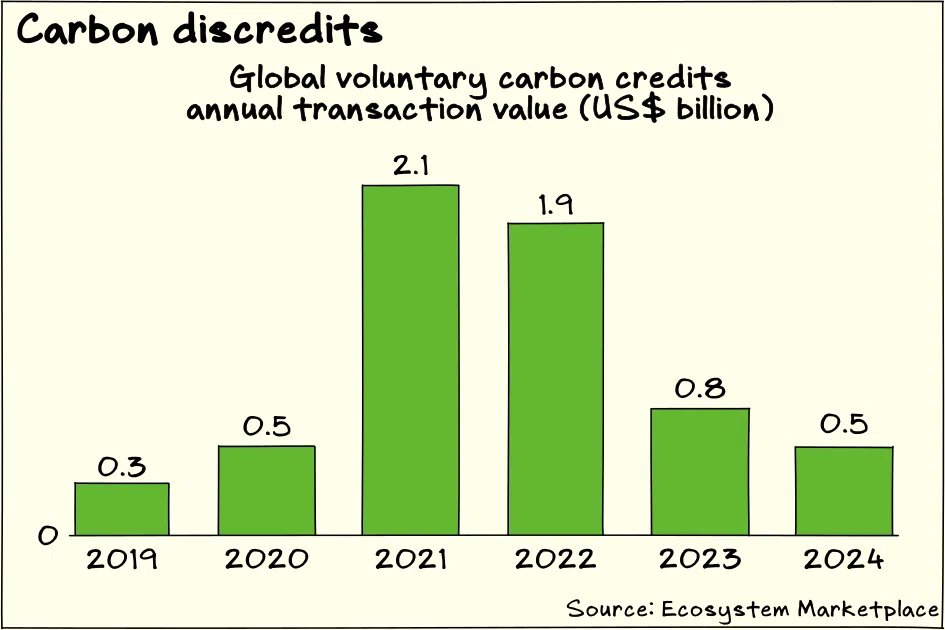
Trading of carbon credits has fallen sharply over the past few years because of credibility issues. The global transaction value of traded voluntary carbon credits in 2024 was US$535.1 million, almost 30 per cent lower than the US$754.5 million traded in 2023, based on data reported by Ecosystem Marketplace. At its peak, the voluntary carbon markets witnessed US$2.1 billion of transactions in 2021.
But just because trade volumes have fallen doesn’t mean that the need has gone down. Ecosystem Marketplace’s data shows that the number of credits being retired – used to offset emissions and therefore no longer tradable – has largely held steady over the past few years.
A lot of work has taken place since 2022 to attempt to address the integrity issues in carbon credits, including changes to methodologies and the creation of a set of Core Carbon Principles by the Integrity Council for the Voluntary Carbon Markets. But improved standards and methodologies don’t protect buyers against the risk that those standards and methodologies might prove inadequate in the future, as happened with the previous standards and methodologies that the current standards and methodologies have replaced.
Many carbon credit projects are also located in emerging and developing countries, where political risk tends to be higher. Future policy changes could alter the integrity of carbon credits bought today. For instance, there has been growing interest in jurisdictional forestry-based credits, which are based on aggregated outcomes across a policy area. However, a change in government could lead to a change in policy, which could affect the integrity of credits from that area.
Carbon credit methodologies have tried to address these risks through the use of “buffer pools”. The way these work is that verifiers retain some of the verified credits issued instead of selling them. If some of the credits need to be undone – called “reversal” in industry parlance – in the future, the retained credits can be used to make good credit holders.
But there are concerns that buffer pools don’t work very well to mitigate risk. Oka, a carbon insurance firm, explains the shortcomings of buffer pools:
- They do not accurately price risk. Oka highlights a lack of transparency about how verifiers determine how large of a buffer pool is required.
- A conflict of interest exists when the verifier sets standards and bears the risk of having to draw on the buffer pool. Verifiers may be structurally disincentivised against developing more stringent standards because doing so could increase the burn rate of the buffer pool, Oka says.
- Buffer pool risk coverage is incomplete. Pools only cover unavoidable, catastrophic losses, but projects are exposed to many other risks.
- Buffer pools are financially inefficient. Because the buffer must be held for the entire period over which the underlying credits might be reversed, they become a growing liability that cannot be reinvested or put to more productive use.
- Buffer pools don’t adequately incentivise project developers to improve quality. When pool contributions are fixed or rely on opaque risk assessment criteria, it’s not clear to developers how better-quality credits will affect their economics.
Insurers hope to offer a better product through carbon credit insurance.
They argue that using actuarial models allows for the correct pricing of risk. Insurers are also able to pool risk worldwide, lowering the average cost of insurance for all market participants. Furthermore, insurance offers flexibility in terms of what is covered and how. A carbon credit insurance policy could pay in cash or in kind, for example.
It could also protect coverage for reversals due to government actions. The Carbon Offsetting and Reduction Scheme for International Aviation (Corsia) allows only carbon credits that are issued with “corresponding adjustments” safeguards. A corresponding adjustment is made when the country where the credit is issued agrees not to claim that credit for its own emissions inventory, so that when the credit is exported – to a foreign airline, for instance – the credit isn’t double-counted by both country and airline. To protect against a future government that disregards the corresponding adjustment, insurers can provide political risk insurance for the credits.
While the rationale for carbon credit insurance looks strong, in practice the amount of time required to create the coverage has raised some concerns about feasibility, as Norton Rose Fulbright observes.
Nevertheless, carbon credit insurance is an innovating space with many kinks to work out. Besides the MAS grant, Singapore is also engaged in discussions via trade agency Enterprise Singapore with leading companies in Asia to establish an industry-led buyers’ coalition. Taken together, these initiatives take aim at key inefficiencies that present hurdles to scaling up the carbon markets.
Sustainable finance
A healthy tension over standards
What makes sustainable finance sustainable?
That question has come to the forefront recently, with questions asked about the appropriateness of a green loan for a residential project and the landmark loan with the “transition” label.
The truth is that perfect sustainability is almost impossible to achieve when it comes to human activities, and discourse about sustainable finance has to be realistic about the choices made between conflicting types of impact. But it’s also important to recognise that the industry tends to err on the side of allowing funding, and that public scrutiny is critical to ensure responsible financing.
A recent S$692 million green loan by DBS and OCBC for property developer Hong Leong came under criticism because the project being funded, a mixed-use residential project in Tengah, would require clearing secondary forest.
The deal ticked fulfilled all the requirements for green labelling. The development would meet green building standards, which cover areas such as energy efficiency, thermal efficiency and materials selection. An environmental impact assessment found that the land being cleared was predominantly scrubland, herbaceous vegetation and abandoned land-forest, and did not have any primary forest. The project was also consistent with national land-use plans. In fact, the land was sold by the Singapore government for this purpose.
The banks understandably granted the loan and labelled it green since it met the criteria. Asking banks to go beyond the established sustainable finance taxonomies and the national sustainability and land-use blueprints may not be a good idea. The result would be different banks having their own standards, which would make greenwashing even worse since there would be less oversight over individual standards, and borrowers could shop around for the easiest criteria.
Notwithstanding that, it’s helpful for the public to raise questions about whether the standards and criteria used by the banks are robust enough. Singapore’s Code for Environmental Sustainability of Buildings is mostly concerned with energy and thermal efficiency and emissions, with hardly any safeguards for nature. As Singapore pursues its green strategy, it’s worth reviewing green building accreditation to incorporate nature considerations.
Another recent deal in the spotlight is a S$500 million transition loan by DBS, OCBC and Maybank for YTL PowerSeraya for the construction of a hydrogen-ready combined-cycle gas turbine (CCGT). This is believed to be the first transition finance loan aligned with the Singapore-Asia Taxonomy for Sustainable Finance.
The deal is worth watching. YTL PowerSeraya says the plant has an expected lifespan of 25 years. If hydrogen never reaches a level of feasibility in Singapore that it can be fed into the plant – and that’s not a remote possibility given green hydrogen’s current state of development – the loan would be paying for a plant that could be burning natural gas for at least a couple of decades.
Despite that risk, the loan fully complies with the taxonomy and with general transition finance principles. The plant is viewed as an enabling investment that allows Singapore to meet its current energy needs – for which renewables are insufficient – but with the means to switch it to a greener feedstock if that pathway ever materialises. There’s also a sunset date whereby the transition label would no longer be valid after 2035, which means that if the hydrogen pathway doesn’t form up by then, the loan would no longer be considered sustainable.
Ultimately, the plant is integral for Singapore, which cannot meet its energy needs on renewables alone, as the country explores different pathways to a green power supply.
Yet it’s important to scrutinise such deals for potential greenwashing. Singapore’s national energy strategy currently still includes hydrogen, so the hydrogen-enabled CCGT legitimately supports that effort. But if a similar deal was struck elsewhere without a clear national strategy and where hydrogen is not a feasible pathway, building another gas power plant is as good as locking in a fossil fuel asset for decades, even if it’s hydrogen-enabled.
Sustainable finance practitioners tend to see compliance with existing standards as good enough, and for good reason. Asking financiers to write their own rules can be counterproductive, worsening greenwashing and slowing the provision of capital for green activities.
But it’s always worth examining the deals and probing the standards to see if they are fit for purpose. It’s an unavoidable tension that comes from trying to strike a balance between letting capital flow smoothly and quickly to green activities and putting in safety valves to keep it from flowing to the wrong places.
Other ESG reads
- Increasingly challenging to find suitable land for data centres: Keppel CEO
- Green data centres: Singapore companies call for new inter-agency body, innovative financing
- Singapore to build 700MW data centre park on Jurong Island, pilot biomethane imports: Tan See Leng
- Jurong Island’s ‘balancing act’: Going green while sustaining jobs and growth
- Singapore’s only active coal plant to transition to biomass by 2028
- Singapore receives interest from Malaysian firms to export renewable energy through second interconnector