

Issue 170: Potential CapitaLand, Mapletree merger’s ESG challenge; COP30 confronts US pullback
This week in ESG: Temasek-linked real estate companies explore union; report finds US gains at expense of others in climate withdrawal

Sustainable investing
Merging ESG strategies for CapitaLand, Mapletree
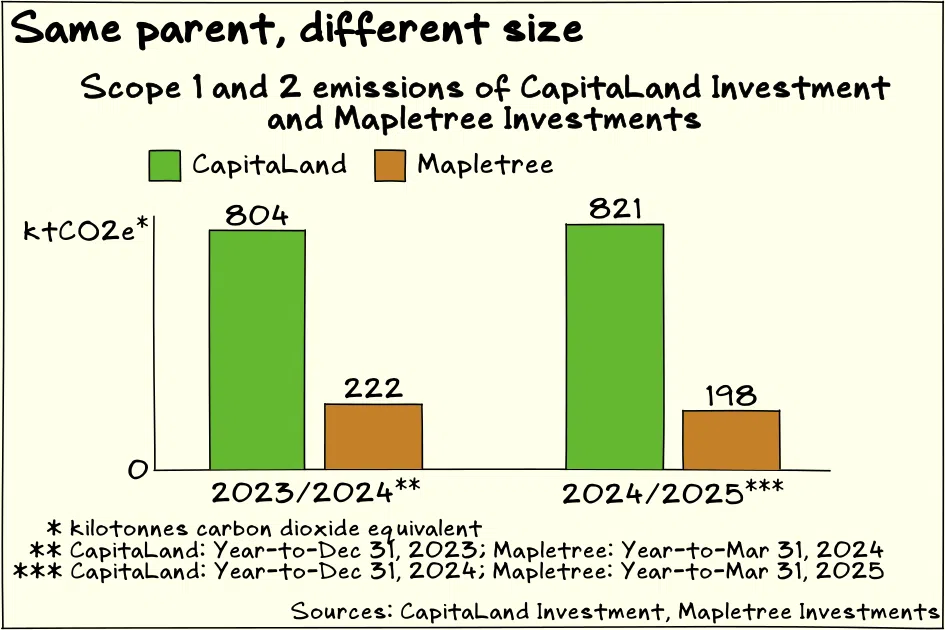
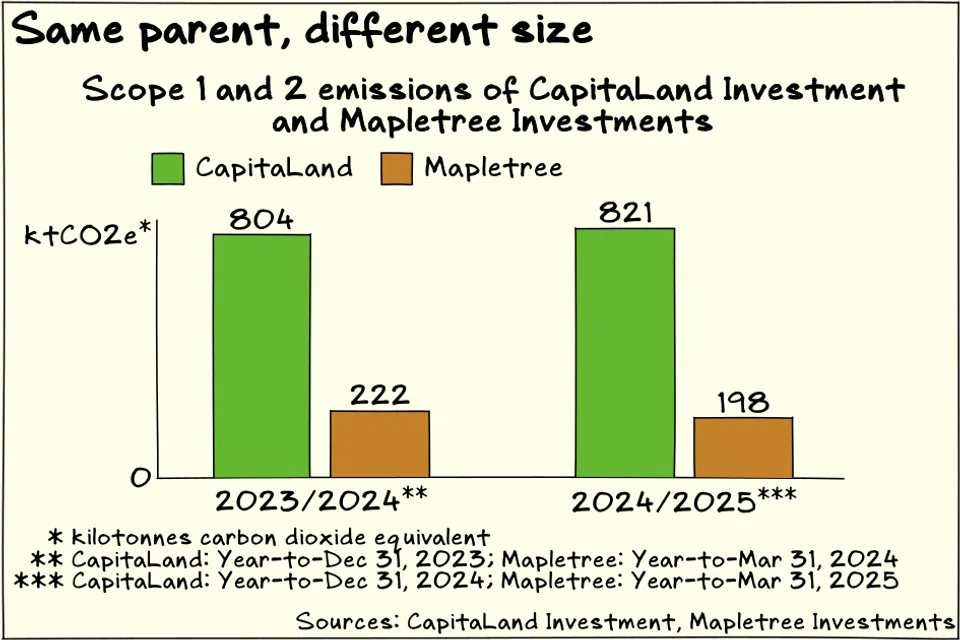
A possible merger between two Temasek-linked real estate groups might require harmonising of environmental, social and governance (ESG) goals and governance if a deal were to materialise.
CapitaLand Investment (CLI), in which Temasek holds a majority stake, and Mapletree Investments (MIPL), a wholly owned Temasek subsidiary, are considering a possible merger, Dow Jones reported this week. Plans are preliminary, the news agency reported.
In a statement, CLI declined to comment on rumours or speculation as a matter of policy, and said it regularly explores and evaluates various investment opportunities that align with its strategic objectives. MIPL did not comment.
If a deal were to happen, it could create one of Asia’s largest real estate companies, with more than S$200 billion of assets under management. CLI is the bigger entity, with S$136 billion of real estate assets under management and S$117 billion of funds under management as at end-2024. MIPL’s total assets under management was S$80.3 billion as at end-March.
No merger at that scale is ever simple or straightforward, but one of the aspects of a business combination that will have to be ironed out is the different ways that each entity approaches ESG.
For a start, while both companies aim to achieve net-zero emissions by 2050, they have different interim targets, with CLI’s 2030 goals more clearly communicated.
For example, CLI aims to reduce Scope 1 and 2 emissions by 46 per cent from 2019 levels by 2030. MIPL has a 2030 target of reducing landlord electricity consumption by 30 per cent from its FY2010 baseline, but only for its Singapore Commercial portfolio. MIPL’s sustainability disclosures mention 2030 targets for its China, India and US assets, but not the amount of reduction that it is aiming for.
However, one of MIPL’s climate targets is to reduce embodied carbon by 30 per cent from an unspecified baseline by 2030. CLI does not address embodied carbon in its climate goals.
The different targets will have to be addressed in any major merger or acquisition between CLI and MIPL because both companies have sustainability-linked debt tied to those targets. Sustainability-linked structures vary the interest rate depending on the borrowers’ performance against sustainability targets.
Because CLI and MIPL use different baseline years, merely imposing one entity’s targets onto the other might be challenging. For instance, MIPL might not even have 2019 emissions data for its portfolio, even though CLI’s targets are based on a 2019 baseline. MIPL’s embodied carbon baseline might not be applicable to CLI’s assets.
As at end-2024, CLI had raised more than S$20.4 billion of sustainable finance since 2018, of which 57 per cent comprises sustainability-linked loans or bonds. Those borrowings are pegged variously to specific targets for reduction in carbon, energy and water intensities; performance ratings on global ESG indices; or minimum green building certification levels of their underlying portfolio.
MIPL’s cumulative total green and sustainable financing secured was S$8 billion as at end-March 2025. MIPL does not provide a breakdown of how much of that is sustainability-linked.
The impact of the different targets goes beyond capital management, and could affect operations as well.
One area is in the use of an internal carbon price. CLI applies an internal carbon price to its evaluations of new investments and capital expenditures, as well as a proprietary Return on Sustainability metric. The internal carbon price is based on the higher of the expected Singapore 2030 carbon tax or the relevant local carbon tax.
MIPL does not formally apply carbon pricing in decision-making, although it incorporates local carbon taxes where available to assess climate risk. If MIPL were to adopt the same carbon pricing approach as CLI, that could affect MIPL’s future decisions about investments.
Both CLI and MIPL also incorporate ESG performance into remuneration for directors and executives, which could make it impractical to have different sets of ESG targets for different parts of a combined business.
BCG outlines three key ESG-related tasks in post-merger integration:
- Mitigate ESG risks
- Integrate ESG practices and ensure continuity
- Capture ESG opportunities
An important insight from the BCG approach is that ESG integration can be a way to capture opportunities and strengthen ESG performance. For instance, MIPL has developed a methodology for modelling embodied carbon, which can benefit CLI.
Done properly, post-merger ESG integration can be a net positive for both sides.
COP30
Fighting the tragedy of the commons
The 30th edition of the United Nations Climate Summit, known as COP30, kicks off with considerable concern about how much progress can be made in the wake of a US retreat from climate action.
A report by Bloomberg Economics describes a tragedy of the commons problem, where the US stands to gain in the long run by sticking to fossil fuels and cutting green energy goals, while the rest of the world loses by doing the opposite and persisting with their transition to low-carbon energy.
However, everybody loses even more if every country follows the US path and abandons the energy transition.
In other words, the US is the jerk at the buffet piling his plate up with crab legs. If you don’t make a grab for it, there’s going to be less for you, but if everyone goes all out on crab legs, the restaurant is going to stop serving the loss-making dish and then everyone loses.
The analysis shouldn’t be a surprise. The tragedy of the commons in climate change exists because climate costs are still mostly externalised at the moment. This means that the emitter of greenhouse gases gets to share the environmental costs of doing so with everyone else in the world, but keeps all of the economic profits.
This is the reason why it has been so challenging to make progress on climate action. Unless everyone does it, climate action is unfair to the virtuous.
One strategy against freeloaders is to go tit for tat, and hope that rationality prevails before Armageddon. However, this approach only works if parties are generally rational, if forecasts are sufficiently accurate to allow cooperation before it’s too late, and if the consequences of early actions can be undone. Those are big asks with a complex global issue like global warming, where runaway climate change can cross points of no return.
To counter the US, countries that remain committed to climate action must stick together more than ever. Continuing to invest in the green energy transition grows the green economy for everyone, even if the US does not join the party.
It’s also important to advance carbon pricing, especially in trade, so that it becomes more difficult to externalise the negative impact of greenhouse gas emissions. If the US doubles down on fossil fuels, then its exported goods and services should be subjected to carbon duties.
The wealthier, developed nations must step up support for the Global South, so that they can undertake climate action at less cost to the development of their communities and economies. Building free trade between climate-supportive nations is a fine way to grow economies despite the US tariffs and to mitigate the US hegemony.
There is no escaping the fact that the US turnabout on climate action is a blow for the rest of the world. But it’s a problem that can be mitigated.
Other ESG reads
- Singapore, Chile, New Zealand launch negotiations for green economy partnership
- Sovereign-backed framework on corporates’ use of carbon credits launched
- Data centres and clean power: Tricky marriage in the spotlight at Singapore’s energy forum
- Australia mandates free power in world first to soak up solar, reduce living costs
- EV maker Seres steps out of Huawei’s shadow with Hong Kong listing debut
- COP30, the moment of truth
TRENDING NOW

JPMorgan, BlackRock among those making bid to manage CPF savings

GIC in talks to lease bulk of 88,000 sq ft CapitaSky space to be vacated by Allianz

BN-PN’s Melaka election landslide puts spotlight on jobs, investments and political divides

Why Singapore, Johor and Riau Islands should build a cross-border ecosystem for AI

