Issue 180: Sembcorp shareholders vote on Alinta deal; new directorship institute launches
This week in ESG: Sembcorp acquisition’s coal exposure raises questions; GDInstitute offers alternative to Singapore Institute of Directors

Sustainable investing
Sembcorp needs to better address Alinta’s coal business
Shareholders of renewable energy group Sembcorp Industries meet on Friday (Jan 30) to decide on a planned A$6.5 billion (S$5.6 billion) takeover of Australian utility Alinta Energy.
Beyond financials, Sembcorp’s management and board will also have to address concerns about the deal’s impact on the company’s hard-won green credentials. While Alinta has a large renewable-energy pipeline, its existing business includes a substantial coal-fired power segment that will set Sembcorp back on its climate targets.
Sembcorp has previously defended Alinta’s coal business as part of a “just and inclusive“ energy transition, but scant details about transition plans for that coal business could leave Sembcorp vulnerable to criticism that it is simply sticking with business-as-usual on coal. A clearer and more comprehensive transition plan would better protect Sembcorp’s shine among investors and stakeholders who are concerned about climate change.
Sembcorp plans to acquire all of Alinta in a cash deal announced in December. Alinta operates 3.4 gigawatts (GW) of installed and contraction generation capacity across coal, gas, wind and solar, and has a 10.4 GW development pipeline of renewables and firming solutions.
But sitting in that portfolio is the Loy Yang B coal-fired power generator, which supplies about 20 per cent of the electricity used by the Australian state of Victoria. Alinta doesn’t own Loy Yang B, but it contracts to buy the plant’s power to supply the state.
Revised goals
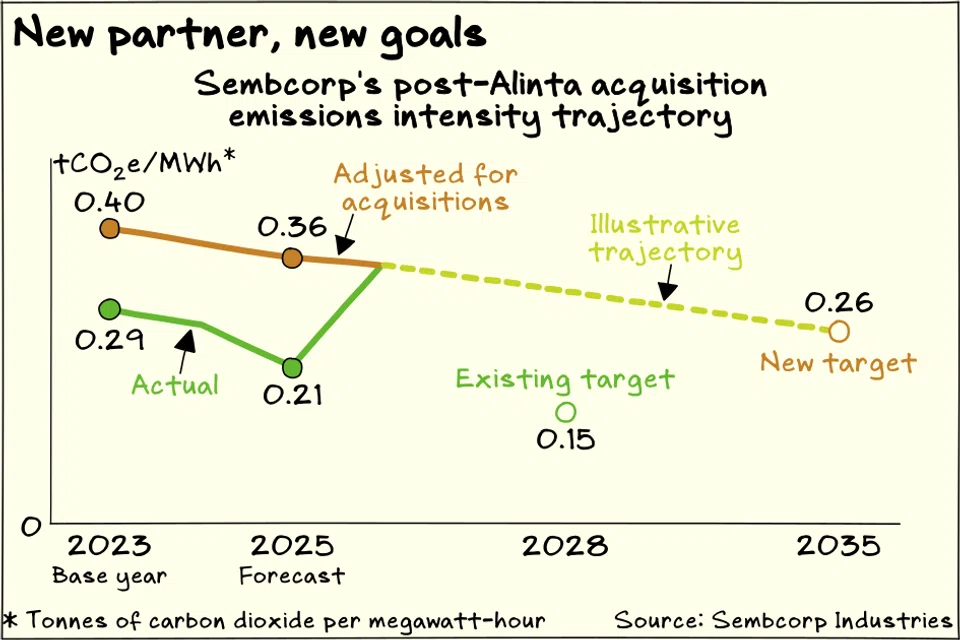
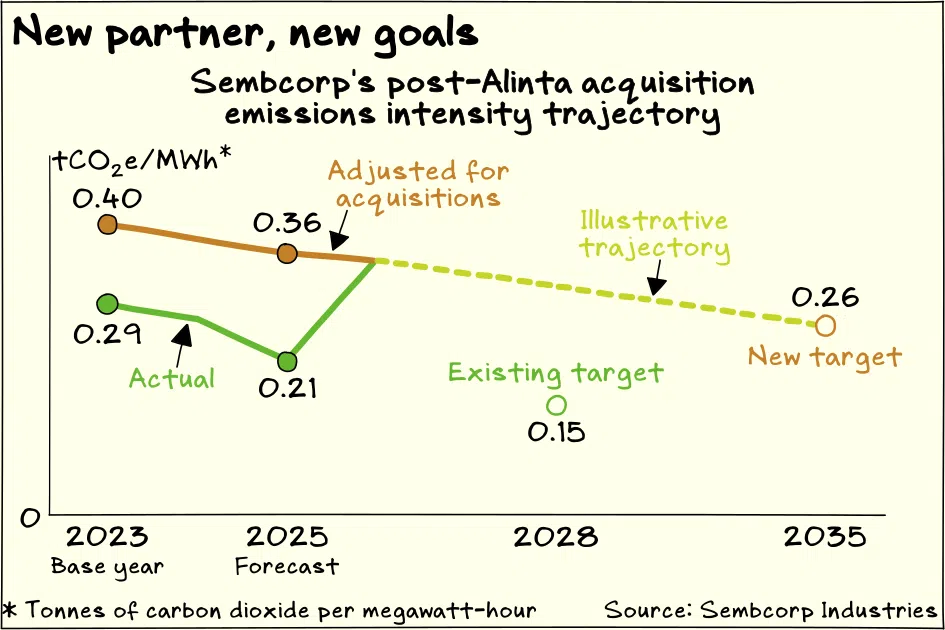
Acquiring Alinta will mean that Sembcorp will no longer be able to achieve its current emissions targets, which includes lowering emissions intensity to 0.15 tonnes of carbon dioxide equivalent per megawatt-hour (tCO2e/MWh). If Alinta were acquired in 2025, Sembcorp’s emissions intensity that year would have risen to 0.36 tCO2e/MWh from 0.21 tCO2e/MWh, Sembcorp says.
Post acquisition, Sembcorp will shift its emissions intensity target to achieving 0.26 tCO2e/MWh by 2035.
Sembcorp has said that despite the negative impact of the deal on its emissions, the acquisition and the Loy Yang B business don’t contradict Sembcorp’s commitment to not invest in any greenfield or standalone coal generation assets in markets that do not have a transition pathway.
Sembcorp has also explained that Loy Yang B provides critical baseload power for Victoria, and will continue to do so until the state can develop enough renewable and storage capacity.
In response to analysts’ queries when the deal was announced, Sembcorp chief executive Wong Kim Yin explained that Loy Yang B was a reliable and low-cost asset serving the Australian market, and that Victoria’s energy transition needs firm baseload technology to be sustained.
“It’s very important to have a just and inclusive transition… Energy security, affordability are just as important as sustainability,” Wong said.
However, positioning Loy Yang B as a transition asset should be supported by a credible transition plan. Investors who are concerned about climate change might want the company to better address its exposure to coal.
Managing exposure
Analysts at the Anthropocene Fixed Income Institute (AFII) have highlighted potential issues on which shareholders should seek more information from Sembcorp.
When the deal was announced, Sembcorp chief financial officer Eugene Cheng told analysts that Loy Yang B’s coal revenue is estimated to represent 5 per cent or less of pro-forma revenue. AFII suggests that shareholders seek clarification on how much of Sembcorp’s revenue will be from coal-fired generation, and how that fits within investors’ coal thresholds. AFII notes that a number of investors may have 5 per cent coal exposure thresholds.
AFII also highlights that Alinta currently obtains coal from a Latrobe Valley coal mine, which also supplies the Loy Yang A thermal unit, which is not part of the Sembcorp deal. But Loy Yang A is scheduled for a 2035 retirement, which raises the possibility that Alinta may have to exercise an option to buy the lignite mine in order to secure supply for Loy Yang B. AFII suggests that Sembcorp’s plans regarding the mine might affect investors that have restrictions on open-pit thermal coal mining.
AFII further recommends seeking more information about the decommissioning plans for Loy Yang B.
Sembcorp deserves credit for being transparent and honest about the rationale for the Alinta deal and the impact on Sembcorp’s sustainability goals. Furthermore, Sembcorp is offering to take full responsibility for transitioning Alinta’s renewables and fossil fuel businesses, instead of selling off the inconvenient assets to dress up its emissions numbers.
But Sembcorp’s approach to transitioning its business relies heavily on increasing green power generation and storage capacity to lower emissions intensity at a portfolio level. Such an approach can neglect absolute emissions from existing brown assets such as Loy Yang B, which continue to operate on pretty much a business-as-usual basis. New green assets may dilute the impact of the old brown ones through averaging, but the brown assets are still spewing out greenhouse gases. A more comprehensive transition strategy should also seek to accelerate the winding down of the coal assets.
Corporate governance
Here comes a new challenger
A new governance and directorship development organisation has set up shop in Singapore, led by prominent corporate governance expert Prof Mak Yuen Teen.
GDInstitute (GDI)– the organisation is not giving any official explanation at this time for what the “G” and “D” stand for – seeks to improve the quality of directorships in South-east Asia, with a strong focus on practical application, and on judgement and ethics.
Prof Mak, who is based at the National University of Singapore (NUS), chairs the board. The other board members are Mary Yeo, independent director at palm oil producer First Resources; Zafar Momin, Petronas Chemicals board member and adjunct professor at NUS Business School; Shireen Muhiudeen, former Bursa Malaysia chair and current deputy chair of the Asian International Arbitration Centre; and Etty Retno Wulandari, former deputy commissioner at Indonesia’s Financial Services Authority. Philip Yeo, former chair of the Singapore Economic Development Board, serves as an honorary adviser.
In Singapore, GDI will offer corporate directors an alternative to the Singapore Institute of Directors, which is the leading directorship development organisation in the country.
The launch gives a welcome boost to a national drive to revive Singapore’s stock market. As part of that effort, Singapore regulators are adjusting market rules to lean further into caveat emptor principles. That places greater importance on directors – especially independent directors – to uphold the standard of corporate governance in listed companies.
Some competition in the directorship development scene should improve the range and quality of training and education offerings for company directors.
Other ESG reads
- Carbon tax: Where Singapore stands in a world divided on price
- EcoCeres opens Malaysia’s first sustainable aviation fuel plant in Johor
- Indonesia’s captive power plants putting energy transition at risk, researchers say
- Flood losses set to soar 1,000% in South-east Asia: insurance firm study
- China’s four-year energy spree has eclipsed entire US power grid
- Should the Code of Corporate Governance be refreshed to complement the EQDP?