

Issue 182: Private equity targets coal; Singapore’s carbon tax realism
This week in ESG: Eastspring, Reviva launch coal phase-out strategy; Singapore Budget 2026 signals caution on carbon tax

Energy transition
Coal phase-out’s existential issues
A new private equity initiative focused on accelerating coal phase-out arrives at a pivotal moment for Asia’s energy transition, but it might need to buff up the level of clarity about its goals.
Eastspring Investments and Reviva Transition Partners say they are jointly developing a new private equity strategy that uses actively managed direct investments in coal-fired power plants to hasten their retirement.
Eastspring, the asset management arm of insurance group Prudential, will source for deals. Reviva, an Abu Dhabi-based private equity firm focused on the coal transition, will provide technical expertise such as investment structuring, coal decarbonisation, thermal asset management and catalytic partnerships.
It appears to still be early days – there is no mention of any specific funds or timelines in the announcements. The collaborators say they are currently “engaging capital providers and coal asset owners”.
Coal-fired plants are among the world’s largest sources of greenhouse gases, and are especially troublesome in Asia and South-east Asia, where many of the plants are relatively young and could be spewing out greenhouse gases for decades unless they are retired early. A key cog in the Eastspring-Reviva strategy is taking direct stakes in some of these plants.
“By directly managing assets, owners have been able to deliver commercial transitions that balance financial returns and tangible impact,” the collaborators say.
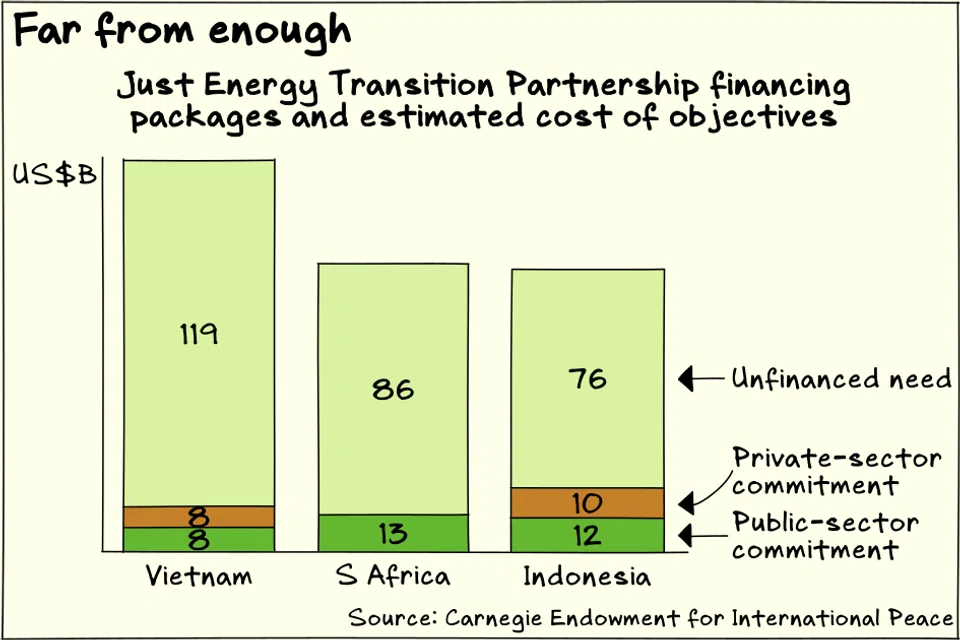
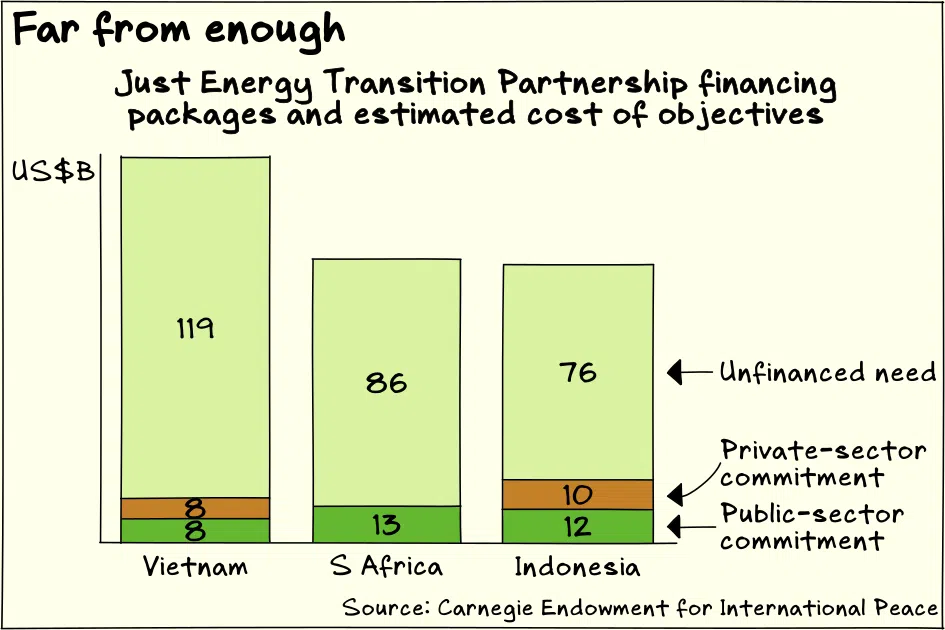
Private-equity financing for coal phase-out would be distinct from the market’s prevailing line of attack, which is predominantly through debt and grants – and grossly insufficient. Data compiled by researchers at the Carnegie Endowment for International Peace show that amounts committed under the multilateral Just Energy Transition Partnership (JETP) programmes fall far short of estimated costs.
A crucial limitation with debt-based financing is that debtholders only have so much control over what management does, which leads to structural distrust between the financiers and the financed. That distrust can handicap a complex, impact-driven deal like the early retirement of a coal plant in Asia, because lenders seeking reassurance might demand too much from cost-sensitive borrowers.
But it’s also generally true that if a solution were so simple, someone would already be doing it. While direct equity investment might be potentially more effective than debt investing at driving the energy transition, coal phase-out faces many challenges that the Eastspring-Reviva strategy will have to overcome.
A fundamental one is building stakeholders’ consensus about priorities.
In December, Indonesia announced that it would cancel the early retirement of the Cirebon-1 coal plant over costs. This was the most advanced project under the Indonesian JETP deal, and its collapse was the latest setback for the JETP programme. Progress on Vietnam’s JETP deal has also been slow.
The multi-billion-dollar, government-to-government JETP deals seem to tick many boxes, yet clear success has been elusive. Even worse, the Indonesian about-turn has raised existential questions about the future viability of JETP.
One problem that JETP faces – and Eastspring-Reviva may face – is confusion about the purpose of coal phase-out, especially when phasing out coal is seen through the lens of justice. The just transition concept strives to ensure that social and economic needs are considered alongside decarbonisation. For example, a coal plant shouldn’t be shut down without addressing the energy needs and costs of affected communities.
The Carnegie researchers argue that the JETP programme has to decide on a core priority, whether that is a narrower goal of energy emissions reduction or a broader objective of economic transformation.
The researchers explain that different stakeholders in the JETP agreements have different priorities, and that creates problems because JETP has limited resources and cannot pursue both objectives at the same time.
“If JETPs are to be successful, the relevant parties must come to a sharper understanding of what ‘success’ entails,” the researchers write.
Eastspring and Reviva are likely to face the same issue. They and their investors will have to be on the same page in terms of how impact is measured and what goals are important. When money has been deployed, the expectations of government and community stakeholders must be managed as well. Shutting down a working power plant without a well-supported plan for replacing it is, very simply, unfeasible.
Questions about purpose will be important as well when it comes to making a return. The recent development of transition carbon credits could allow a private-equity investor to sell carbon credits for reduced emissions from retired coal plants, but buyers must be comfortable making that trade.
Despite great need, the phasing out of coal-fired power plants remains hobbled by a lack of financing. Financing is in turn stuck behind an expectation gap between asset owners who need money and investors who have money. While a focused private equity strategy is a welcome development, taking the approach forward requires clarity about the foundational issue of purpose.
Singapore Budget 2026
Carbon tax calibration to protect business competitiveness
In a Budget short on initiatives and handouts for sustainability and environmental, social and governance issues, Singapore’s 2026 fiscal plan instead struck a note of caution on how quickly the country can decarbonise.
The key message on sustainability in Prime Minister and Finance Minister Lawrence Wong’s Budget speech was that Singapore will calibrate its approach towards decarbonisation to maintain a credible transition, but not at the expense of international competitiveness.
While stating that “retreating from action is not an option” for Singapore, PM Wong said: “While Singapore will continue to contribute responsibly to climate action, we recognise that our actions alone cannot determine global outcomes.
“We will therefore calibrate our moves cautiously – doing our part to reduce emissions as a responsible global citizen, while taking into account what other countries are doing, in order not to put ourselves at a competitive disadvantage.”
That stance will directly affect future rates for Singapore’s carbon tax, which is currently set at S$45 per tonne of emissions until 2027, with existing guidance for the rate to increase to between S$50 and $80 per tonne by 2030. PM Wong said Singapore is assessing the trajectory “carefully”, noting that Singapore already has the highest carbon tax rate in Asia.
“If global climate momentum continues to weaken, we may need to position ourselves towards the lower end of the S$50 to S$80 per tonne range by 2030,” he said.
In terms of clean energy, Singapore is raising its solar deployment target to 3 gigawatt-peak by 2030, having already reached the earlier goal of 2 gigawatt-peak ahead of schedule.
Support for businesses comprises extensions of the existing Energy Efficiency Grant and the Enterprise Financing Scheme, which includes green loans within its scope.
The Singapore government’s calibration signal is a recognition that most of the rest of the world is putting the brakes on decarbonisation at the moment. Furthermore, heightened short-term global risks and uncertainties have understandably lowered climate action among national priorities. Given the importance of trade for Singapore’s economy, it’s reasonable to argue that being too aggressive on carbon pricing could hurt businesses and workers.
On their own, Singapore’s domestic emissions will not make much of an impact on global emissions and climate change. However, there are important strategic reasons for Singapore to maintain a credible climate strategy. Economically, credibility helps to position Singapore as a hub for the growing global green economy. Investments in protecting natural assets and in climate adaptation build defences against the negative impacts of climate change.
The strategic reality is that Singapore can probably get by without having to actually achieve timely net zero emissions; it just has to do so ahead of its potential competitors.
Nevertheless, over the long term Singapore cannot count on always being able to adjust climate policies to fit what others are doing. That could create too much uncertainty for businesses, especially for long-term projects. For instance, certain renewable energy solutions could depend on appropriate carbon pricing to ensure competitiveness against fossil fuels.
As Singapore pushes forward with its decarbonisation journey, it’s critical that the country better insulate its economy and its climate strategy from policy turbulence elsewhere. That should include growing the share of the green sector in the economy, and more rapidly greening Singapore’s energy sources.
Singapore’s caution on the pace of carbon pricing may be appropriate in the short term, but that should be coupled with continued, aggressive investments in building a greener economy to secure the long term.
For more of BT’s Budget 2026 coverage, go to bt.sg/budget26
Other ESG reads
- Transition finance in South-east Asia expected to grow in 2026, say market watchers
- Singapore carbon tax hike spurs demand for credits, but companies face supply crunch
- Indonesia distributes 10.9 trillion rupiah in subsidies for palm oil replanting programme
- World’s biggest nickel mine in Indonesia told to cut output
- More than 150 countries agree that focus on GDP harms nature
- Stay the course: 5 inconvenient climate truths Singapore boards must address
TRENDING NOW

Cracks emerge in AI borrowing boom as CoreWeave, Oracle and SoftBank debt worries grow

Could stablecoins be the future of money?

‘How many will survive?’: Bubble fears arise as China’s humanoid robotics face reality check

Philippine power giant First Gen rebuffs foreign offers, plans up to US$2.6 billion in expansion

