

Issue 183: Amova eyes Singapore-listed renewables; new sparks for Malaysian solar
This week in ESG: Fund manager sees structural opportunities for renewables; Solarvest to more than double solar capacity

Sustainable investing
Amova targets Singapore-listed renewable plays
Singapore’s efforts to boost its equities market could raise the profile of its listed renewable energy stocks.
Amova Asset Management president and head of Asia ex-Japan Eleanor Seet says that renewable energy – alongside innovation-driven healthcare, technology-led infrastructure and financial services – are among the key sectors that the fund manager will target under the Singapore Equity Market Development Programme (EQDP).
The Monetary Authority of Singapore in November said it will place S$2.85 billion with Amova, AR Capital, BlackRock, Eastspring Investments, Lion Global Investors and Manulife Investment Management to invest in strategies that significantly focus on Singapore-listed equities and to broaden investor participation beyond large-cap counters.
Under that programme, Amova is preparing to launch two new funds – the Singapore All Share Strategy and the Singapore Small Mid Cap Strategy – in the first quarter of this year.
Seet says the firm is focusing on “new Singapore sectors” to capture the structural future of the Singapore economy.
“These represent the innovative thrust of the economy, and play through a lot of the secular trends that are long-term in nature, like demographic and technological change,” she tells The Business Times.
Singapore’s listed renewable players could use some positive attention after an uneven 2025.
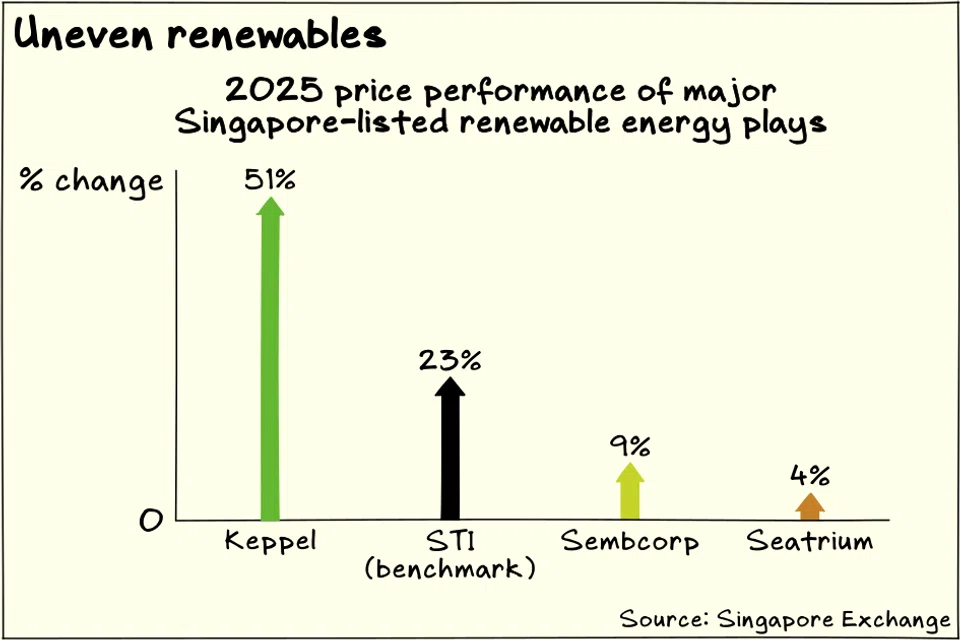
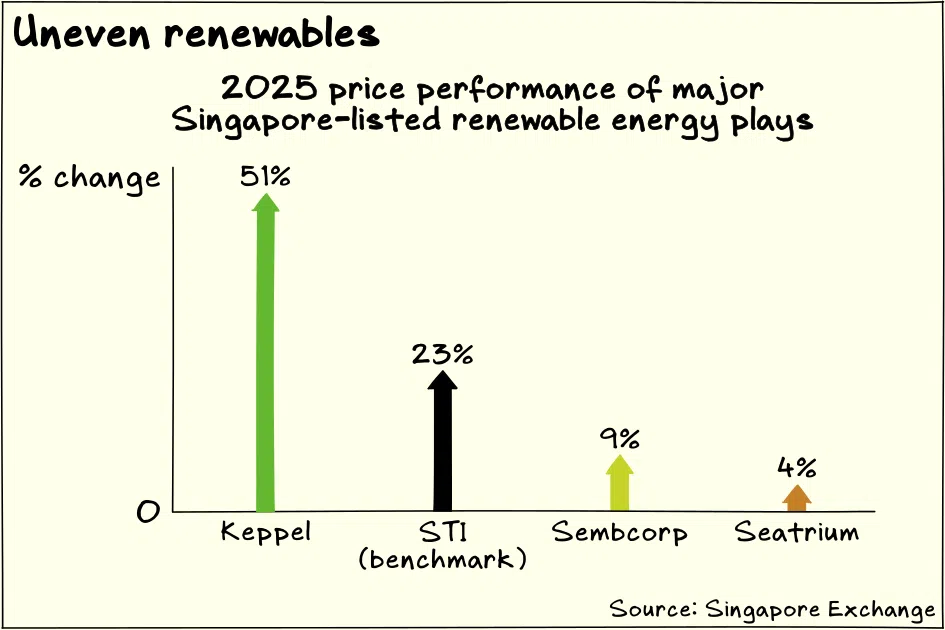
Shares of Keppel, an infrastructure, real estate and connectivity asset manager with a significant renewables portfolio, rose about 51 per cent in 2025, handily beating the Straits Times Index (STI) benchmark’s 23 per cent gain over the same period. However, renewable energy developer Sembcorp Industries underperformed the broader market despite a 9 per cent increase in its share price. Seatrium, a shipbuilding giant with a sizable pipeline of projects supporting green vessels and offshore wind projects, also lagged the market even though its share value grew by 4 per cent in 2025.
Shares of Singapore’s three major banks – which stand to profit from the financing they provide to the renewables sector – also showed mixed results. DBS Group Holdings shares gained 29 per cent to stay ahead of the market. But OCBC’s 18 per cent increase and United Overseas Bank’s 3 per cent decline placed them behind the pack.
On balance, the renewables plays tended to underperform in 2025. That’s not surprising in light of the US-led pullback on climate action and of the geopolitical and economic storms that have pushed sustainability down on the list of priorities for governments and companies.
However, the longer term outlook may be more aligned with Amova’s argument for structural tailwinds.
Singapore’s commitment to its national climate targets means that the country will be investing and spending heavily in its energy transition in the coming years. The country is making progress on importing low-carbon energy, and has raised its 2030 target on solar deployment to 3 gigawatt-peak (GWp) after hitting the previous 2 GWp goal ahead of time. To foot the bills, Singapore has set aside S$10 billion for a Future Energy Fund. That amount of fiscal spending will probably have an expansionary impulse on the sector.
A March 2025 LSEG analysis notes that 10.9 per cent of STI companies’ revenues could be considered green as at end-2024. That was more than that global average of 8.6 per cent and double the green revenue share of 4.2 per cent in 2016. Furthermore, just over half of the 30 STI companies have green revenues. Increasing the level of green exposure improves the prominence of Singapore and its listed companies for green investors and green investment products and indices.
Singapore’s large listed renewables players like Sembcorp and Keppel also have significant exposure to Asia, where governments remain supportive of the energy transition, even if the pace of the transition has slowed over the past year. The green growth in Asia has already attracted institutional interest. A September report by MSCI showed that global climate-themed funds have increased their Asia-Pacific exposure by 12 percentage points since 2018, while US and Europe exposure slipped in the same period.
Those tailwinds have been blowing for a while now, so even operating in a structurally supportive environment doesn’t mean that getting noticed by investors is inevitable. Singapore’s listed renewable players need to step up their game by improving their sustainability disclosures so that the likes of Amova will take notice.
Energy transition
New boosts for Malaysia’s solar ambitions
Efforts to accelerate Malaysia’s uptake of solar power are stepping up in 2026, with more capacity in the works and fresh rules to encourage rooftop solar.
Solarvest Holdings, Malaysia’s largest solar company, plans to add 2 gigawatts (GW) of capacity through 2027, almost tripling its current capacity of about 1.2 GW, chief executive Davis Chong tells Bloomberg.
Chong explains that power-guzzling data centres for artificial intelligence are driving growth expectations on the demand side, while falling battery prices are enabling development on the supply side. Chong notes that batteries now cost about US$90 to US$100 per kilowatt-hour (KWh), down from as much as US$230 per KWh a year ago. He sees US$60 per KWh as a possibility.
Solarvest will not be alone in growing capacity. Malaysia this year revamped its rooftop solar strategy with the new Solar Accelerated Transition Action Programme (Atap). The new plan does away with the old quota system to one with no fixed quota and a shortened feed-in contract period of 10 years from 21 years. Atap also introduces tax deductions for batteries.
Solar accounted for 4 per cent of Malaysia’s energy mix in 2024, according to Suruhanjaya Tenaga (ST), the national energy commission. But while renewable energy had earlier been targeted to account for about 31 per cent of capacity mix in Peninsular Malaysia in 2025, by December the projected reality was just about 11 per cent.
Malaysia needs to significantly improve solar adoption if it is to hit its renewable targets, which include raising renewable share of the national energy mix to 40 per cent by 2035 and 70 per cent by 2050. The Solar Atap programme is the latest iteration of policies hoping to drive that growth.
Other ESG reads
TRENDING NOW

JPMorgan, BlackRock among those making bid to manage CPF savings

GIC in talks to lease bulk of 88,000 sq ft CapitaSky space to be vacated by Allianz

BN-PN’s Melaka election landslide puts spotlight on jobs, investments and political divides

Why Singapore, Johor and Riau Islands should build a cross-border ecosystem for AI

