Issue 187: Iran conflict may boost adaptation demand; Sembcorp’s diversity to the rescue
This week in ESG: Mideast troubles may raise need for climate adaptation and resilience; CGS names Sembcorp a top pick

Sustainable investing
Adaptation opportunities in Iran conflict’s fallout
An underappreciated source of investment opportunities amid the Middle East conflict may lie in climate adaptation and resilience.
While disruptions in oil and gas supply chains may raise the attraction of clean energy at this moment, the benefit for renewables may be blunted by competition from non-Middle East sources of fossil fuels and from financing hurdles. Unfortunately, there may be greater certainty that the conflict will set back climate progress. With global warming likely to be more acute, companies that offer exposure to climate adaptation and resilience solutions could present medium-to-long-term opportunities.
Oil prices have risen by about one-third since the US and Israel launched attacks on Iran on Feb 28, and since the vital Strait of Hormuz has been shut down to vessels that carry Middle Eastern oil and gas to the rest of the world.
Encouragingly for renewable players, a number of countries have signalled that they view low-carbon energy as a solution to improve energy resilience.
A statement by South-east Asian foreign ministers on the conflict includes accelerating the transition to renewable energy as one of the ways to achieve economic stability.
In India, Prime Minister Narendra Modi cites the growth of the country’s solar generation and electric vehicle fleet in calling for the country to be less reliant on imported energy.
South Korean President Lee Jae Myung is urging his Cabinet to take the opportunity to “swiftly and extensively” transition to renewable energy.
Similar calls have emerged in Europe and in the UK.
But look past the rhetoric, and the reality on the ground is more nuanced. For example, while China’s recently released 15th five-year plan renews the country’s commitment to renewable power and green technology, it also softens goals on coal and emissions intensity.
In the immediate term, many Asian countries are also turning to coal to help ease the oil and gas shortage.
The coal pivot underscores the point that the solution to energy resilience isn’t actually to go all in on renewables, but to diversify energy sources instead. So while many countries face an immense need to develop significantly more renewable power, renewables must fight for development budgets against coal and against oil and gas supply chains outside of the Middle East. This will be especially the case for countries that have domestic supplies of fossil fuels.
Existing power infrastructure is also dominated by fossil fuels, especially in Asia, which makes increasing fossil fuel usage in the short and medium term the preferred way to address the immediate problem of fuel shortages.
Furthermore, Asia’s ability to invest more in sustainable energy might be further hampered by economic uncertainties that stem from the Middle East conflict. There was already a sizable funding gap for the energy transition in Asia before the conflict. Slower economies that constrain fiscal purses as well as lower the availability of private capital could make that gap even bigger.
Those factors raise uncertainties surrounding the pace of Asia’s energy transition, which in turn increases risks of global warming. Higher climate risks can mean better investment outlooks for climate adaptation and resilience players as losses and damages from climate change become inevitable.
Adaptation and resilience as an investment theme is a nascent and still-developing space, with ongoing work to better define what counts as climate adaptation and resilience exposure.
The private sector-led Global Adaptation and Resilience Investment Working Group (GARI) has developed a framework for investing in climate adaptation and resilience. The approach considers companies as adaptation and resilience plays if they provide solutions that address or enable the addressing of risks and damage from climate change.
For example, a climate information services company enables preparation and prevention of climate risk and damage before they occur. A water irrigation system enables the response to climate risk and damage when they occur, while climate parametric insurance enables recovery from climate risk and damage. All three can be considered adaptation and resilience plays.
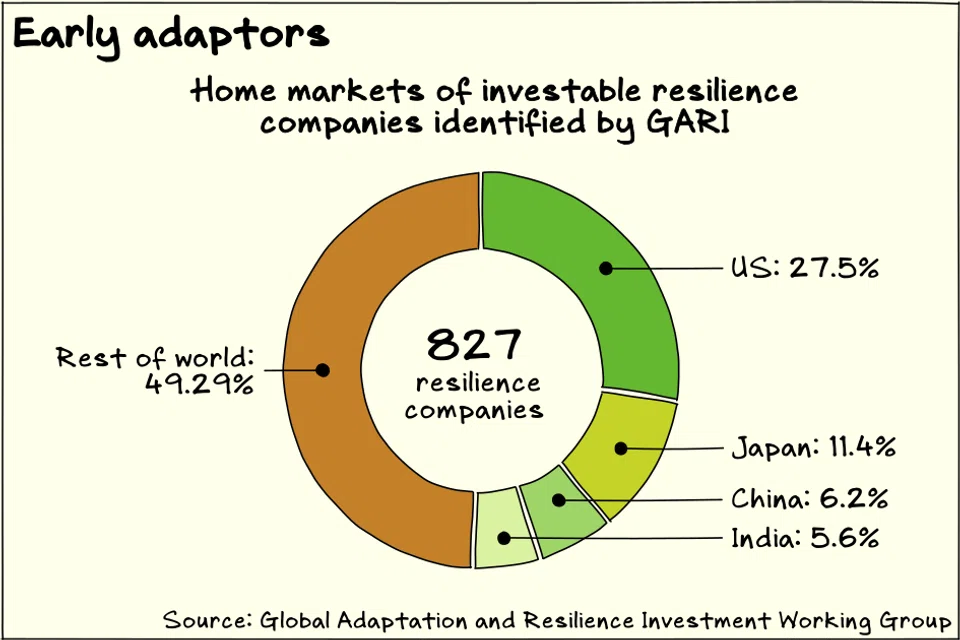
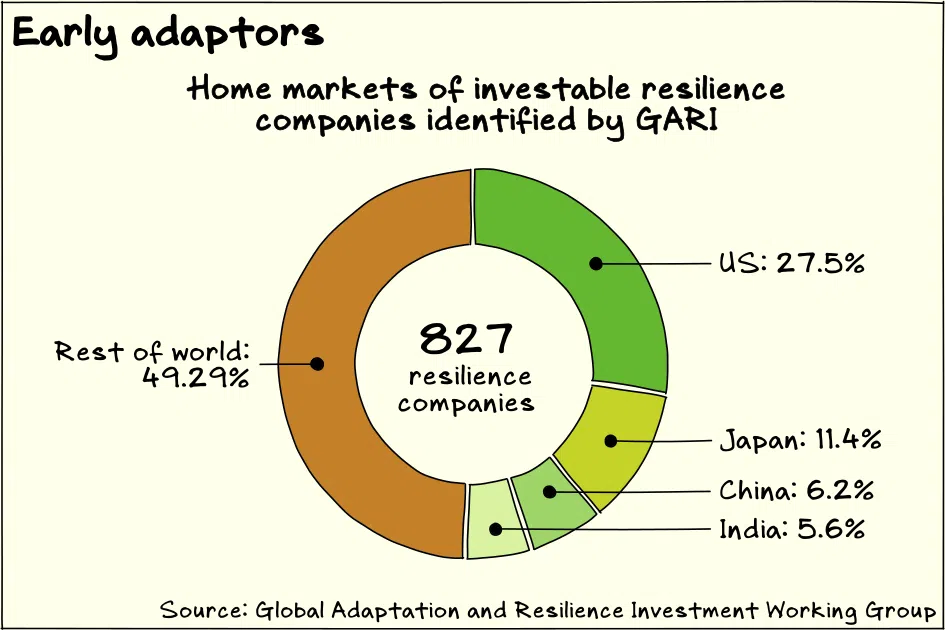
Using the framework, GARI estimated in 2024 that about a tenth, or 827 companies, of the MSCI All Country World Investable Market Index can be considered resilience plays. US companies account for the largest slice, but Asian companies from Japan, China and India come next and also have a significant presence.
In a 2025 report on adaptation investments, Singapore sovereign wealth fund GIC considers five broad classes of climate adaptation solutions: fire, storm, heat or water stress, flood, wildfire and general solutions. The report deems weather intelligence as a sector with among the highest revenue growth and potential increase in total addressable market due to climate change.
It’s important to note that companies can provide both climate adaptation and climate mitigation solutions – these are not mutually exclusive domains. Companies like Sembcorp Industries and Keppel, which have renewable energy businesses as well as engineering and infrastructure-related arms that provide climate adaptation solutions, offer multiple types of exposure to climate impact.
The appeal of adaptation and resilience plays definitely doesn’t render renewable energy and other types of climate mitigation investments irrelevant. But assessing market opportunities through the adaptation lens can reveal overlooked long-term gems.
Energy transition
Sembcorp’s diversity cushions Mideast shock
Sembcorp Industries positions itself as a renewable energy player, but gas is still the largest source of the company’s profit.
Not surprisingly, the natural gas supply disruption due to the Middle East conflict has kept the stock about 3 per cent to 6 per cent below pre-conflict levels in the first half of March. But the stock has reversed course over the past week as the company began to assure investors that it has limited exposure to gas from the affected regions.
CGS International, which named the stock one of its top picks this week, highlights two key buffers for Sembcorp. The first is that its long-term power purchase agreements, in which Sembcorp is the seller, contain fixed-margin cost past-through mechanisms that insulate Sembcorp from the natural gas input costs. The second buffer is that most of Sembcorp’s gas business is via piped natural gas, which is not subject to access to the Strait of Hormuz.
In navigating the energy transition, Sembcorp’s diversified portfolio has proven its value. Before the Middle East conflict, the gas business provided relatively stable profits that the company could use to help fund its aggressive investments into growing its sustainable business segments. Within the gas segment, having a mix of gas supplies has proven to be valuable in light of the current disruptions.
After the onset of the conflict, the renewables segment now serves to help cushion the impact of the volatility in the gas business.
The global energy transition in the years ahead is unlikely to be smooth, and this moment’s turbulence demonstrates the value of Sembcorp’s diversified approach.
Other ESG reads
- Singapore’s EV charging prices remain stable, but an April increase looms
- Cambodia turns to Singapore, Malaysia for fuel as Vietnam, China restrict supplies
- Asian refiners scour the world for oil with Hormuz flows halted
- Asean’s tourism sector could contribute to region’s sustainable aviation fuel development, says Airbus
- A new decisive moment for renewable energy
- Unlocking a new competitive tool for Singapore: demand for low-carbon products
TRENDING NOW
He built the Vingroup empire. Now South-east Asia’s richest man is handing some key roles to his sons
Quarter of Singtel special discounted shares sold ahead of CPF Board transfer
Why Tan Aik Keong of digital solutions specialist Agmo wants to make himself less indispensable
Asia needs new energy security architecture