

Issue 192: Sembcorp’s renewable catalysts; South-east Asia’s geothermal potential
This week in ESG: Sembcorp shareholders approve S$0.16-per-share final dividend; Singapore requests geothermal feasibility study

Sustainable investing
Structural changes ahead for Sembcorp’s renewables business
Sembcorp Industries shareholders who stuck with the energy and urban solutions group through a tumultuous year will receive a slightly higher dividend for their patience.
But keeping those shareholders happy will boil down to Sembcorp’s success on three pivotal renewable energy bets: A fix to China’s imbalanced market, a spin-off of assets in India, and a major acquisition in Australia.
Sembcorp declared a S$0.16 final dividend in February for its 2025 performance, taking the company’s total payout for the year to S$0.25. That is S$0.02 more than the S$0.23 that the company distributed to shareholders for 2024. In a February press release, Sembcorp group chief executive Wong Kim Yin said: “This year’s dividend affirms our confidence in the company’s future performance and ability to generate sustainable returns.”
Shareholders didn’t hesitate. At Sembcorp’s annual general meeting on Wed (Apr 29), the proposed dividend was the only resolution with zero voting against.
Flat year
The higher payout may be welcome, but it’s only modest relief for investors holding what has turned out to be an underperforming stock over the past year. Sembcorp’s shares fell almost 14 per cent on Aug 8, 2025 after the company announced disappointing first-half results. The shares have barely recovered since, with Wednesday’s S$6.64 close still 15 per cent below the last traded price of S$7.80 on Aug 7, 2025.
Over the past year, Sembcorp’s share price is effectively flat, up just 0.3 per cent or S$0.02 as at Wednesday’s close. That significantly lags the Straits Times Index benchmark, which is up 28 per cent over the same period.
The flattish share performance reflects a similar performance on the bottom line for Sembcorp, which saw 2025 net profit decline by 4 per cent or S$32 million to S$984 million.
Net profit before exceptional items from gas and related services shrank 4 per cent or S$27 million to S$701 million, partly due to lower margins in Singapore. The margins stem from narrower spark spreads, which is the difference between electricity prices and Sembcorp’s cost of production.
Gas margins could start to recover due to the Iran War. In a research note published shortly after the conflict began, DBS analyst Ho Pei Hwa says that Sembcorp tends to benefit from higher gas prices and volatility. Sembcorp has previously enjoyed a positive earnings impact of S$30 million to S$100 million from “prolonged disruption lasting weeks to months”, Ho wrote.
Another weight on Sembcorp’s results is the strong Singapore dollar, which has appreciated against the key foreign currencies of Sembcorp’s overseas operations. Sembcorp estimates that 2025 reported profit was S$32 million lower due to the Singdollar’s rise.
But gas prices and exchange rates fluctuate, so their impact on future earnings will vary as well. In other words, these will not be major long-term factors for investors.
It’s in the company’s renewables business where structural factors are in play, and where outcomes in the months ahead may have longer-lasting impact.
China wildcard
The first of those factors is China, where renewables net profit fell to S$74 million in 2025, down 17 per cent or S$15 million. This was despite attributable installed renewables capacity in China increasing 12.5 per cent to 4.5 gigawatts between 2024 and 2025.
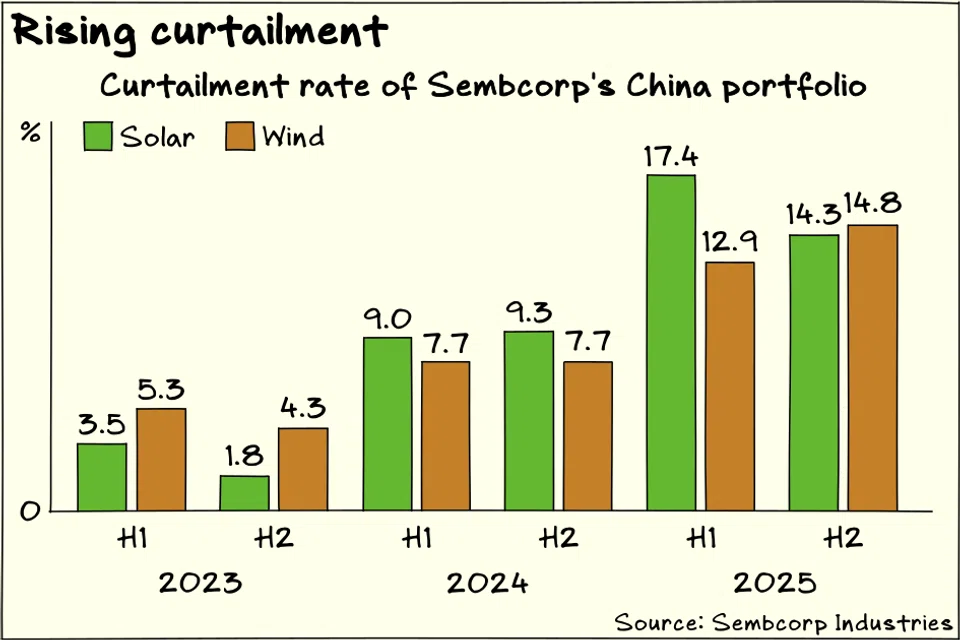
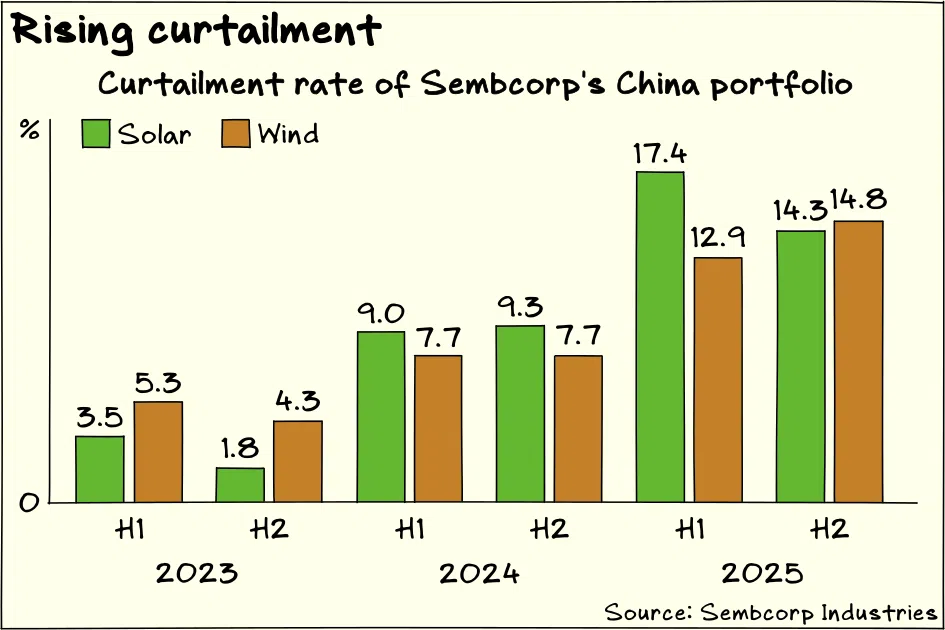
An imbalanced renewables market and market-based pricing reforms lie behind that pressure. Sembcorp’s assets in China’s northwest are especially hit by what is essentially an oversupply of renewable energy. That has led Sembcorp’s China renewables portfolio to experience climbing curtailment rates over the past two years.
Curtailment is a deliberate pause in electricity generation to maintain grid stability, and reflects a situation where there would be too much electricity produced without curtailment. Sembcorp’s China solar portfolio curtailment rate – which is the percentage of generation capacity that is intentionally unused – was 17.4 per cent in the first half of 2025 and 14.3 per cent in the second half, compared to about 9 per cent in 2024. Curtailment for Sembcorp’s China wind portfolio was 12.9 per cent in the first six months of 2025 and 14.8 per cent for the next six months, versus just under 8 per cent in 2024.
Sembcorp has highlighted that China’s national grid operator plans to invest 4 trillion Chinese yuan (S$748 billion) between 2026 and 2030 to upgrade the grid and improve renewable energy transmission. China is also encouraging the development of data centres in the west to try to soak up the excess capacity.
The effectiveness of those plans and the pace at which the impact hits Sembcorp’s portfolio are key wildcards. Even with the lowered profit, China still accounts for almost 40 per cent of Sembcorp’s renewables net earnings. Sembcorp could therefore see meaningful improvements in its renewable business if China can improve the balance of its electricity market in the coming months. However, poor progress on improving curtailment rates will renew concerns about Sembcorp’s China renewables portfolio.
India recycling
Another issue for Sembcorp is lacklustre returns from its renewables investments.
Return on equity for renewables before exceptional items was 7.4 per cent in 2025, lower than the 8.0 per cent return in 2024. Sembcorp says this is due to partial contribution from projects commissioned during the year as well as unproductive capital expenditure from projects that are still under construction or development.
The relatively low returns on equity in renewables are understandable, given that renewables represent a growth and investment-heavy segment for Sembcorp. Nevertheless, even when assuming full-year contribution from projects completed during the year and adjusting for capex spent on projects under construction, “normalised” return on equity would just be 8.3 per cent. This is significantly lower than normalised group return on equity of 20.0 per cent.
One way that Sembcorp could improve the returns it gets from the segment would be to spin off some assets, allowing the company to potentially realise a higher value for those assets and recycle the capital.
Sembcorp has been looking into a potential spin-off for its India assets, but no firm plans have been announced. The economic and geopolitical turmoil from the Iran war might make it challenging to make such a move now. An unimpressive initial public offering for renewables player Clean Max Enviro Energy Solutions on India’s National Stock Exchange in March – the stock fell 18 per cent on its debut – may also caution against being too hasty.
Nevertheless, recycling capital is crucial in such a capex-intensive segment, and a successful spin-off would inspire confidence about Sembcorp’s ability to generate returns in renewables. On the flip side, failure could lead the market to reassess upside expectations.
Australia addition
Sembcorp’s planned acquisition of power utility Alinta Energy in Australia is the third potential catalyst for the stock.
Alinta represents a relatively stable entry into a developed market for Sembcorp in a deal that is earnings accretive. Just as importantly, Alinta has a 10.4 GW development option pipeline of renewables and firming solutions. The deal is still subject to regulatory approvals, but the company and analysts widely expect the transaction to be completed before the second half of 2026.
Alinta could give a significant boost to Sembcorp’s earnings, and significantly expand its renewables pipeline. Analysts are largely positive on the deal. For instance, Phillip Capital’s Paul Chew reckons that a successful acquisition “will drown out the underlying weakness in Singapore’s power operations”.
However, Sembcorp is reported to be seeking a loan of about A$3 billion (S$2.7 billion) to help finance the deal, which is valued at A$6.5 billion in enterprise value. That additional debt could limit the company’s aggressiveness in pursuing other projects and acquisitions to avoid over-burdening its balance sheet. In that light, Sembcorp’s ability to recycle capital in India could be even more important.
Watch this space.
The possible structural changes in the months ahead could leave deep imprints in Sembcorp’s renewables business segment. Although renewables are still a relatively minor contributor to Sembcorp’s net profit, it’s the segment where Sembcorp’s future lies. These changes have gravity that will shape the course forward.
Energy transition
Unearthing South-east Asia’s geothermal potential
Singapore is leaving no hot stone unturned in its quest for low-carbon energy, inviting proposals for a feasibility study into geothermal energy in the city-state.
The study will add to a growing body of in-depth examinations of geothermal potential in South-east Asia, where the region’s proximity to tectonic plate boundaries and new technological advances underpin increasing interest.
Singapore’s request for proposal comes after an earlier study commissioned by the National Research Foundation found elevated temperature gradients in two slimholes dug to depths of about 1.2 km and 1.8 km. Those findings were favourable for Singapore’s geothermal potential, and warranted further research at greater depths, the study said.
A key reason that geothermal is even being considered in Singapore – where a modest hot spring is the island’s chief geothermal feature – is that the latest geothermal technologies allow capturing heat energy in the ground even in the absence of natural hydrothermal reservoirs.
The first class of technologies is called Enhanced Geothermal Systems (EGS), in which existing geothermal reservoirs are expanded or new reservoirs are created. The second class is called Closed-Loop Geothermal Systems (CLGS), in which the heat transfer medium circulates in a closed system. EGS technology is the more mature of the two, but it has raised concerns about inducing seismicity and the longevity of the reservoirs. The CLGS method presents fewer issues related to seismicity and leakage, but real-world implementations are so new that long-term issues are largely uncertain.
As it turns out, South-east Asia could be sitting on sizable geothermal potential. A 2024 study by the International Energy Agency, citing work by geothermal-focused non-profit Project Innerspace, found that South-east Asia represents a combined 15 per cent, or 125 terawatts, of the global technical potential for EGS systems. Indonesia and the Philippines, in particular, lead the region in potential.
Geothermal energy, with its low carbon footprint and stability, is a prime alternative to fossil fuels, provided geology and cost cooperate. But the technology is still nascent, and the largest need at the moment in South-east Asia is more research, such as the studies that Singapore is commissioning.
The build-up of knowledge could yet lead to action, and savvy businesses could find early-bird opportunities.
Other ESG reads
- SP Mobility, ComfortDelGro Engie bag contracts to deploy EV fast-charging hubs in HDB towns
- Aster to explore new Singapore facility turning used motor oil into high-grade products
- Low-carbon electricity trading between Singapore and India being mulled, says global solar body
- South-east Asia office workers swelter in energy-saving drive, heatwave
- Trump cancels more wind leases to spur oil and gas investment
TRENDING NOW

Singapore identifies 7 firms responsible for haze fires, notices issued urging action: Grace Fu

Could stablecoins be the future of money?

Singapore should prepare for prolonged haze until November, says Grace Fu

High Court rules against Julius Baer’s Singapore trust arm in US$50 million family trust dispute

