

Issue 2: Grab gets rated; carbon market inclusivity

Singapore
Grab’s AA ESG rating
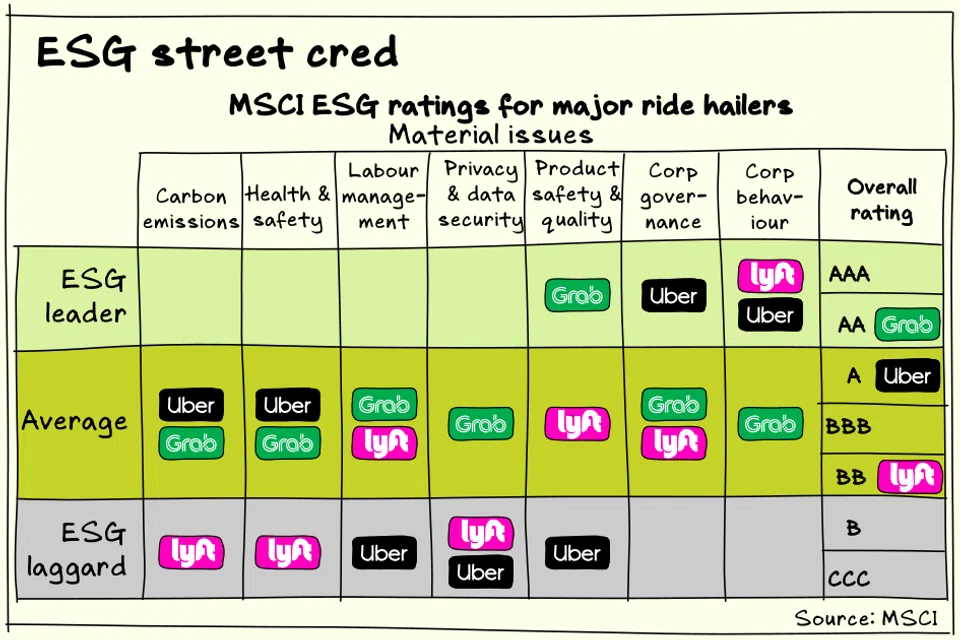
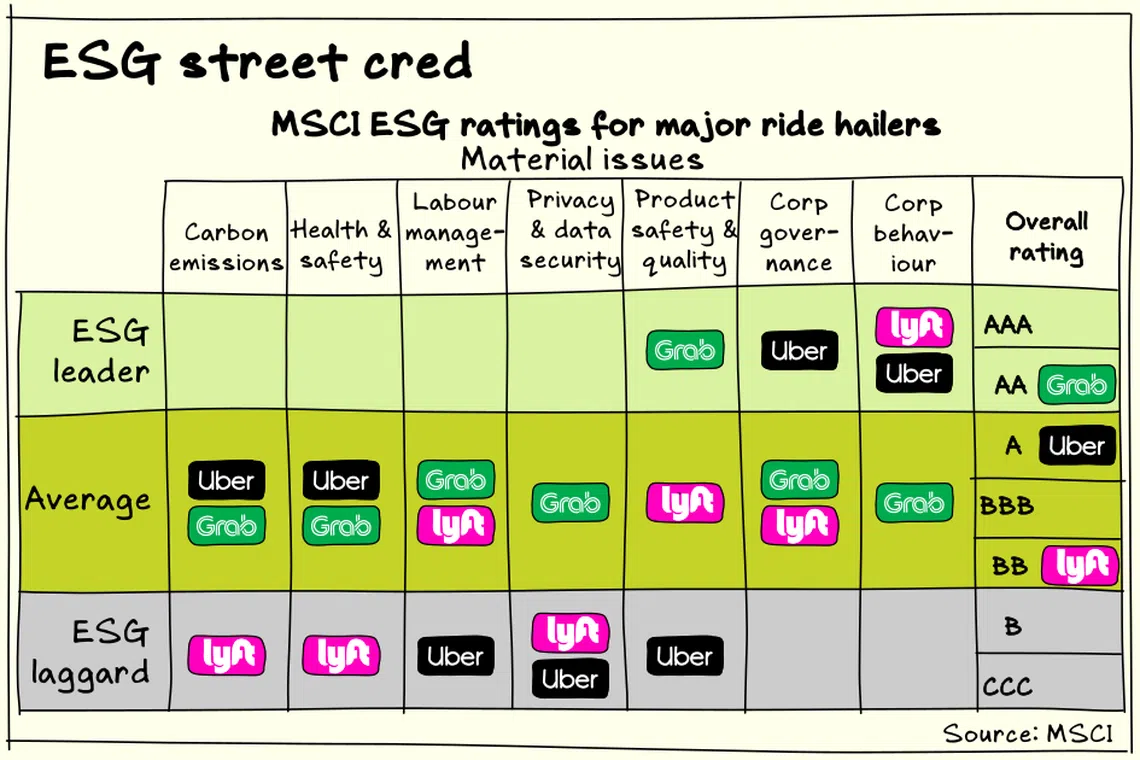
Grab, the regional provider of ride hailing and food delivery services, has earned an MSCI ESG rating of “AA”. That is the second-highest possible rating by MSCI, and indicates that Grab is a “leader among 33 companies in the road and rail transport industry”.
Does this rating mean that Grab makes a solid ESG investment? On one hand, Grab’s rating is certainly better than a number of its peers. MSCI has Uber rated one notch down at “A”, Didi Global and Lyft three notches down at “BB”. For those wondering, GoTo, Grab’s main competitor, isn’t rated.
On the other hand, Grab is a land transport company whose drivers and delivery persons contribute to about 1.5 million tonnes of greenhouse gas emissions every year. The company is also a key driver behind the gig economy, which has come under criticism for its social impact.
It is challenging in the best of times to make sense of ESG investing and ESG ratings. Unlike a credit rating, which reflects default risks based on more or less the same criteria, ESG ratings differ by provider in their measurements and inputs. That’s largely because the environmental, social and governance aspects of a company do not necessarily correlate, and ESG scorers are trying to capture the fuzzy concept of how well non-financial risks are addressed. Throw in qualitative, non-standardised data, and you get low correlation and high confusion.
The industry will have to agree on the best way to rate ESG, because most investors need to rely on experts to assess a company’s credentials. Confusion-inducing ratings add friction to the flow of capital towards sustainable targets. At the same time, when different raters give different scores, the temptation to shop for the best rating is extremely high.
A lot of regulatory work at the moment is, therefore, focused on harmonisation and standardisation. One to keep an eye on is the International Financial Reporting Standards Foundation’s International Sustainability Standards Board, which was set up in November 2021. It’s a good bet that whatever the auditors say, many folks will follow.
Green shoots
Good news for anyone who’s been looking to hire for their sustainability-related functions (and that’s everyone): The fresh graduates are coming! It seems like the top students headed for Singapore’s universities are finally shunning accountancy, and are instead choosing data science and environmental sustainability. For the sustainable finance folks out there, which is easier? Teaching a finance person about sustainability, or teaching a sustainability expert about finance?
Other Singapore reads
- Doom or bloom - how can businesses prepare for Carbon Tax 2024?
- Climate tech startups report flood of customers, but funding is trickling in
South-east Asia
Size matters in offsets
Carbon credits have a fragile reputation because of past scandals from credits that did not really deliver the climate change mitigation they promised. There is a lot of focus on improving the quality of credits through independent monitoring, reporting and verification.
The downside is that the extra work to create a good-quality credit can be costly. David Antonioli, chief executive of standards giant Verra, told a conference that it would be “really difficult” for smallholder farmers to join the voluntary carbon market because of the stringent (and expensive) standards.
The region’s agriculture sector is dominated by smallholder farmers. A lot of opportunity and efficiency is lost when they are not included in the plans.
This need to have solutions that fit local circumstances is why Philippines Finance Secretary Carlos Dominguez III has asked the Asian Development Bank (ADB) to facilitate the sharing of information on climate action projects among South-east Asian countries.
As the pressure of transition increases, expect to see more attention being paid to tailoring solutions for local circumstances. This could lead to effectiveness and efficiency, but also risks fragmentation and departure from scientific principles and global best practices.
Other South-east Asia reads
- Bursa ESG index additions suggest improved practices for Malaysian companies: CGS-CIMB
- Sustainability data firm EcoVadis raises US$500m from investors including GIC, gets unicorn status
Other good reads
Greenium and ESG scrutiny
If you have some time, here’s a good paper by the US Federal Reserve that looks at “greeniums” – the premiums that green bonds have been getting from the market. Bond investors have been paying more for labelled green bonds, which means that funds cost less for issuers if the proceeds are used for green purposes.
But the Fed’s researchers have found that the greenium appears to reflect green bonds and good-quality issuers, rather than the quality of the green project that is being financed. The green bond may benefit an already well-regarded issuer — which gets to burnish its green credentials — more than it incentivises quality green projects. Performance-linked financing, such as sustainability-linked bonds, might be a more effective way to drive impact.
Elsewhere, the scrutiny on ESG asset managers continues with news that US regulators are focusing on Goldman Sachs’ role in ESG funds. Details of the investigation are scarce, and come after European authorities raided offices of Deutsche Bank and DWS over greenwashing allegations.






