Issue 200: MAS-supported blended fund hits milestone; UN urges data centre transparency
This week in ESG: Energy Transition Acceleration Finance fund lands US$250 million first close; UN chief proposes data centre impact reporting initiative

Sustainable finance
MAS-led blended platform passes key test
Singapore’s blended finance initiative Financing Asia’s Transition Partnership, or Fast-P, has hit another milestone with a second fund reaching a close.
The Energy Transition Acceleration Finance (ETAF) partnership reached a US$250 million first close for its “displacement” strategy, which will support investments in grid modernisation and other energy transition infrastructure projects such as energy storage that can accelerate the displacement of fossil fuel-based power generation. ETAF also has a mandate for a “replacement” strategy, which focuses on replacing coal-fired power generation with lower-emissions power sources.
The Monetary Authority of Singapore (MAS) and the Private Infrastructure Development Group (PIDG) are the catalytic capital providers for the first close. A PIDG vehicle is providing a guarantee for ETAF’s mezzanine financing structure to improve its risk-return profile and crowd in additional commercial investment. PIDG is an infrastructure development finance organisation funded by the governments of Australia, Canada, the Netherlands, Sweden, Switzerland and the UK.
Singapore government-owned investor Temasek is also expected to contribute catalytic capital from its Concessional Capital for Climate Action vehicle. Singapore bank DBS is the fund’s senior lender, providing a US$210 million senior financing facility.
Clifford Capital is the fund manager.
ETAF’s fundraising success comes after the Green Investments Partnership (GIP) – another fund under Fast-P – secured US$800 million in committed capital following a second close in May. That fund is managed by Pentagreen Capital.
ETAF and GIP represent Singapore’s bet that investment platforms will facilitate the scaling up of blended finance, which is a form of financing that relies on concessional capital to improve the risk-return profile of investments so that commercial capital can take part.
The largely developing nature of South-east Asia’s markets mean that many of the region’s energy transition needs cannot obtain regular financing since profit-seeking capital might find these projects too risky for their expected returns. Blended finance is therefore seen as a potential solution for closing the region’s climate investment gap.
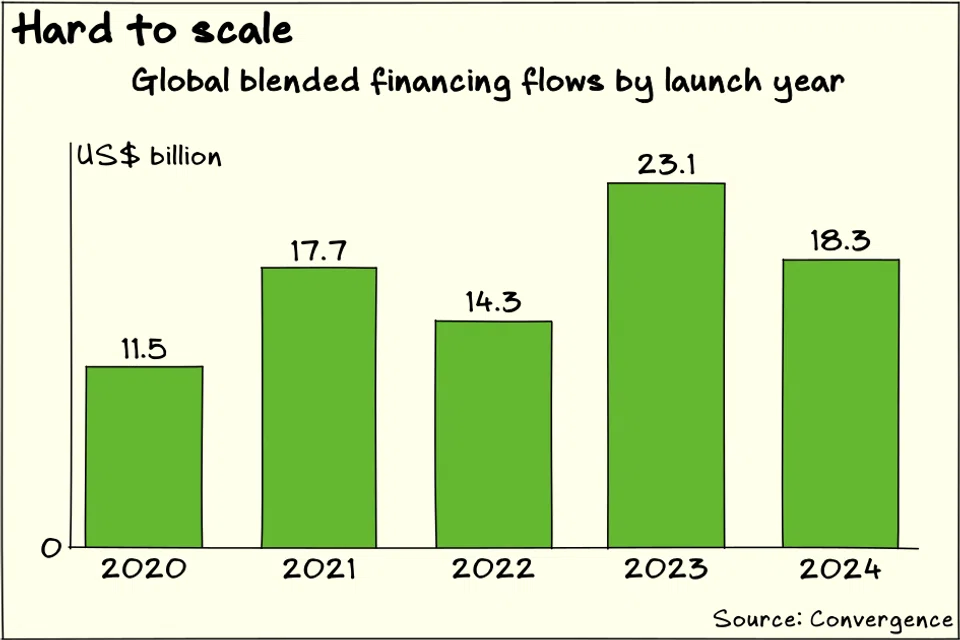
However, blended finance has traditionally been challenging to scale up. Data compiled by blended finance development group Convergence show that annual blended finance volumes have increased at an average of US$1.7 billion each year, from US$11.5 billion in 2020 to US$18.3 billion in 2024. While the growth trajectory is positive, the total blended market size is still a drop compared to the region’s climate infrastructure investment needs, which are estimated to be north of US$200 billion a year.
The fundamental issue is that the capital providers in a blended deal have vastly different objectives and conditions, and structuring deals to satisfy everyone tends to result in highly customised transactions. “Every deal is different” does not scale.
Fast-P is Singapore’s attempt to solve the scaling challenge in blended finance by using investment platforms. Instead of finding partners and raising capital one deal at a time, the platform approach pools much larger amounts of capital, then leaves it to a fund manager to deploy the capital based on predetermined criteria.
That Fast-P has been able to reach funding close on two funds at a time when development financing budgets are stretched – global economic uncertainties and the US pullback from international aid have curtailed the availability of public-sector concessional capital – is a positive sign for the initiative’s approach.
Fundraising closes are an important first step towards validating the thesis. The next test will be in the actual deployment of the committed capital. If the platforms work, they will solidify Singapore’s standing as a sustainable finance gateway for the region.
Sustainability reporting
Data central to data centre impact
A global call by the United Nations for greater transparency from artificial intelligence companies on the environmental impact of their data centres is especially relevant to South-east Asia, a hotbed for new data centre development.
Sound policies as South-east Asia expands its slice of the data centre pie can help to ensure that growth does not come at the expense of society and the environment.
The pace of data centre development in Asia and South-east Asia is among the fastest in the world. McKinsey estimates that data centre demand in the Asia-Pacific could triple to 86 gigawatts (GW) by 2030 from 28 GW in 2025, a compounded annual growth rate of about 25 per cent. KPMG tells a similar story, forecasting that South-east Asia data centre capacity will triple to between 5.2 GW and 6.5 GW by 2030 over a similar period.
The data centre boom is part of an increasingly valuable digital economy, which could be worth north of US$1 trillion by 2030 for the region, by at least one estimate cited by the Association of South-east Asian Nations (Asean).
But the economic returns also come with serious societal and environmental costs. Data centres are heavy guzzlers of electricity and water, and therefore have the potential to produce large amounts of greenhouse gasses, and to strain energy and water supplies.
Asean sees per-rack energy use of data centres rising to about 50 kilowatts (KW) by 2027, more than six times the 8 KW intensity in 2021. A mid-sized data centre can use more than one million litres of water every day.
That level of consumption naturally places stress on surrounding resources and infrastructure, and makes it more difficult for countries to achieve their climate targets. That is why Singapore imposed a moratorium on new data centres in 2019 and has only begun to allow new development, albeit under stringent sustainability guidelines. The International Energy Agency observed that in 2024, Johor rejected up to 30 per cent of data centre applications due to inadequate efficiency performance on power and water use.
Asean’s Guide for Sustainable Data Centre Development describes a digital infrastructure trilemma of three goals – digital expansion, resilience and resource integrity, and environmental sustainability – where gaps in one can jeopardise the other two.
The guide recommends a strategic framework based on four elements:
- Energy and renewables integration;
- Greenhouse gas emissions and operational efficiency;
- Water management and cooling innovation; and
- Waste and circular economy.
Key enabling aspects to the framework are reporting and measurement of efficiency and impact metrics such as power usage effectiveness (PUE), water usage effectiveness (WUE), carbon usage effectiveness (CUE), circularity performance, in addition to standard emissions.
A common reporting standard across South-east Asia as well as disclosure requirements for data centres will allow stakeholders to obtain a more accurate picture of the impact of data centres. For investors, lenders and insurers, the data will also facilitate assessments of risks and performance, which could reduce friction in the flow of capital.
Other ESG reads
- Singapore firms expected to show net-zero progress under revised standards, instead of just set targets
- Ho Bee Land to issue S$150 million worth of 5-year green notes at 3.3%
- China Resources New Energy draws 6.4 trillion yuan in retail bids for biggest Shenzhen IPO
- China’s push for green power use in AI projects faces hurdles: experts
- Global business leaders back faster electrification shift to cut fossil fuel costs and boost energy security