Issue 202: Temasek’s pragmatic climate ambition; China’s green yuan versus the US petrodollar
This week in ESG: Temasek shifts to baseline scenario of warmer, more fragmented world; veteran economist urges yuan-denominated financing for green transition

Sustainable investing
Temasek adapts to warmer, fragmented world
Temasek is striking a tone of pragmatism as it institutionalises the recognition that the world will probably be hotter than hoped.
As it acknowledges the reality that fossil fuels might be needed for longer, and that physical climate costs will be higher, the Singapore government-owned investor’s latest sustainability report seems to send a message that while Temasek isn’t deviating from its long-term climate goals, the shorter-term pathways could get a little twisty.
Temasek has adopted a new baseline climate scenario that reflects expectations of a warmer world where temperatures will rise 2.4 degrees Celsius (deg C) above pre-industrial levels by 2100, instead of the previous view of a 1.8 deg C warming.
The new baseline is the Network for Greening the Financial System (NGFS) Fragmented World scenario, characterised by “uneven policy ambition and weaker global policy coordination”, where some markets are able to take more aggressive climate action while others are more limited. This scenario presents moderate transition risks and high physical costs.
Temasek explains that the new baseline means “a patchwork of divergent policies and associated timelines.”
“Carbon prices and regulatory stringency vary across markets, cross-border measures and trade frictions become more pronounced, and technology diffusion is slower where international cooperation is weak. Emissions abatement is increasingly backloaded, raising the risk of missing near-term emissions reduction targets. When policies are eventually tightened in response to escalating physical risks, transition impacts may be more abrupt and disruptive.”
This replaces the previous baseline, which was based on the Inevitable Policy Response Forecast Policy Scenario (IPR FPS). That scenario assumed significant acceleration in policy by 2025, and presented medium transition and physical costs.
Slightly negative impact
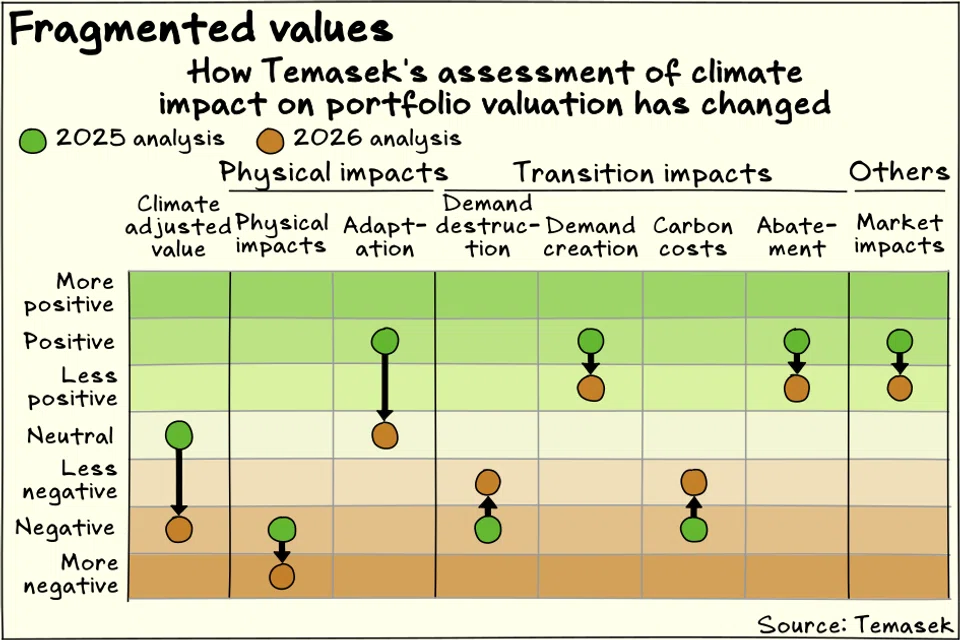
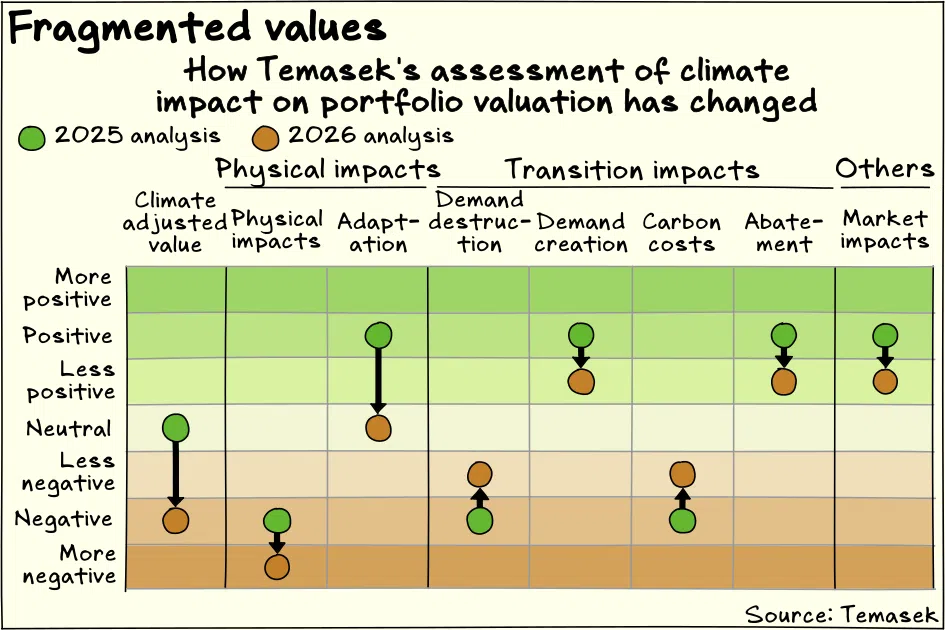
That new baseline scenario affects Temasek’s analysis of how climate change could impact the valuation of its investments, with the potential impact to annual earnings flowing through several channels. One of the more important ones is that the expected physical impacts of climate change are now more negative than in the previous analysis, since the new baseline scenario envisions higher global temperatures amid fragmented policy responses.
Furthermore, a fragmented world might reduce the negative impact of carbon costs, since some jurisdictions will be more lenient about carbon pricing. However, that would also mean that there is less positive impact from abatement and market impact channels.
The result is that the new baseline scenario has a slightly negative impact on Temasek’s climate-adjusted portfolio valuation, where the previous baseline had a broadly neutral impact.
Core strategy unchanged
Just as importantly, Temasek also considers a high-ambition scenario and a low-ambition scenario. The group expects the high-ambition scenario – where policy and technology progress sufficiently for the world to reach net zero carbon emissions by 2050 – to have a likelihood of higher returns for its portfolio in 20 years compared to the baseline scenario. On the other hand, the low-ambition scenario – where climate mitigation stalls and global warming exceeds 4 deg C by 2100 – has a higher likelihood of lower returns in Temasek’s analysis.
The scenario analysis remains consistent with Temasek’s central thesis that climate change is, on the whole, negative for its portfolio. The firm is therefore reaffirming a three-pronged net zero strategy:
- Investing in opportunities that support a low-carbon economy;
- Encouraging decarbonisation efforts in portfolio companies; and
- Enabling carbon markets solutions to mobilise capital towards climate solutions.
Near-term adjustments
Translating that analysis into action, Temasek chief executive Dilhan Pillay describes taking a “balanced and pragmatic” approach to the energy transition: “This recognises that parts of today’s energy mix will remain necessary over the longer term to support energy security and a just transition, alongside a credible commitment to lowering emissions.
“Accordingly, this is not a zero-tolerance approach to fossil fuels. Rather, it reflects a disciplined assessment of opportunities where the forward trajectory points towards a greener generation mix over time.”
Temasek has identified adaptation and resilience and sustainable infrastructure as areas of opportunities in a volatile world of fragmented climate policies. Workforce resilience has also emerged as a new field as artificial intelligence (AI) becomes more widespread.
In what Temasek calls the “core-plus infrastructure” segment, the firm says it sees “compelling opportunities to deploy patient capital across ageing infrastructure and grid modernisation, renewable and nuclear energy, energy storage, and breakthrough decarbonisation technologies”.
“Increasing electrification demand and AI-driven data centre growth underpin the investment case,” Temasek says. “These trends drive stable, compounding returns while contributing to the decarbonisation of power systems.”
About S$7 billion, or 1 per cent, of Temasek’s portfolio value is currently exposed to the core-plus infrastructure segment. Although the amount has not changed over the past year, Temasek says it could increase that to 5 per cent of portfolio value by 2031.
There is a focus on what Temasek chief sustainability officer Kyung-Ah Park terms “pragmatic ambition”, which emphasises investments and strategies where Temasek can influence outcomes. Park says investments should tick boxes for both sustainability and returns.
Indeed, Temasek being disciplined about its sustainability investments could mean that its portfolio will green more slowly at times. But Temasek is a long term, patient investor. While the firm expects to miss its 2030 portfolio emissions targets and is working on new climate targets, Temasek is not giving up on its 2050 net zero goals just yet.
Sustainable finance
The green yuan or the petrodollar
It is no secret that the petrodollar system is an important pillar that helps to hold up the US dollar as the world’s reserve currency.
It is therefore also not a secret that America’s biggest rival, China, has an interest in weakening the petrodollar system.
Given that context, former People’s Bank of China chief economist Ma Jun suggests that South-east Asia might be better off financing its energy transition with yuan-denominated debt. We see where that’s going!
But in all seriousness, it’s not terribly far-fetched to suggest yuan financing for the energy transition, simply because China dominates the green economy. It’s the world’s largest developer of renewable energy, the largest producer of solar panels, of batteries, and of rare earths. Second place is not even close.
Of course, where you buy your batteries isn’t quite the same as where you make your money, and from a borrower’s point of view it’s often more useful to borrow in the same currency as your revenue, so that you can service your debt without having to worry about the exchange rate. Ma’s suggestion will have varying levels of utility depending on the circumstances of the borrower.
But it’s noteworthy that the green economy has taken on strategic value in global politics. It’s also a reminder for South-east Asia that energy security isn’t merely building more renewables and infrastructure, since the region could remain exposed to supply chain dependencies, just with less Middle East exposure. Resilience matters for renewables supply chains, too.
Financial resilience is also important. Regardless of whether the dollar or the yuan is the more important global currency in the future, one of the best ways for South-east Asia to lower funding barriers and risks is to build up local-currency financing capabilities and solutions at scale.
Other ESG reads
- Singapore, Indonesia seek closer energy and sustainability cooperation to power up green ties
- Singapore’s record-high electricity tariff drives retailers to roll out discounts, but price war unlikely
- Amid global energy pressures, South-east Asia seeks to unlock geothermal power’s promise
- Coffee trader seeks to shield more Vietnam growers from weather
- Tencent inks first deal for carbon-removal credits outside China