
ESG Insights

Issue 51: CIX aims to set standard for carbon pricing; EU carbon tariff’s impact on S-E Asia rules

Kenneth Lim
Published Fri, May 26, 2023 · 07:00 PM
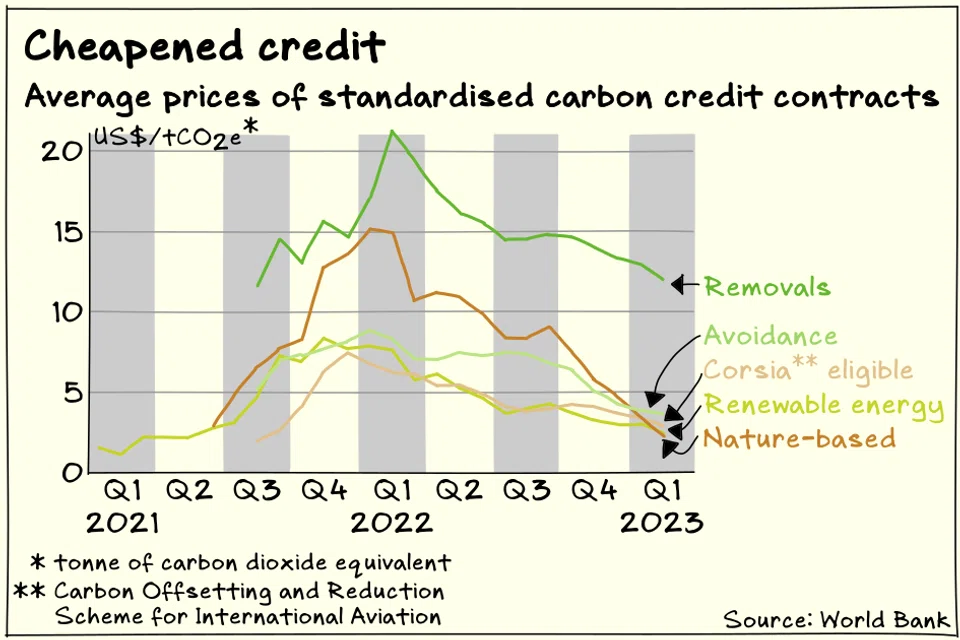
    • Prices of exchange-traded carbon credits have been falling over the past year alongside an increase in the use of standardised contracts.
    • Prices of exchange-traded carbon credits have been falling over the past year alongside an increase in the use of standardised contracts. ILLUSTRATION: KENNETH LIM

    In this issue: The race is on to create a standardised contract that will become a benchmark for voluntary carbon markets, while Europe’s tariffs on imported emissions have triggered only muted response from Asian governments.

    Singapore

    Who gets to sit on the carbon benchmark throne?

    The voluntary carbon markets (VCMs) still suffer from highly inefficient pricing. The price of reducing one tonne of carbon dioxide equivalent emissions can vary widely from one project to the next, and it’s extremely challenging for a buyer to figure out what’s the right price to pay for a credit.

    In a market, figuring out how much something is worth often works through comparisons. A is better than B, so A should be worth more than B. The problem in the VCMs is that there are so many different As and Bs to compare that pricing is all over the place. Liquidity is also poor in most contracts, so even if you found something comparable, you might not be confident about the price you’re comparing against.

    A good benchmark can make the process a lot more efficient. If there is a single standardised carbon contract that is liquid, then everyone can use its characteristics and its price to figure out the spreads for the rest of the market. It’s similar to how bond prices can be figured out as a spread against Treasuries or other “risk-free” debt, or how prices for different kinds of oil can be worked out from how much Brent or West Texas Intermediate is worth.

    No surprise then that voluntary carbon exchanges are all racing to create a contract that can become the market benchmark.

    It’s easier said than done.

    In order for a standardised contract to become a market benchmark, it must represent a large enough segment of the market. The dominant approach so far has therefore been to design contracts that represent as many qualifying projects as possible.

    But inclusivity could be detrimental in trying to build a benchmark. That is because credits from different projects might represent very different quality and risk profiles even though they are similarly verified and have similar vintages. A standardised contract that includes credits from too many different projects could therefore turn out to not be very standardised.

    Climate Impact X (CIX), the carbon exchange set up by DBS, Singapore Exchange (SGX), Standard Chartered and Temasek, is trying to change that with its new Nature X contract. One key difference in Nature X is that instead of trying to represent all credits with the same vintage, type and verification standard, it will represent credits from only a handful of projects.

    However, those projects are carefully curated to account for about two-thirds of the market, and to already have existing liquidity in addition to the usual vintage, type and verification requirements. The idea here is that better uniformity within the contract is more important than inclusivity.

    CIX could be on to something. The World Bank’s latest report on carbon pricing trends includes an interesting observation by carbon markets intelligence outfit Ecosystem Marketplace about some unintended consequences of a more inclusive contract design.

    Ecosystem Marketplace reported that the use of standardised carbon contracts on VCMs contributed to a drop in exchange-traded carbon credit prices over the past year.

    “By grouping credits that meet certain minimum criteria, exchanges increase market liquidity and facilitate investments, but the specific attributes of the highest quality projects, and consequently their value, can be lost to a ‘least common denominator’ effect,” the report said. “To avoid this, sellers of credits with features that can attract a higher price may opt to sell through bilateral deals rather than on exchanges.”

    Indeed, preliminary analysis by Ecosystem Marketplace suggests that over-the-counter prices for some good-quality credits have risen significantly, in contrast with the decline in exchange-traded prices.

    Market operators will tell anyone that creating a standardised contract that gets enough liquidity and market share is more art and luck than science. For instance, negative news at any of the projects associated with CIX could potentially erode confidence about the quality of CIX’s curation.

    But the glory and profit of getting it just right are enough to spur the exchanges on. CIX parent SGX knows this well, having had success in iron ore and milk futures. Now CIX will try to do the same for carbon.

    Please note: The ESG Insights newsletter will take a break on June 2 and resume on June 9.

    Other Singapore reads

    South-east Asia

    ‘Lacklustre’ policy response to EU’s carbon tariff

    Europe’s Carbon Border Adjustment Mechanism (CBAM) is the latest addition to the rarely seen class of extraterritorial regulations.

    CBAM, which takes effect in October, imposes a tariff on imports of carbon-intensive products into Europe. It directly affects European importers, but of course its ultimate impact is to subject exporters around the world to European emissions requirements.

    In its first-quarter review of ESG trends, Sustainable Fitch argues that Asian governments’ response to CBAM have been “fairly lacklustre”. However, if Europe expands the scope of CBAM to cover more imports, policymakers in South-east Asia might review their carbon policies to address the additional costs that CBAM would impose on goods in this part of the world, the research firm says.

    Regardless of what the regulators and policymakers are doing, anecdotes from the ground suggest that businesses are not waiting to respond. Companies that want to or are already exporting to Europe have already been scrambling to address their carbon footprints. It’s positive for the climate, but, as Sustainable Fitch rightly points out, there are more complex inflation implications in affected developing countries.

    Other South-east Asia reads

    Other good reads



