Issue 56: MAS, GIC contemplate too-little-too-late future; S-E Asia’s vulnerable workers

In this issue: A climate scenario marked by more but ineffective policies has become the most plausible, according to GIC, while a Deloitte study finds significant exposure among workers in the region to climate disruption.
Singapore
Maybe we shouldn’t put too much faith in policymakers
Imagine a world in which governments come up with new climate policies every time there is another extreme weather event, but these policies are never effective enough to get ahead of global warming. So the weather disasters keep coming, and the policies keep changing, but the world keeps getting hotter.
That is a “Too Little Too Late” (TLTL) scenario that the Monetary Authority of Singapore (MAS) and GIC have started to include in their analysis of climate risks and opportunities. For GIC at least, it has emerged as the most likely scenario to come true – albeit with a high degree of uncertainty.
MAS revealed the inclusion of TLTL in its matrix of climate scenarios this week when it released its latest sustainability report. The central bank uses these scenarios to figure out the spectrum of climate-related risks and opportunities that could affect the assets it manages so that it can formulate investment strategies. MAS’ assets include Singapore’s official foreign reserves.
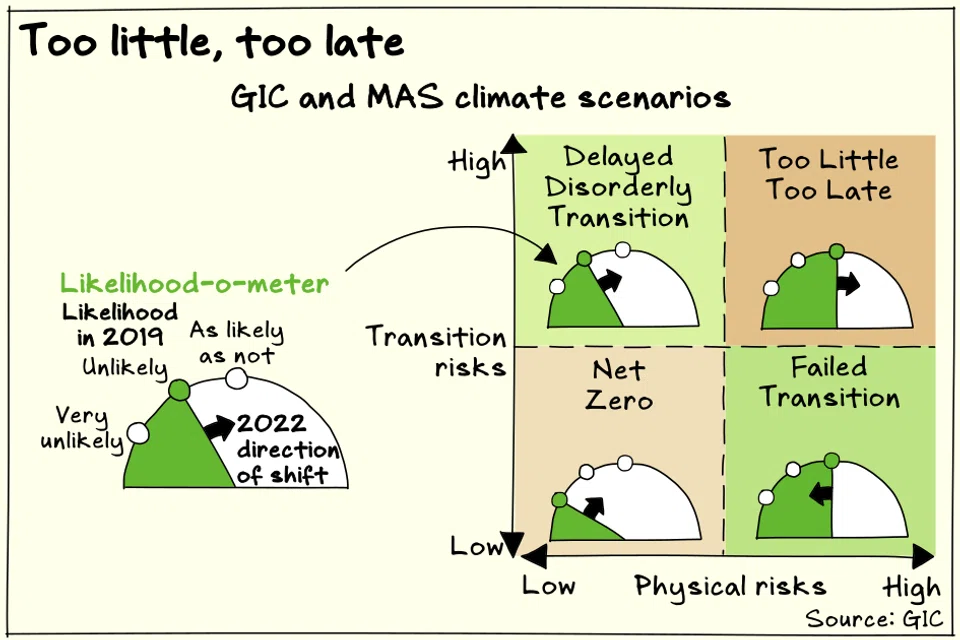
MAS has adopted the same scenario analysis approach as GIC, which builds its scenarios from the interplay of two kinds of risk dimensions. The first dimension is physical risk, which arises from rising temperatures and extreme weather events. The second dimension is transition risk, which comes from policy and technology developments.
From those two dimensions came an initial set of three scenarios that MAS and GIC have used for at least a year:
- Net Zero: Low transition risk, low physical risk. An early, orderly and ambitious transition achieves global net zero emissions by 2050 and limits global warming to 1.5 degrees Celsius above pre-industrial levels.
- Delayed Disorder Transition (DDT): High transition risk, low physical risk. The world is slow to implement climate policies but finally gets its act together after a surge of extreme weather events and keeps global warming below 2 deg C by 2100.
- Failed Transition: Low transition risk, high physical risk. No new climate policies are implemented and global temperatures rise over 4 deg C above pre-industrial levels by 2100.
Looking back, it should have been obvious a fourth scenario needed to be considered, one in which both transition and physical risks are high. But what could create such a scenario? In short, ineffective policy.
“GIC decided to explore this highly disruptive scenario because, as investors, we need to contemplate a world of insufficient policy actions as a potential outcome,” GIC said.
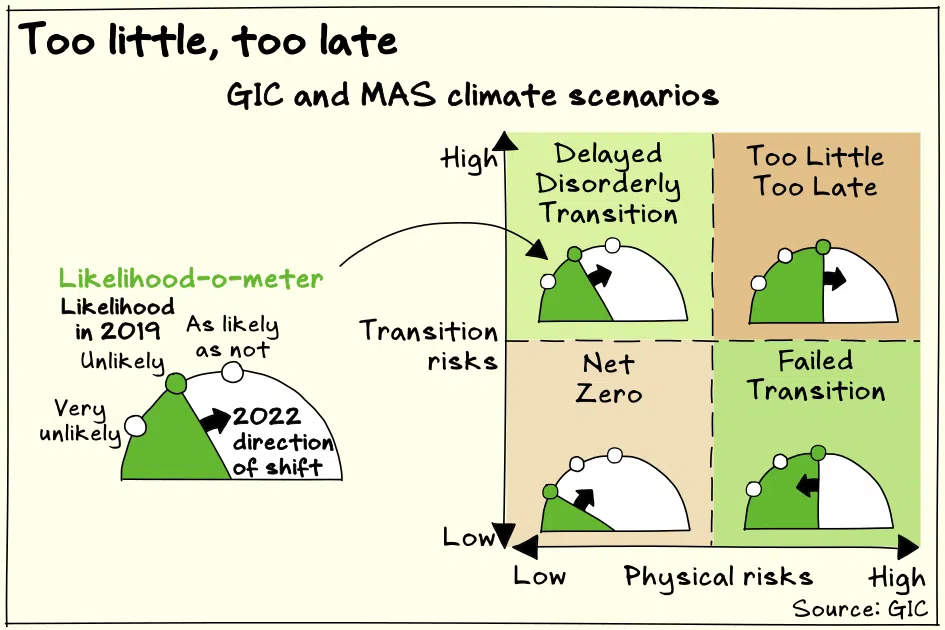
The TLTL scenario is basically the DDT scenario – except policies created in the wake of weather disasters don’t work. In such a future, global warming reaches 2 to 3 deg C by 2100.
Interestingly, GIC said in an April report that the TLTL scenario now appears to have the highest likelihood of coming true among the four possibilities. In 2019, the odds of TLTL and a Failed Transition happening were about even. The probability of a DDT future was deemed to be unlikely, while Net Zero success was seen as highly unlikely.
But countries and businesses have increasingly committed to net zero targets, the public has become more knowledgeable about climate change and investments in green solutions have increased, GIC said. The likelihood of Net Zero and DDT has therefore increased in 2022 from 2019, while the chances of a Failed Transition have diminished.
The probability of TLTL has also nudged higher, however. As GIC explained, there is a “widening gap between countries’ words and deeds as countries appear to accelerate their commitments even as actual policymaking lags behind”.
An important note about TLTL being the most likely scenario is that the degree of certainty is rather low. None of the scenarios has a more than 50 per cent probability of coming true, GIC said.
One takeaway is that a significant portion of Singapore’s reserves – MAS manages the official foreign reserves, while GIC manages the government’s assets – could be managed on the increasing expectation of ineffective policies and missed climate goals if the current trajectory holds.
GIC has also been fairly transparent about its methodology and that openness allows others who do not have the benefit of GIC’s deep resources to benefit from its scenario analysis. There is, therefore, the potential for these scenarios, and GIC’s likelihood assessment, to affect investment and business decisions outside of GIC and MAS.
Other Singapore reads
- Mandatory climate disclosures proposed for large non-listcos from FY2027, all listcos from FY2025
- Singapore banks can’t afford to miss out on coal phase-out despite immense challenges
South-east Asia
Don’t forget the vulnerable workers
A sobering report by Deloitte said that almost four in 10 workers in South-east Asia are in industries vulnerable to disruption from climate change and the transition to net zero emissions. Those industries include agriculture, conventional energy, manufacturing, transportation and construction.
Governments in the region have to do more, and do it more quickly, to address the potential livelihood disruptions. Policymakers have a long history, even in the best of times, of struggling to help displaced workers transition towards other kinds of work. The urban blight that hit American auto cities after the Global Financial Crisis is still creating problems today.
The scale of environmental disruption could dwarf those previous episodes and it is imperative to start sooner rather than later. Until they can take care of the people who are affected, South-east Asian nations will not be able to muster the whole-of-country effort required to adapt to and mitigate climate change. The longer they wait, the more challenging and expensive it will be for countries to address these issues.
Other South-east Asia reads
- South-east Asian companies sharpen internal lens as ESG disputes rise
- The Seafood Company invests to stay cool for less