Issue 6: Temasek’s internal carbon pricing; Top Glove’s Scope 3

In this issue: Temasek raises the amount that it charges internally for emissions, while Top Glove’s use of negative emissions raises questions
Singapore
Internalising carbon’s cost
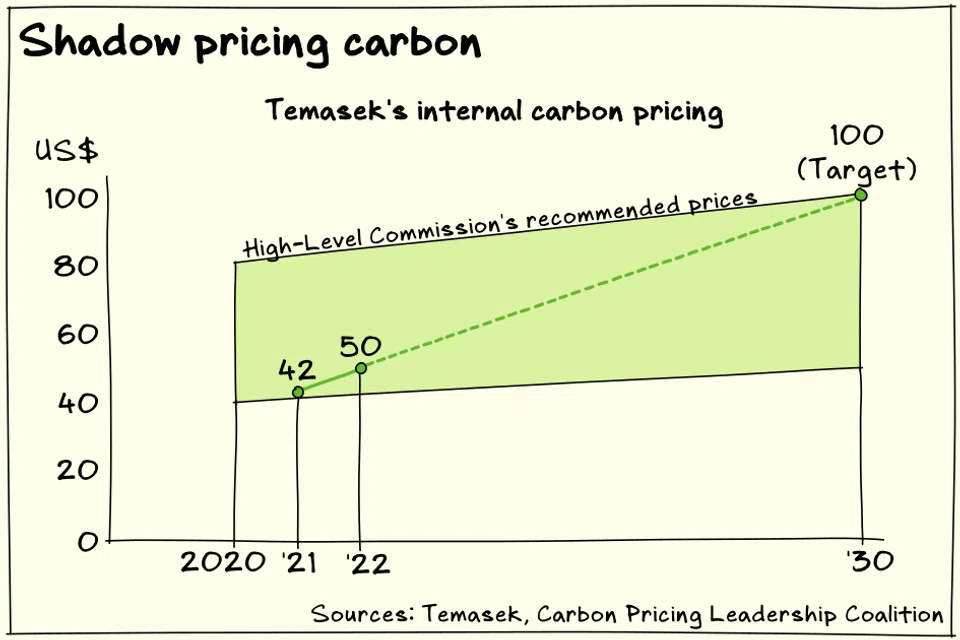
Temasek’s raising its internal carbon price to US$50 per tonne of carbon dioxide equivalent. The Singapore government-owned investment company will raise that price even further over the next 8 years, until it reaches US$100 per tonne in 2030.
One of the reasons climate change is so difficult to address is that harm from greenhouse gases is externalised. A company doesn’t pay the true cost of emitting carbon dioxide because most of the damage is borne by everyone else; the impact of climate change is also felt over a long period, so the true cost of emissions are kicked down the road to be paid later (hopefully by someone else).
A growing number of organisations have begun imposing internal carbon prices on themselves to unmask that hidden cost. There are varying ways to implement the internal carbon price, but the general principle is that activities and investments made by the organisation will have to include a cost for emissions. Microsoft, for example, imposes an internal carbon fee, then uses the money from those fees to mitigate climate change.
Temasek has said that it will incorporate its internal carbon price in its investments. We don’t have specific details, but presumably a US$100 million investment to which 100,000 tonnes of emissions are attributed every year will now appear internally to cost an additional US$5 million per year.
Internal carbon prices are great conceptually, but the tricky part comes in setting the price. The price should be high enough to influence decisions, but it should not be unrealistic to the extent that it leads to poor choices.
The High-Level Commission on Carbon Prices of the Carbon Pricing Leadership Coalition has recommended US$40 to US$80 per tonne by 2020 and US$50 to US$100 per tonne by 2030. Temasek is starting out near the lower end of the recommended range, but aims to hit the top of the range by 2030.
Those recommendations notwithstanding, let’s consider what US$50 per tonne might actually mean for Temasek. Temasek’s equity portfolio emitted 81 tonnes of greenhouse gases per S$1 million of portfolio value in the year ended March 2022. This means that for each S$1 million of portfolio value, Temasek would have to internally factor in about US$4,050 of carbon (about S$5,700). In percentage terms, that’s just under 0.6 per cent.
Temasek’s one-year total shareholder return in fiscal 2022 was 5.8 per cent, so its internal carbon price could appear internally to hit about one-tenth of the company’s returns per year. It’s not debilitating, but it’s noticeable.
Other Singapore reads:
- Re-imagining the Code for an ESG world
- Keppel Seghers and NEA to study carbon capture in waste-to-energy plants
South-east Asia
Top Glove’s questionable Scope 3
Top Glove has come under an ESG spotlight once again, this time for criticism about the way it reports its greenhouse gas emissions. The rubber glove maker, which is listed in Singapore and Malaysia, had previously come under fire for its labour practices.
The issue with Top Glove’s reported emissions is that its Scope 3 emissions — which by definition are indirect emissions, usually from suppliers and partners — included “avoided” emissions from recycling. As a result, Top Glove reported negative Scope 3 emissions in fiscal 2021.
There are still significant differences between reporting standards, but it is generally accepted that you can’t count emissions avoided by recycling as negative Scope 3 emissions. That is because recycling generally emits greenhouse gases. It might be less than if the waste were to be incinerated, but it is still positive emissions.
Top Glove has said that it is reviewing its methodology, and has asked for understanding because it is still new to sustainability reporting.
This issue was brought to light only because of Pantas, a Malaysia-based climate tech startup that is trying to build a carbon accounting app. Otherwise, non-conforming reporting is extremely challenging to detect.
With financial reporting, the markets rely primarily on independent auditors to ensure that companies are giving a true and fair account of their numbers.
A lot of problems with ESG investing could be addressed if we could similarly get independent assurance on ESG disclosures. So why isn’t independent external assurance mandatory? Well, given that sustainability reporting itself is still not fully mandatory, compulsory assurance might seem a step too far at the moment. The auditing profession is also still waiting for its own rules to be written.
In the meantime, the inconvenient truth is that any genuine desire to invest in sustainable — particularly with regard to climate change — companies is severely hampered by the lack of good disclosures. For most investors who don’t have the resources to scrutinise every sustainability report with the trained eyes of ESG professionals, responsible investing practically means sticking to 3 kinds of investments: (1) Companies that obtain respectable external assurance; (2) Companies whose core businesses are directly sustainable or impactful; or (3) ESG funds by respectable, large fund houses.
The problem is that doing so severely limits your investable universe. A 2021 study of sustainability reports among Singapore-listed companies found only 3 per cent of companies used external assurance.
Other South-east Asia reads
- Unlocking the ESG investment potential in emerging markets
- Only 28% of data centres in Asia-Pacific know how their energy is utilised: JLL