Issue 62: Singapore targets ESG ratings shortcomings; money exits S-E Asia’s ESG funds

In this issue: The financial sector grapples with flaws in the world of ESG ratings, while investors are pulling out of ESG funds in South-east Asia.
Singapore
Bringing order to ESG ratings
Tuesday, Aug 22, is the Monetary Authority of Singapore’s (MAS) deadline for public feedback on a proposed code of conduct for providers of ESG ratings and data products.
The proposed code of conduct was drafted by MAS in consultation with industry players, and comprises seven core principles. Singapore’s financial sector competes in the global arena, and it is therefore important that its rules are aligned with international best practices. Not surprisingly, the proposed principles hew closely to recommendations by the International Organisation of Securities Commissions (Iosco), and are largely aligned with similar moves by regulators in key global markets.
Two of the questions being asked in the MAS consultation on the code of conduct are worth delving into.
The first is whether the code of conduct should apply to providers of second party opinions (SPOs).
The MAS proposal defines data products as products that add “estimations, calculations or analysis” to raw data and that are specifically focused on ESG factors. MAS said it had received industry feedback that SPOs could be deemed to be ESG data products under that definition.
MAS acknowledged that SPOs are not quite the same as ESG ratings and data products. SPOs are specifically meant to provide independent assurance about the degree with which an ESG instrument is aligned with market practices and rules. They might therefore be more closely related to audits and audit reports.
Nevertheless, MAS also recognised that best practices on governance and conflicts of interest could also apply to SPOs.
How MAS resolves this question could affect the growing SPO field, although SPO players for the most part are generally seen to be honest purveyors. For instance, when advocacy group Mighty Earth lodged a complaint against the sustainability-linked bonds of Brazil meat giant JBS in January, it cited the SPO by ISS ESG. A code of conduct for the SPOs might therefore be more of a precaution.
The other key question in the MAS consultation is how to enforce the code of conduct. The current proposal is to adopt a “comply or explain” regime, which means the ratings and data product providers need to explain their reasons only if there are parts of the code of conduct to which they do not adhere. Product providers will also have to complete and publish a “self-attestation checklist”.
The “comply or explain” model gives MAS and the industry some elbow room to find their way around a new and developing space. As has been done in Singapore’s stock market with the Code of Corporate Governance and sustainability reporting regulations, certain rules could then be elevated in the future to strengthen compliance and enforcement.
The problem with “comply or explain” is that it has not been very effective at lifting baseline behaviour. Essentially, regulated entities will improve only what they have always been prepared to improve, and no more. That is why, for instance, the Singapore Exchange had to mandate a nine-year tenure cap for independent directors instead of leaving it as a best practice in the Code of Corporate Governance.
Similarly, the checklist being proposed for ESG ratings and data providers might have limited efficacy. MAS might have to do more to nudge players toward external assurance. Support for an independent and rigorous accreditation system could yield better results. As a fun thought experiment, however, wouldn’t it be hilarious if the accreditation body wound up requiring accreditation for itself? Then that accreditation body would need its own accreditation, and so on. A regulatory recursive loop!
The proposed code is coming at a time of heightened scrutiny into ESG ratings. Besides MAS, regulators in Europe, Britain and India have also consulted on similar measures. Norway’s Norges Bank Investment Management has come out in support of the European proposal, saying that “the ESG rating market suffers from deficiencies”. S&P Global Ratings said recently that it will no longer provide ESG scores for issuers.
Other Singapore reads
- Singapore startup lets drivers access wider EV charging network from within existing apps
- Temasek weighs US$2 billion Pavilion Energy asset sale: sources
South-east Asia
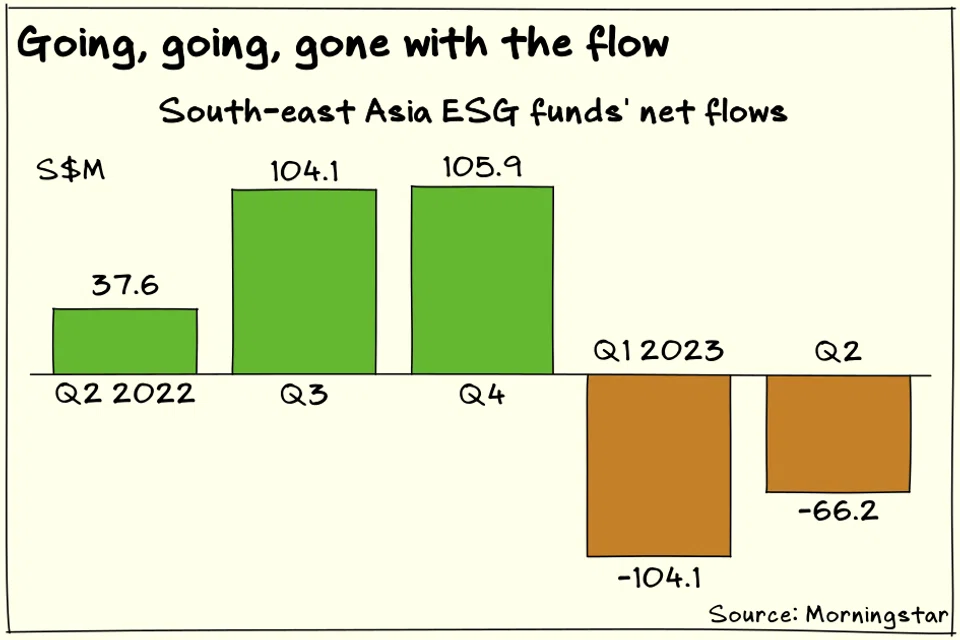
The great outflow of 2023
Funds are flowing out of ESG funds in South-east Asia. Non-ESG funds, on the other hand, are seeing inflows.
Are investors souring on ESG investing? There is definitely some pushback against sustainable investing, most notably the anti-ESG movement among conservative politicians in the United States.
Concerns about greenwashing have also played a part to dampen demand for ESG funds. That concern has manifested itself in two ways. The first is a rush to quality, with investors preferring only the ESG funds with strong credentials. This year alone, MSCI has downgraded 95 per cent of the “AAA” ratings it had awarded to European ESG exchange-traded funds (ETFs), according to Oliver Wyman.
The second way has been a regulatory shadow cast over many ESG products. The US Securities and Exchange Commission this week issued subpoenas to a number of investment firms to obtain information about the way they marketed their sustainable investments. The news has sent shudders through the industry, raising fears that new enforcement actions might be on the horizon.
Another major factor in the ESG outflows has been the resurgent fortunes of the energy sector. The iShares Global Energy ETF had a one-year total return of 15 per cent as at Jun 30, while the iShares Global Clean Energy ETF’s total return was minus 2 per cent over the same period. Many investors ultimately want to make money.
Interestingly, ESG investments might yet have their value. Morningstar’s data showed that ESG funds in South-east Asia had minus 1.3 per cent three-month returns in the second quarter of 2023, which was an outperformance against the region’s non-ESG funds’ minus 15.6 per cent returns for the same period.
Despite the current turmoil, ESG products should continue to have a place in the investing universe, if only because they address a truly distinct set of risks and opportunities and a truly distinct set of values. Now we just need the fund industry to figure out how to properly capture those economics and value systems in an investable product.
Other South-east Asia reads
- Maybank reaches half of RM80 billion green loans goal, CEO says
- Indonesia plans random emission tests on motorists as poor air chokes Jakarta
Other good reads
- US investor group clinches tax credit deal for US$1.5 billion renewable power acquisition
- 50% chance 2023 will be warmest year on record: NOAA
TRENDING NOW
‘Not trying to solve world hunger’: GoTo takes pragmatic approach to AI
He built the Vingroup empire. Now South-east Asia’s richest man is handing some key roles to his sons
Malaysian developer Eco World tops bids for Sin Ming area housing plot with S$1,612 psf ppr bid
Singapore’s new data centres must use renewables. Can they overcome the hurdles?