Issue 7: SGX tinkers with sustainability reporting; few in SEA link pay to ESG

In this issue: Singapore Exchange mulls digital sustainability reporting solutions, while South-east Asian companies aren’t integrating ESG factors into the pay of directors and executives.
Singapore
SGX tries to enhance sustainability reporting
The Singapore Exchange (SGX) has made sustainability reporting compulsory for issuers since 2017, but how those disclosures are presented to the market has generally been left up to issuers.
Tan Boon Gin, chief executive of SGX Regulation, the market operator’s regulatory arm, says the exchange is considering whether to now prescribe a common digital format for sustainability reports.
Tan did not provide details about what he meant by a common digital format, but his remarks about the need for “available, comparable” disclosures suggest that those are the key principles at play. The exchange’s recent actions surrounding its sustainability reporting regime provide further clues about how those principles might translate into a common format.
To improve comparability, SGX appears to be leaning towards a metrics-led approach to disclosures that emphasises quantitative information. In 2021, SGX proposed a list of 27 “core ESG metrics” that were relevant to most industrial sectors and served as guidance for the minimum of what should be disclosed by all companies. The exchange stopped short of mandating the 27 metrics, but described them as a “starting point”.
Another aspect of SGX’s approach is to improve digital access to sustainability disclosures. In its 2021 proposal, SGX described an ESG data portal that would allow issuers to:
- Input ESG metrics, including those beyond the 27 core metrics;
- Input material ESG factors;
- Input commentaries and explanations for reported metrics;
- Input discussions on strategies, processes, board statements and targets; and
- Conduct trend analysis and peer benchmarking.
The portal could even enable issuers to generate sustainability reports from the data they input.
The ESG data portal, now named ESGenome, had strong support during public consultation. The hope is it will make companies’ ESG data more readily available to the market and improve incorporation of such data into investment decisions.
One way to envision what SGX might be thinking about is to consider financial statements, which focus primarily on numbers with qualitative commentary as notes to the numbers; versus annual reports, which are heavily embellished with qualitative information. The state of sustainability reporting on SGX is predominantly skewed towards the annual report-type of format right now. Reporting that is more akin to financial statements could shift the focus towards more easily compared metrics. As an added bonus, streamlined reports could reduce costs for companies.
Ultimately, whatever facilitates greater transparency is the way to go. The entire sustainability reporting complex, from rules to implementation, must enable the discovery of companies that succeed in building sustainable businesses and that are effective in identifying and addressing non-financial risks and opportunities.
A little appreciated context to SGX’s work is that there is a broader national effort to improve climate reporting among all companies, listed and unlisted. The exchange’s approach could therefore have far-reaching impact beyond the listed issuers.
Other Singapore reads
- EMA awards grants, announces grant call, new partnership in clean energy transition efforts
- Regulators can do more about governance lapses at Incredible Holdings and Watches.com
South-east Asia
Giving green for greenness
Who is responsible for ESG at South-east Asia’s largest companies, and are they properly incentivised to do a good job of it?
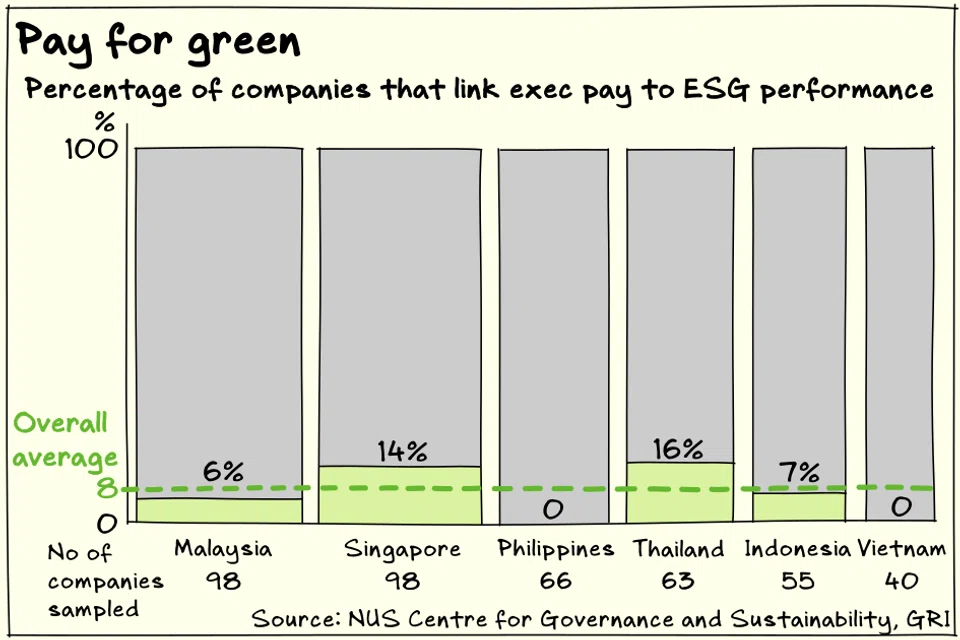
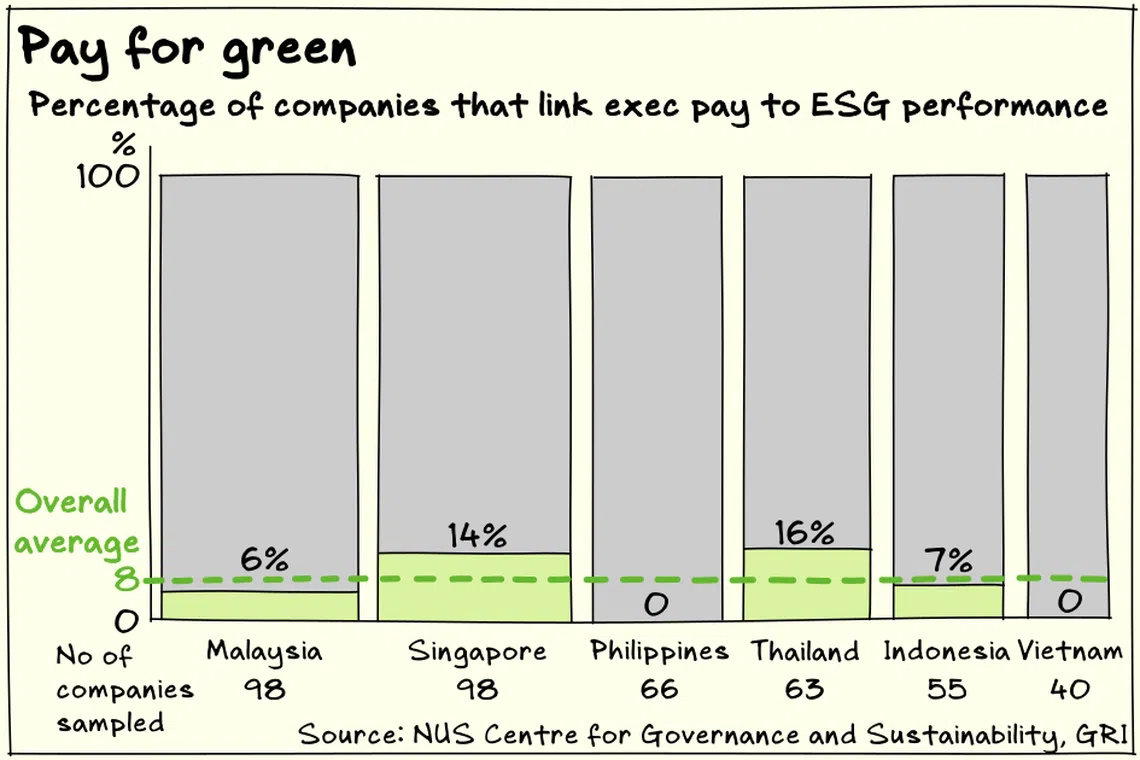
The National University of Singapore (NUS)’s Centre for Governance and Sustainability and the Global Reporting Initiative looked at 420 of the largest listed companies in Indonesia, Malaysia, the Philippines, Singapore, Thailand and Vietnam, and found that just 8 per cent of them disclosed linking remuneration of directors and senior management to ESG performance. The full report is here.
To put that in context, about 45 per cent of companies in the FTSE 100 link pay to ESG.
To be fair, the low percentage in South-east Asia is reflective of the relatively nascent stage of the ESG journey for many companies in the region. The report initially looked at the 600 largest listed companies in the six markets (100 from each major exchange), and only found 420 with climate reporting.
We should expect to see the use of ESG-linked remuneration increase in the region as companies become more sophisticated in the way they track their ESG performance, and given that target setting is a common component in many sustainability reports. If directors or senior management are responsible for ESG performance, it makes sense that their compensation is linked to how well they carry out that duty.
Another NUS academic, Professor Mak Yuen Teen, has published a very practical and thorough examination of ESG-linked remuneration. One important takeaway is that merely tying compensation to ESG performance isn’t enough; it is just as important to do it correctly.
Pitfalls include misalignment of metrics and goals, and the abuse of ESG metrics to boost executive pay or shield executives from poor performance. There is a fascinating case study of Marathon Petroleum in the United States, which awarded its chief executive a hefty bonus for exceeding environmental goals in a year when the company had its worst oil spill in years. The reason? The environmental goals counted the number of oil spills in a year, not the amount of oil spilled.
Done right, however, ESG-linked remuneration is correlated with better outcomes. Investors and independent watchdogs will have to help ensure that companies do it right.
Other South-east Asia reads
- Bilateral projects in solar and wind energy likely to take off in Asean in the near-term
- Economic disparities, differing policies holding back Asean’s energy transition plans
Other good reads
Claims that “good” companies are also more profitable or have better stock price returns should always be taken with a pinch of salt. Correlation is not causation! Companies with stronger businesses tend to have more resources to invest in their ESG practices, and it’s not always clear which comes first. Sometimes, better stock returns are due less to an ESG portfolio’s strong fundamentals, and more to the portfolio’s overexposure to a sector that just happens to be hot (like tech).